Posts

Showing posts with the label 3.2.325-356

(Part 8) Hamlet in 3.2 as the boy Jesus: Why has this been missed?

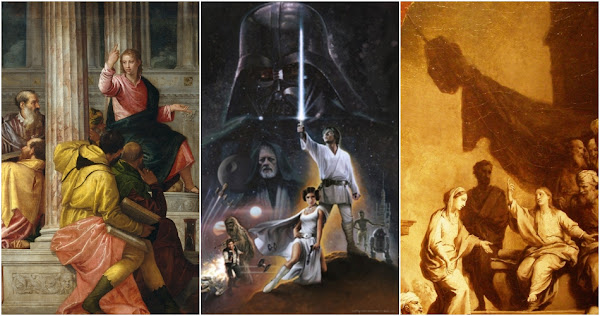
Image
~~~~~~~~~~~~~~~~~~~~~~ INDEX OF POSTS IN THIS SERIES: https://pauladrianfried.blogspot.com/2023/01/index-hamlet-in-32-as-boy-jesus-lost.html ~~~~~~~~~~~~~~~~~~~~~~~~~~~~~~~~~~~~~~~~~~~~~~~~ In previous parts of this series,[1] I have explored Hamlet’s allusion in 3.2 to himself and his mother Gertrude [2] as like the boy Jesus, found in the temple by an astonished mother Mary among the elders.[3]  This allusion was missed by all major writers of reference books on Shakespeare and the Bible through at least the late 20th century [4]. Why have these scholars in this specialty field missed this allusion? Possibilities: 1. THE BIAS OF SCHOLARS: Perhaps many critics have preferred to imagine Hamlet as either not religious, or as a virtuous hero, rather than as one who would gloat after The Mousetrap and compare himself, perhaps blasphemously, to the boy Jesus? [5] And perhaps some scholars, especially in the last half century, simply resisted viewing Hamlet as a Christ fig...

(Part 7) Hamlet’s allusion in 3.2 to the boy Jesus: Hamlet as Abbott, Rosencrantz and Guildenstern as Costellos?

Image
~~~~~~~~~~~~~~~~~~~~~~ INDEX OF POSTS IN THIS SERIES: https://pauladrianfried.blogspot.com/2023/01/index-hamlet-in-32-as-boy-jesus-lost.html ~~~~~~~~~~~~~~~~~~~~~~~~~~~~~~~~~~~~~~~~~~~~~~~~ Hamlet’s allusion to himself and his mother as like the boy Jesus and his mother Mary is delivered, couched inside of a kind of comedy routine, not unlike Abbott and Costello’s “Who’s on First?” [1] This is great fun but makes it easier to miss the allusion. Rosencrantz and Guildenstern are being serious with Hamlet, trying to convey messages about the king’s “distemper” and the queen’s “affliction of spirit,” but Hamlet keeps joking. Even Hamlet’s final allusion line, “O wonderful son that can so ’stonish a mother!” is delivered as a joke. Note this section of the scene: ~~~~~ GUILDENSTERN  Good my lord, vouchsafe me a word with you. HAMLET  Sir, a whole history. GUILDENSTERN  The King, sir— HAMLET  Ay, sir, what of him? GUILDENSTERN  Is in his retirement marvelou...

(Part 6) Hamlet in 3.2 as boy Jesus: Plucking mysteries' hearts?

Image
~~~~~~~~~~~~~~~~~~~~~~ INDEX OF POSTS IN THIS SERIES: https://pauladrianfried.blogspot.com/2023/01/index-hamlet-in-32-as-boy-jesus-lost.html ~~~~~~~~~~~~~~~~~~~~~~~~~~~~~~~~~~~~~~~~~~~~~~~~ When Hamlet implies after The Mousetrap that he and his parents are like (or ironically unlike) the boy Jesus and the Holy Family, [1] we have an analogy: Hamlet, his mom Gertrude and uncle/stepdad Claudius on one side, Jesus, his mother Mary and stepdad Joseph on the other.  Some analogies may seem simple and straightforward: The moon is like a pearl in the night. But what if both elements of the analogy are mysterious, ambiguous, moving targets? That is the case with Hamlet and Jesus. HAMLET IS NOT YOUR AVERAGE REVENGER: He wants to be sure his uncle is guilty, to avoid killing the wrong man.[2] Soon after Hamlet thinks he can be sure, he kills the wrong man - Polonius, by accident.[3] This is not your average revenger. Peter Lake says that Hamlet the play is a hybrid of four genres: Rev...

(Part 5) The targets of Hamlet's 3.2 ironic allusion to Luke 2:46-52

Image
~~~~~~~~~~~~~~~~~~~~~~ INDEX OF POSTS IN THIS SERIES: https://pauladrianfried.blogspot.com/2023/01/index-hamlet-in-32-as-boy-jesus-lost.html ~~~~~~~~~~~~~~~~~~~~~~~~~~~~~~~~~~~~~~~~~~~~~~~~ As previously suggested in this series (especially Part Four),[1] Hamlet’s subtle allusion [2] to the boy Jesus among the temple elders [3] is an ironic allusion, perhaps deeply ironic, rich and complex. But who is the target of this irony, and who is aiming it? AIMED BY HAMLET AT ROSENCRANTZ Rosencrantz had been sent to tell Hamlet that his uncle is angry and his mother is upset that Hamlet angered his uncle. So Hamlet jokes that he amazed and astonished his mother Gertrude, like Jesus did his parents and the temple elders. Eager to please king and queen, Rosencrantz may not get the joke. (More irony.) BY HAMLET, AT HIMSELF Hamlet may be aware that as a revenger, perhaps called to his task by heaven and hell [4], he is no Jesus among temple elders. BY HAMLET, AT MOTHER & UNCLE Hamlet...

(Part 3) Hamlet as boy Jesus among Temple Elders: A closer look

Image
~~~~~~~~~~~~~~~~~~~~~~ INDEX OF POSTS IN THIS SERIES: https://pauladrianfried.blogspot.com/2023/01/index-hamlet-in-32-as-boy-jesus-lost.html ~~~~~~~~~~~~~~~~~~~~~~~~~~~~~~~~~~~~~~~~~~~~~~~~  After The Mousetrap, Hamlet subtly compares himself to the boy Jesus,[1] amazing elders in the Temple (Luke 2:41-52).[2] See Part 1 of this series [3] for a simple comparison of the Hamlet lines to the scripture verses in Luke 2.  Some of my readers caught the allusion right away with the texts side-by-side. Others were reluctant. It may help to look more closely. HOW THE ALLUSION WORKS Why might Hamlet (and Shakespeare) have thought that this moment parallels the Luke tale enough to warrant the allusion? (Not an exhaustive list.) DISTRESSED PARENTS - In Luke: Mary and Joseph had “heavy hearts” (v.48) to find that Jesus was missing. - In Hamlet: Claudius is “marvelous distempered” [4]; Gertrude, “in most great affliction of spirit" [5]. ASTONISHED & AMAZED - Luke uses the word “a...

(Part 1) Hamlet as the Boy Jesus among Temple Elders

Image
~~~~~~~~~~~~~~~~~~~~~~ INDEX OF POSTS IN THIS SERIES: https://pauladrianfried.blogspot.com/2023/01/index-hamlet-in-32-as-boy-jesus-lost.html ~~~~~~~~~~~~~~~~~~~~~~~~~~~~~~~~~~~~~~~~~~~~~~~~ After the play-within-the-play, in conversation with Rosencrantz, Hamlet implies that he has amazed and astonished his mother like the boy Jesus did when his parents found him with the elders in the Temple. I’ve omitted some parts of the Hamlet text so as to focus more closely on the applicable parts below. Compare the text from the play, below, to the text from 2:46-52 (Geneva), which was read every January in Shakespeare's lifetime on the Sunday after Epiphany: [1] GUILDENSTERN: The King … Is …marvelous distempered.... The Queen your mother, in most great affliction of spirit, hath sent me to you. ...your behavior hath struck her into *amazement* and admiration. HAMLET: O wonderful son that can so *’stonish* [astonish] a mother! (3.2.325-356) [2] Compare Luke 2:46-52 (Geneva): 46 And i...