Posts

Showing posts with the label Cognitive Dissonance

Cain and Jesus in Gertrude's Closet, Hamlet 3.4 (Good Friday post)
Image
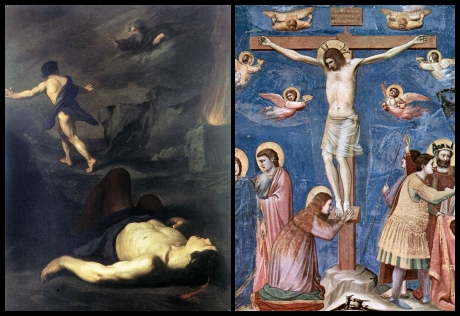
GOOD FRIDAY & CAIN IN GERTRUDE'S CLOSET Compare: Hamlet 3.4.31-32, after Hamlet kills Polonius unseen: Queen:  O me, WHAT HAST THOU DONE? * Hamlet:  Nay, I KNOW NOT. Is it the King? * [1] Genesis 4:9-10, Geneva trans.: Then the Lord said unto Cain, Where is Abel thy brother? Who answered, I cannot tell. Am I my brother’s keeper? Again he said, WHAT HAST THOU DONE? * the voice of thy brother’s blood crieth unto me, from the earth. Luke 23:34, Geneva, Jesus from the cross: Then said Jesus, Father, forgive them: for THEY KNOW NOT what they do. * (* Emphasis mine) - Queen Gertrude echoes God to Cain: What hast thou done? - Hamlet echoes Jesus from the cross: I know not (what I've done). AT LEAST TWO IMPLICATIONS: 1. By killing a human being, Hamlet has sinned, like Cain killing his brother. 2. By stabbing the person hidden behind the arras, blind to who he was stabbing, Hamlet fits what Jesus says from the cross: They know not what they do. WHY HAS THIS BEEN MISSED by previous...

Part 32: A Surprised and Sentimental Gertrude (Interlude B)

Image
[An earlier post said that the next set would explore four different interpretations of Gertrude; this post explores the second of those interpretations in greater detail, a Gertrude who is surprised at finding herself poisoned, blinded by her own sentimentality.] Productions that portray Gertrude as unsuspicious and surprised to find in 5.2 that the cup from which she drank had been poisoned are not convincing to me: They ignore too many textual details. But many find it compelling.[1] We might well ask: Why do some people prefer an unsuspicious Gertrude who is surprised at the poison? - Do they prefer to view her as an unwitting victim of Claudius? - As being punished for alleged adultery and an "incestuous" marriage? - As lacking intelligence or wisdom enough to be suspicious? - As lacking agency, so they don't want her to be A) secretly acting as her son's wine-tester, testing for poison, B) setting a mousetrap deliberately for Claudius by choosing to drink, a...

Hamlet's Palm Sunday Allusion & Cognitive Dissonance: "preaching to stones, Would make them capable."

Image
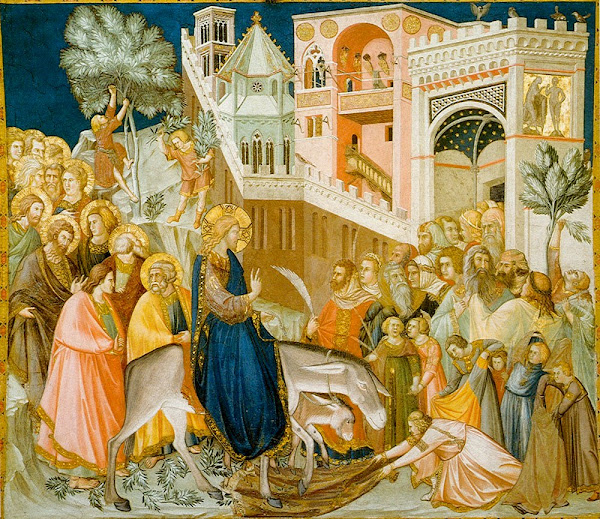
[This post was originally written in 2022, but substantially expanded and edited in 2026.] In Hamlet 3.4, the prince sees the ghost of his father, and tells his mother, HAMLET: On him, on him! Look you how pale he glares. His form and cause conjoined, preaching to stones , Would make them capable. (3.4.142-4) This recalls the Palm Sunday reading (Geneva trans.), Luke 19:39-41:  39 Then some of the Pharisees of the company said unto him, Master, rebuke thy disciples. 40 But he answered, and said unto them, I tell you, that if these should hold their peace, the stones would cry. Stone capable of speech? In fact, at the end of Shakespeare's  The Winter's Tale , what seems to be a statue of Hermoine comes to life and is able to speak, which Richard Strier compares to the Pygmalion myth [1]. Strier connects this also to a stone wall in Habakkuk 2:11, which speaks to rebuke the sins of the wicked.  One might also connect it to the writing on the wall in Daniel 5...