
Posts

Showing posts with the label Flannery O'Connor

Hamlet as Cassadra

Image
Shakespeare’s Hamlet doesn’t merely have a number of allusions to prophets among its many biblical allusions; the play may serve as a reflection on what it means to be prophetic, and to strive to be more effectively and authentically prophetic, for both individuals and for art, and perhaps especially in politically dangerous contexts.  What does it help to oppose immoral and criminal behavior among the powerful, or in a corrupt system, if the result is that one’s life is snuffed out without reforming the corruption one spoke out against? What does it help to claim one is a prophet, sent to correct injustices and corruption, if one is part of the corruption (prince Hamlet in a reckless moment kills Polonius), or if one drives people away (Hamlet bids Ophelia get to a nunnery, offends his mother and uncle) instead of winning them over to one’s view? (In this way, many prophets are dismissed because they are imperfect messengers. Instead of heeding or debating the message, the st...

Hamlet & The Misfit: What was Flannery O'Connor Thinking?

Image
In Hamlet, after the prince hears news from Horatio about the sighting of a ghost that appears to be Hamlet's father, Hamet says to Horatio: HAMLET: I would I had been there. This reminds me of what The Misfit in a Flannery O'Connor story says to the grandmother just before he shoots her: "I wisht I had of been there..." [Image via USPS.com] In Flannery O'Connor's famous short story, "A Good Man is Hard to Find" - a favorite of many fiction writers, including the late Raymond Carver - the Grandmother asks the Misfit to pray to Jesus. The Misfit comments that Jesus messed things up by rising from the dead: MISFIT: "I wasn't there so I can't say He didn't," The Misfit said. "I wisht I had of been there," he said, hitting the ground with his fist. "It ain't right I wasn't there because if I had of been there I would of known. Listen lady," he said in a high voice, "if I had of been th...

Shakespeare, Christ Figures, and the Critics

Image
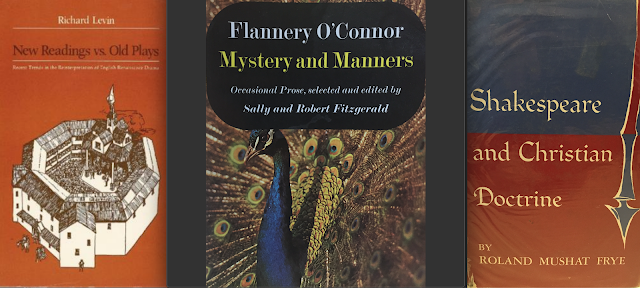
Two books in roughly the past half-century have done a good job identifying the flaws in sloppy or superficial Christian criticism that tries too hard at times to find Christ-figures everywhere. These have had good and bad effects on the way that people who are less aware of the field of Shakespeare and Religion sometimes perceive it. On the one hand, Christians should not proselytize sloppily through Shakespeare, finding religious allegories anywhere or everywhere, and if they point out religious themes or biblical echoes, they should cite evidence to support their claims. Fair enough. But some of this criticism of the Christian theologizers is fraught with its own flaws and distortions, as well as having unintended negative effects. Roland Mushat Frye was a scholar-in-residence at the Folger Shakespeare Library, and his book, Shakespeare and Christian Doctrine (1963), is often cited. Chapter 1 (19-42) is called "Theologizing Analyses: The School of Knight," named after...
PAPER ACCEPTED FOR 2018 SEPTEMBER SW CCL I recently had another paper accepted, this one for the the 2018 Southwest Conference on Christianity and Literature at Oklahoma Baptist University in late September. The theme of the conference is "Gathering in the Strange: Literary Vision in a Disenchanted World." Related to the theme of "the Strange," my paper will examine four works that echo aspects of the biblical Emmaus story about meeting Christ in the stranger. I have briefly written about two of these in past LinkedIn posts: In The Merchant of Venice https://lnkd.in/dynRAwu and in Hamlet https://lnkd.in/egrcrUa I'll also examine Emmaus plot elements in Flannery O'Connor's short story, "A Good Man is Hard to Find," and in (gasp!) the Disney film, Moana; this is especially striking once spotted in Moana. Welcoming the stranger exposes one to danger and enemies. But if we neglect the stranger out of fear, then we miss the chance to...