Posts

Showing posts with the label assumptions

NO ONE TELLS OPHELIA that Hamlet killed her father (Ophelia Postlude)

Image
Ophelia and Laertes know their father’s burial was abbreviated and secretive [1]. Claudius says, For good Polonius’ death, and we have done but greenly In hugger-mugger to inter him… [2] Claudius confides in Laertes that Hamlet killed his father [3]: This suits his purposes, to enlist the help of Laertes to kill Hamlet without Claudius revealing that he killed his brother, the king. But Claudius does not reveal to Ophelia how her father died. While he confides in Laertes, Ophelia is drowning [4]. There is no scene in Hamlet in which a character tells Ophelia that Hamlet killed her father. None. No character refers to Ophelia having been told, or knowing it, or finding out via gossip from Elsinore guards or servants. This may *not* be a small point: It is one thing to assume that Ophelia should be defined mostly by her familial and romantic relationships, and to have gone mad merely because of them. Yet it is very different for her to be defined by political awakenings, to have - lov...
Part 31: Gertrude as Protestant Allegory (Interlude A)

Image
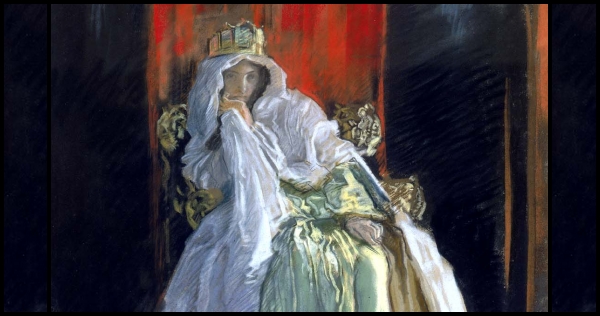
[My previous post said that the next four would explore four different interpretations of Gertrude; this post explores the first of those interpretations in greater detail, an allegorical reading.] One of my least favorite interpretations of Gertrude in Shakespeare’s Hamlet is when people read her merely as a Protestant allegory for the corrupt Catholic church. In this reading, Gertrude (like the Roman church) is a slave to her passions; she cannot resist either her lust for Claudius or her desire for wine.[1] Many readers and playgoers today are too removed from Protestant-Catholic debates and propaganda in Shakespeare’s time, so to suggest this allegory often elicits only confusion. In the Bible, in Revelations 17, Protestants found an analogy for corruption in the Roman Catholic church, comparing it to a fallen woman selling favors, worshiping idols of pleasure instead of the “one true God.” It helps to know that Shakespeare and most everyone in England and on the continent were exp...

Biases & Assumptions Influence What We Notice, Seek, or Neglect (Part 1)

Image
Our biases and assumptions will influence what we notice, seek, or neglect. I have been thinking about bias in recent weeks, in part because I came across two articles from late 2018 about a visit by Rowan Williams (former Archbishop of Canterbury) to Notre Dame. He gave a keynote lecture titled “‘Relieved by Prayer’: Power, Shame and Redemption in Shakespeare’s Drama.” The lecture is available on Youtube and was also scheduled to be published in Religion and Literature Journal . The lecture itself begins about 6 minutes in, and goes until about the 50 minute mark, although the introductions take a while and some discussion follows. What caught my attention was that the news items described the keynote as part of a series called “The Catholic Artistic Heritage,” as if assuming Shakespeare was Catholic. Yet the two news items ( here and here ) did not quote Rowan Williams as mentioning anything about Shakespeare’s institutional-religious allegiancesas leaning Catholic, but the fu...