Posts

Showing posts with the label Absent Fathers

HAMLET, SUPERMAN, and ST. FRANCIS WALK INTO A BAR

Image
HAMLET, SUPERMAN, AND FRANCIS OF ASSISI WALK INTO A BAR.  What do they talk about? Fathers.  Was it ever more honorable to disobey your father than to obey him?  SUPERMAN, in the latest film (dir. James Gunn, 2025), faces a choice: His biological father on Krypton had recorded messages for him. One had been damaged, at first thought irretrievable. When finally decoded, Superman learned that he was sent to earth because its inhabitants were weaker, so that he could dominate them.  Should he obey his biological father’s plans for domination?  He disobeys and heeds the advice of his adoptive parents, using his powers to serve.  The first sentinel in Hamlet?  FRANCISO, named after FRANCIS OF ASSISI, once a soldier and prisoner of war. His father, a rich merchant, was not quick to ransom him for early release.  Francis later heard a voice: “Repair my church.” At first he thought this was about church buildings, but soon realized it was about repairin...

(Part 11) Cordelia is about her father's business in Shakespeare's King Lear

Image
~~~~~~~~~~~~~~~~~~~~~~ INDEX OF POSTS IN THIS SERIES: https://pauladrianfried.blogspot.com/2023/01/index-hamlet-in-32-as-boy-jesus-lost.html ~~~~~~~~~~~~~~~~~~~~~~~~~~~~~~~~~~~~~~~~~~~~~~~~ This series has considered Hamlet’s allusion to Luke 2:46-52, the tale of the boy Jesus amazing temple elders and his parents.[1] Last week we considered a similar thematic echo in Macbeth , when the son of Lady Macduff amazes and humors his mother with wit and grace while also catching her conscience, like a court fool. But Hamlet and Macbeth are not the only Shakespeare plays that echo or allude to the Luke 2 story: King Lear contains an allusion to this gospel story, spoken by Lear’s exiled daughter, Cordelia.[2] We might recall how in Luke 2, Jesus tells his parents that he went to the temple because he had to be about his (heavenly) “father’s business.” Hamlet also believes he must be about his father’s business, but he is confused, at first striving reluctantly to be about the ghost’...

Father Figures in Hamlet

Image
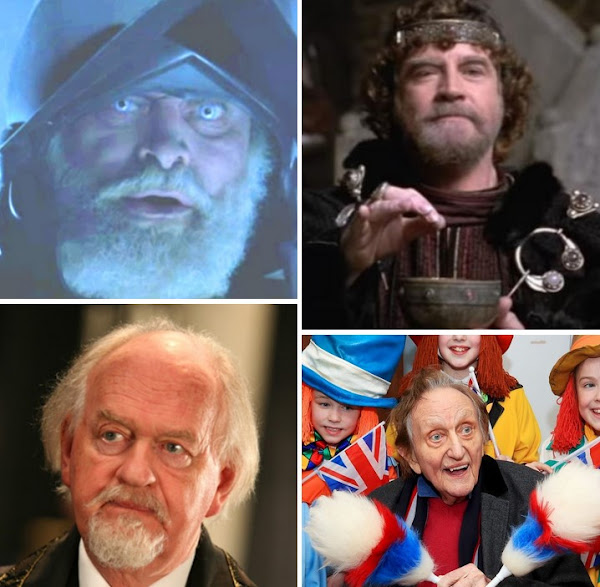
Today is Father’s Day in the USA. What kinds of father figures are there in Hamlet? [1] [Images: Top left: Brian Blessed as the Ghost in Hamlet , 1996, directed by Kenneth Branagh. Via Hamlet Digi-book, Blue Ray -dot-com . Fair use. Top right: Alan Bates as Claudis in Hamlet , 1990, directed by Franco Zeffirelli. Via Shakespeare Navigators . Fair use. Lower left: Oliver Ford Davies as Polonius in in Hamlet , 2008, directed by Gregory Doran. Via BBC and RSC . Fair use. Lower right: Sir Ken Dodd, who played Yorick in Hamlet , 1996, directed by Kenneth Branagh. Via Telegraph UK . Fair use.] Many children are haunted by their fathers, at least figuratively, in good or bad ways. Old Fortinbras: The father of Young Fortinbras gambles his life in for ambition. The prize: Honor and land conquest by defeating an adversary. He loses. Some fathers are ambitious, gamblers, violent, but blunt about it, making no secret of their ambitions, or their violence. Some are killed in battl...

Pieta in Lear, and Sons Sacrificed for Fathers in 1 Henry VI & Hamlet

Image
Last week I posted about instances of "beg" and "poor" in 1 Henry VI, in light of references in Hamlet to the prince as begging or poor, and of the Lazarus allusion in that play. I mentioned how, in 4.5, John Talbot begs his father to flee, while he himself will stay behind and fight to his death. This is a touching moment, as is the moment when the father later finds the dead body of the son. And as my blog often focuses upon biblical allusions, I should mention that this scene echoes two essential plot ideas from the Christian story of the gospels: First, it echoes the idea that Jesus is the son who was sent and sacrificed for the salvation of humanity. The son has to die, and is obedient to the father to the end. (In fact, some Biblical scholars and theologians have noted that Pauline theology assumes that the human Jesus only becomes divine through his love/service and obedience to the father, to his death, rather than being divine from birth; Paul's let...

What I'm Reading: Absent Fathers in Hamlet & Other Lit

Image
Before the COVID-19 crisis shut down libraries, I had a number of books on inter-library loan from college and university libraries in Minnesota, within a few hours of where I live. The books are now long overdue, but as libraries are all closed, I’m getting no notices of late books. Two of these books are about absent fathers, one by Avi Erlich relating to Hamlet (Hamlet’s Absent Father, Princeton University Press, 1977), the other by Paul Rosefeldt relating to modern drama in general (The Absent Father in Modern Drama, Peter Lang, 1995). The second book (Rosefeldt) gives a good overview of work on absent fathers by Freud and some of his contemporaries, and also an essay on Oedipus, The Libation Bearers, and Hamlet. Yet quite a bit of the thinking on absent fathers seems muddied in a number of ways: 1. FREUD ON KILLING THE FATHER: Freud’s position is one of atheistic scientific reductionism. He assumes that religions and the idea of a father-god are human inventions, which ...