Posts

Showing posts with the label John the Baptist

What are Herods to Hamlet?

Image
What's Herod to Hamlet? My last post* surveyed occurrences of “Herod” in five Shakespeare plays. The word occurs only twice in Hamlet. (Herod had sons named after him, so Hamlet might say, What are Herods to Hamlet?)** Like King Hamlet (with an “H”) and his son Prince Hamlet [1], Herod the Great had many sons, some also named Herod. Herod means “heroic.” King Hamlet was considered heroic in battle [2]. Herod the Great had at least three of his sons executed, one for conspiring to poison him [3]. As depicted in Matthew 2:16, he was thought to be mad for seeking to have all boys less than two years old killed, after a visit from Magi who told him of signs in the heavens indicating a new king’s birth. King Hamlet kills King Fortinbras, a competitor for his lands [4]; Claudius poisoned his brother, King Hamlet, to take the throne [5]. So an allusion to Herod the Great is appropriate. But Christopher Taylor notes, “The figure of Herod loomed so large in the Christian imagination that of...

Hamlet, John the Baptist, and Jesus as Symbolically Political

Image
My previous post noted that Hamlet alludes to John the Baptist [1]. Consider the religious, symbolic, and political significance of John baptizing at the Jordan [2], for Jews who knew their founding story by heart, that Moses led their ancestors through parted waters of the Red Sea to freedom and a promised land, escaping a foreign oppressor [3].  John at the Jordan plays into the same tropes, where Rome (not Egypt) is the foreign oppressor (which in part explains why Rome and Herod Antipas saw him as a threat). England’s Henry VIII claimed he needed to repent of incest, had seen action in battle, but was thought to have died a sinful man, guilty of foul crimes. Hamlet deals with an incestuous king and the ghost of a king, fearsome in battle, who died with sins on his soul, foul crimes. Same tropes. Hamlet alludes to both Julius Caesar and Jesus. Consider Jesus, preaching where Roman coins bore the image of a Roman emperor [4] with an inscription calling the emperor “son of a go...

Hamlet's Baptista and the Multiverse of Allusions

Image
In Shakespeare's England, the 3rd and 4th Sundays of Advent (before Christmas) featured John the Baptist [1], a prophet referred to in Hamlet. The name is feminized to "Baptista" and given to the player queen in 3.2. Hamlet claims "The Mousetrap" or "Murder of Gonzago" was an existing ("extant") historical tale [2]. In fact a Duke of Urbino (not Vienna) was poisoned; Eleanor Gonzaga was his wife. The wife of a predecessor was Battista Sforza [3]. Shakespeare made historical errors on purpose: Hamlet picks the duke’s predecessor’s wife’s name to borrow the name Baptista, so he can allude to John the Baptist, who condemned the marriage of Herod Antipas to his brother's divorced wife [4]. Hamlet wants to catch the king's conscience [5], but must avoid being too confrontational, so he borrows "Baptista" to subtly evoke (but also cleverly distract from) a biblical allusion to Jesus’ kinsman [6] who was beheaded for opposing a k...

Painting of John the Baptist in Shakespeare's schoolroom

Image
On Instagram, ShakespearesSchoolroom notes, "during the restoration of Shakespeare’s Schoolroom & Guildhall in 2016 a rare medieval wall painting was uncovered. Identified by experts as John the Baptiste..." [1]. Interesting to think of a young Shakespeare perhaps seeing that and other paintings of the prophet, and later naming the player queen in Hamlet as "Baptista," after the prophet who condemned the marriage of Herod Antipas to his brother's divorced wife. Also, when Jesus goes to be baptized by John at the Jordan River, John says to Jesus, *you* should be baptizing *me* - but Jesus replies, "Let be." Famous line also in Hamlet, and in Paul McCartney's song catalog. In some of the old variorum Shakespeare editions, some editors resisted the idea that "Baptista" was an allusion to John the Baptist, claiming it was merely a common female name, but Joseph Ritson (1752-1803) held his ground and said it was. Good for him. Even centuri...

First Day of Christmas in English churches of Shakespeare's Time (series, Part 1)

Image
On the first day of Christmas in Shakespeare’s time, what Bible tales did they hear? People in England were required by law to attend church on Sundays and Holy Days, so hearing at least some of the Bible readings in church [1] would have been mandatory. On Christmas Day, if one rose early and made it to church for Matins (early morning prayer), one would hear the tale from the Gospel of Luke of the shepherds hearing the angels announcing the birth of Jesus, and going to adore him [2]. But if one attended only the later liturgy with communion service, one would hear from the Gospel of John about the Word of God being made flesh (the incarnation, the God of heaven made “incarnate” as a human being on earth), and about John the Baptist preparing the way for Jesus [3]. John the Baptist was already familiar from the gospels for the last two Sundays of Advent, a theme repeated on the first few days of Christmas at morning prayer. How do these come up in Shakespeare? - The infant princess,...

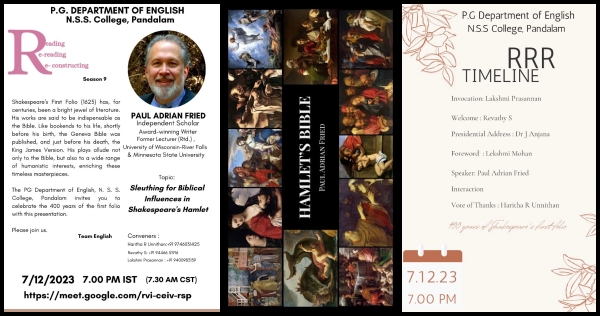
TRANSCRIPT: Presentation for Post Graduates, N.S.S. College, Kerala, India, 7 December, 2023

Image
TRANSCRIPT: Presentation for Post Graduates, N.S.S. College, Kerala, India, 7 December, 2023 Edited planned transcript of remarks delivered on 7 December, 2023, in an online presentation for the Post Graduate program, N.S.S. College, Kerala, India, 7 P.M. IST, 7:30 A.M. CST. (A few words and points below were cut from the live presentation for time considerations, and I made a few additional extemporaneous remarks, but for the most part, this is the transcript.) (I did not have time to talk about allusions that fit into the theme of orphaned children who find transcendent parents in others or in a heavenly parent, but perhaps some other time....) ~~~~~~~~~~~~~~~~~~~~~~~~~~~~~ Informal outline (followed by transcript): INTRODUCTION: [Disclaimers] - Contested times, contested scripture LIST OF BOOKS cataloging Bible allusions in Shakespeare, some open-access: Sleuthing scripture allusions in Hamlet CHANGE THOSE NAMES WITH YOU: Servant-Prince, & Renunciation of Fruits DOUBTING ...