Posts

Showing posts with the label Stealth

Biases & Assumptions Influence What We Notice, Seek, or Neglect (Part 1)

Image
Our biases and assumptions will influence what we notice, seek, or neglect. I have been thinking about bias in recent weeks, in part because I came across two articles from late 2018 about a visit by Rowan Williams (former Archbishop of Canterbury) to Notre Dame. He gave a keynote lecture titled “‘Relieved by Prayer’: Power, Shame and Redemption in Shakespeare’s Drama.” The lecture is available on Youtube and was also scheduled to be published in Religion and Literature Journal . The lecture itself begins about 6 minutes in, and goes until about the 50 minute mark, although the introductions take a while and some discussion follows. What caught my attention was that the news items described the keynote as part of a series called “The Catholic Artistic Heritage,” as if assuming Shakespeare was Catholic. Yet the two news items ( here and here ) did not quote Rowan Williams as mentioning anything about Shakespeare’s institutional-religious allegiancesas leaning Catholic, but the fu...
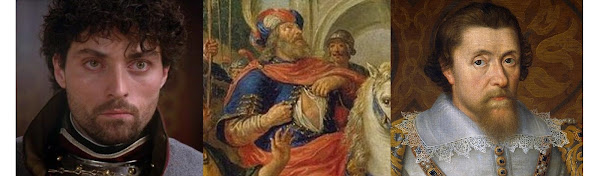
Fortinbras, Jephthah, James: Stealthy, Allusive Triangulation (a Jephthah Postscript)

Image
One of the most astonishing revelations for me during my limited recent research on the Jephthah allusion was how many correlations there were between many aspects of the Jephthah plot, and the character of Fortinbras. There is no literal sacrifice of a daughter, but hints of other kinds of sacrifice. Other scholarship on the Jephthah allusion in the play tends to focus on Polonius, the object of Hamlet's Jephthah remarks, or on unholy vows and the consequences to Ophelia. Some considers the hasty or unholy vows of other characters such as Hamlet or Laertes. But Shakespeare scholars have also noticed correlations, not only between Prince Hamlet and James VI and I of Scotland and England, but also between Fortinbras and James. So if Fortinbras points at least in part toward James, and also to Jephthah, was Shakespeare in a sense predicting that James was an ambitious Jephthah-type, the kind one could imagine sacrificing one of his children on the altar of his ambition? This see...

Hamlet & the Gerasene Demoniac: Using Subversive, "Changeling" Words

Image
Sometimes a single word can be politically subversive. BAPTISTA: Prince Hamlet claims the wife of the player queen (actually of a poisoned Italian duke) was named "Baptista," an Italian name in an otherwise mostly English play. An actual, historical figure, he claims. But this is not true. "Battista" was the wife of a predecessor of the poisoned duke, not the wife of the poisoned duke himself. [See the long note, p. 507, bottom, in the 1982 Arden Hamlet edited by Jenkins.] Did Hamlet and Shakespeare mess up the history, or is something else going on here? Something else, I think. Hamlet makes a point of it to mention her name because she is named after John the Baptist, the prophet mentioned in the gospels who opposed the marriage of Herod Antipas to his brother's divorced wife. Hamlet wants to use this name because, like John the Baptist who opposed an incestuous marriage, Hamlet opposes the incestuous marriage of Claudius and Gertrude. Shakespeare's ...