Posts

Showing posts with the label mystery

Hamlet and the First Commandment: THE PRESSURE VALUE OF CLASSICAL GODS - Series

Image
Did people in Shakespeare’s time sometimes have good reason for appearing to Puritans as if they were violating the first commandment [1], celebrating and retelling tales from classical mythology, tales about gods from ancient religious cults that Christianity had declared to be false?  If one wished to talk and write about mystery and transcendent meaning, what was a person to do if one hoped to avoid being executed as a heretic, when Christianity was contentious and rigid, with certain topics prohibited, dangerous?  It was safer to re-tell tales from classical mythology involving gods and humans interacting, and possibly to use these as analogies for contemporary events.  Many gods and other classical references are in Hamlet:  1.2: Hyperion, Hercules, Niobe; 1.4: The Nemian lion (defeated by Hercules); 2.2: Pyrrhus, Priam, Hecuba; 3.2: Vulcan, Phoebus, Neptune, Hymen, Hecate; 3.4: Hyperion, Jove, Mars, Mercury;  5.1: The Greek mountains, Pelion, Olympus, and ...

Shakespeare's Uses of Ambiguity (What We Talk About When We Talk About Ambiguity in Shakespeare)

Image
There are at least three major uses of ambiguity in Shakespeare. How we speak of it, and what we value about it, vary widely.  1. One popular use of ambiguity can be a “Rorschach Effect”: Many believe that this gives actors and audiences permission to imagine and interpret any meaning or motivation they wish about the lines [1].  Shakespeare, his playing company, and early audiences may not have been quite that relativistic [2], but it certainly helps playing companies today in new contexts, to adapt plays to changing circumstances.  2. A second kind of ambiguity might be a “Scheherazade Effect” [3]. If you live in times when many are executed for their opinions or religious allegiances, you might feel like Scheherazade, who had to entertain with stories to stay alive.  If you also wanted to catch the conscience of the monarch, you had to be careful, or there would be trouble [4]. Instead of being too confrontational, one had to be indirect [5]: One had to use storie...

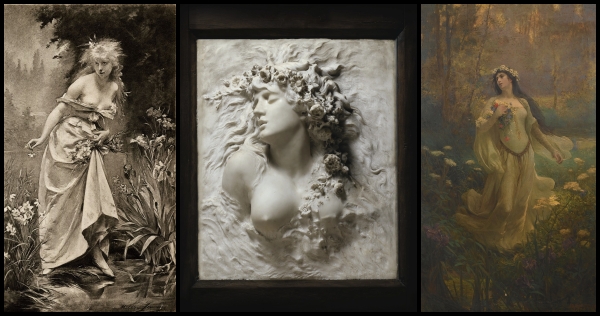
NO ONE TELLS OPHELIA that Hamlet killed her father (Ophelia Postlude)

Image
Ophelia and Laertes know their father’s burial was abbreviated and secretive [1]. Claudius says, For good Polonius’ death, and we have done but greenly In hugger-mugger to inter him… [2] Claudius confides in Laertes that Hamlet killed his father [3]: This suits his purposes, to enlist the help of Laertes to kill Hamlet without Claudius revealing that he killed his brother, the king. But Claudius does not reveal to Ophelia how her father died. While he confides in Laertes, Ophelia is drowning [4]. There is no scene in Hamlet in which a character tells Ophelia that Hamlet killed her father. None. No character refers to Ophelia having been told, or knowing it, or finding out via gossip from Elsinore guards or servants. This may *not* be a small point: It is one thing to assume that Ophelia should be defined mostly by her familial and romantic relationships, and to have gone mad merely because of them. Yet it is very different for her to be defined by political awakenings, to have - lov...

Part 50: Ophelia Pregnant with Mystery

Image
As I said at the end of Part 48 [1], I do like that a pregnancy for Ophelia is suggested but not conclusive in Hamlet, and that such mysteries and ambiguities may be something like a presence of God: "Who's there?" - the play’s opening question, would have been appropriate for the rich man who neglects the beggar Lazarus to whom the Ghost refers [2], as well as for the baker’s daughter referred to by Ophelia [3]. In both cases, those who neglect the beggar at the door neglect the presence of God. How do we face the presence of mystery in the beggar, the stranger? In Ophelia? Did Ophelia miscarry, and in postpartum depression, commit suicide, which Gertrude generously conceals in a story about an “envious sliver” and a death in faith [4]? Would the Ophelia we come to know in the play have killed herself and an unborn child? Can we know for certain, or is such a quest for certitude like a form of self-idolatry? How might we consider the mystery of Ophelia in the context of ...

Part 48: From Maurice Hunt, "Impregnating Ophelia," 2005

Image
Excerpt: ...getting playgoers and readers to imagine a pregnant, or carnal, Ophelia amounts to a dramatic benefit because, at some point (usually a retrospective moment), the recollection of this identity obviously compounds the pathos of her personal tragedy. At the same time, those contemporary consumers of Hamlet aware of an Elizabethan aesthetics of the pregnant imagination are likely to question their reconstruction of Ophelia’s sexual status, simply be- cause they know that her supposed pregnancy could be the result of the operation of their pregnant minds on the elements of Shakespeare’s play. In other words, Shakespeare calls attention to the challenging plastic quality of mind that he generally seems always to require of his educated theater readers and playgoers. Every play in the Shakespeare canon, virtually every Shakespearean character, becomes richly enjoyable and instructive to the degree that pregnant minds animate them. Shakespeare’s urging the pregnant mind to make ...

Part 36: Gertrude builds a better mousetrap for Claudius (Interlude D.3)

Image
In Hamlet 5.2, Gertrude suspects poison, [1] but doesn't know for certain — a dangerous mystery: she avoids openly accusing Claudius. This scene is a variation of King Aegeus, saving son Theseus from a poison cup from stepmother, Medea — with some genders switched and stakes raised.[2] Gertrude will test the wine by drinking it, without saying that is her reason for doing so. In this she sets a better, simpler mousetrap for Claudius: If it is poison, he could stop her and confess. If not, maybe “mad” Hamlet was mistaken about Claudius? Hamlet’s “Mousetrap” foreshadows (and sheds light on) Gertrude’s. She cannot pluck the mystery’s heart without drinking from the cup to test it, and to test Claudius. By drinking, in effect, Gertrude tells Claudius: If you would poison my son, you must go through me first. In her closet, Hamlet had told her that he would later beg a blessing of her [3]. Testing the wine for poison is the blessing she offers her son, without his having to ask. This ...

Part 33: A Suicidal Gertrude (Interlude C)

Image
[In an earlier post , I mentioned four contrasting interpretations of Gertrude, the third being a suicidal Gertrude as portrayed by Lia Williams in a 2018 BBC production with Andrew Scott as Hamlet, dir. Icke. This post considers that third reading of Gertrude.] Some consider Gertrude drinking the poison cup in Hamlet 5.2 as an act of suicide. But for it to be suicide, Gertrude at least needs to suspect that the cup has been poisoned: If she is ignorant of poison and unsuspicious, it cannot be suicide; a reaction of surprise would then make sense. If she merely suspects and is testing the cup for poison intended for her son, an act of risk and selflessness, it is not strictly suicide.[1] For suicide as sole intention, she must not merely suspect, but know for certain that the cup has been, poisoned. The texts of the play do not support certainty for Gertrude that the cup has been poisoned: Claudius and Laertes conspired about the poison apart from her; she had no way of knowing. But a...

Part 29: Pivot from Ophelia to Getrude - and their mysteries

Image
Before completing my series on Ophelia, some elements about Gertrude require scrutiny. The controversy and mystery of Ophleia overlaps with Gertrude in a variety of ways: - Gertrude learns of her son’s love letters to Ophelia, encourages Ophelia’s love to heal her son’s madness, reports Ophelia’s death by drowning, and says at Ophelia’s grave that she wished Ophelia had been her son’s bride. Characters are said to be static (unchanging) or dynamic (changing) in light of developments in the plot and interactions with other characters. Without having to speculate at all whether she has any sort of Christian afterlife in heaven, hell, or purgatory, we might say that Ophelia has something of an afterlife through her example to, and influence on, the Queen. But this requires a clear understanding of a series of events and the evidence in the texts. In upcoming posts, I will explore some of these and other overlaps between Ophelia and Gertrude; the “envious sliver” of the willow that break...

Part 10 (B): Ophelia via Elaine Showalter’s 1985 “Representing”

Image
Excerpts from Elaine Showalter, “Representing Ophelia: Women, Madness, and the Responsibilities of Feminist Criticism” [1]: …Though she is neglected in criticism, Ophelia is probably the most frequently illustrated and cited of Shakespeare’s heroines.(282) …Why has she been such a potent and obsessive figure in our cultural mythology? [...] how should feminist criticism represent Ophelia in its own discourse? What is our responsibility towards her as character and as woman? …Shakespeare gives us very little information from which to imagine a past for Ophelia.  [...] Her tragedy is subordinated in the play; unlike Hamlet, she does not struggle with moral choices or alternatives. [283] [PF note: Showalter’s essay is an important one, but on this point I would disagree: Ophelia struggles to know what to think of Hamlet’s love and perhaps her good fortune, to grasp what it may mean to become Denmark’s next queen; she struggles against disapproval of her brother and father, against ...

Part 10: Ophelia via Elaine Showalter’s 1985 “Representing”

Image
Excerpts from Elaine Showalter, “Representing Ophelia: Women, Madness, and the Responsibilities of Feminist Criticism” [1]: …Though she is neglected in criticism, Ophelia is probably the most frequently illustrated and cited of Shakespeare’s heroines.(282) …Why has she been such a potent and obsessive figure in our cultural mythology? [...] how should feminist criticism represent Ophelia in its own discourse? What is our responsibility towards her as character and as woman? …Shakespeare gives us very little information from which to imagine a past for Ophelia.  [...] Her tragedy is subordinated in the play; unlike Hamlet, she does not struggle with moral choices or alternatives. [283] [PF note: Showalter’s essay is an important one, but on this point I would disagree: Ophelia struggles to know what to think of Hamlet’s love and perhaps her good fortune, to grasp what it may mean to become Denmark’s next queen; she struggles against disapproval of her brother and father, against her...