Posts

Showing posts with the label Shakespeare & Bible

Religious and Biblical allusions and plot echoes in Hamlet 1.2

Image
Here are a few key religious and biblical allusions in Hamlet 1.2 (not an exhaustive list): ~~~~~ CLAUDIUS: ...our sometime sister, now our queen,/ [...] Taken to wife. (1.2.8-14) For Shakespeare’s English audience, this would have struck a nerve: Henry VIII had married his dead brother’s widow, Katherine of Aragon, but later (after no living sons and an affair with Anne Boleyn) claimed it was a biblically forbidden marriage.  [For more on the biblical passages related to "incestuous marriage" see this link: https://pauladrianfried.blogspot.com/2022/06/the-bible-henry-viii-claudius-and.html ] Therefore he claimed he needed an annulment, which triggered the English Reformation and many executions of Protestants as heretics (by Mary I) and of Catholics as treasonous (by Henry, Edward, Elizabeth). So audiences would have viewed Claudius as being like a Henry VIII who had not repented of his incestuous marriage. ~~~~~ CLAUDIUS: Young Fortinbras, Holding a weak supposal of our...

Biblical Seeds of Secular Shakespeare Bias (Part 4: Religious Bias in Shakespeare Scholarship)

Image
I have written recently about various forms of bias in Shakespeare scholarship, including that of those who prefer a secular or seemingly post-Christian Shakespeare. But it would be good to recognize the biblical seeds of a secular (non-religious) outlook. One could argue that the Jesus of the gospels had something resembling what would later be called a secular humanist streak, and disliked religiosity for its own sake. A few examples: The first appears in each of the synoptic gospels [1]. Consider Matthew 22:35-40, read in Shakespeare’s lifetime at morning prayer every 24th of January and May, and every 21st of September, and on the 18th Sunday after Trinity (which varies, but which fell on 3 October, 2021): Jesus is asked by a Pharisee what is the greatest law. He replies with *two*: First, to love god with all one’s heart, soul, and mind. Then he says the second is “like unto” the first: To love one’s neighbor as one’s self. It’s curious and important that Jesus claims ...

Top 20 Greatest Hits: Hamlet & the Bible

Image
Below are some of my most essential posts about biblical echoes in Shakespeare, most of them beyond those listed by Naseeb Shaheen & predecessors ( Biblical References in Shakespeare's Plays , which focuses mostly on explicit biblical name- and verse-allusion). A description of my book project is included at the very end. This is not intended to replace Naseeb Shaheen's reference book, but to compliment it, especially with plot echoes that are less explicit and may have been more thoroughly internalized by the writer, or used in more subtle ways for artistic or political reasons. Most of these are short reads, especially early in the list, with a few longer posts toward the end, and a few of them including links for more details. I've tried to illustrate all of these with paintings and drawings from Shakespeare's time or earlier in most instances. Where credits for the images are missing here, see the link for each section. On the one hand, a part of me...

RMMRA Denver topic: PROTESTANT, EMPIRICAL, & CONFIRMATION BIASES IN SHAKESPEARE & THE BIBLE, AND HOW WE MIGHT TRANSCEND THEM

Image
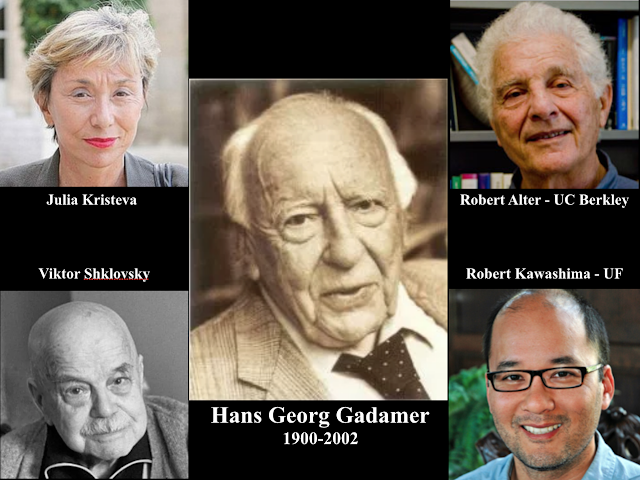
This week I am headed to Denver, Colorado, for a meeting of the Rocky Mountain Medieval and Renaissance Association (instead of attending the Shakespeare Association of America conference in Washington D.C., which was tempting for its proximity to the Folger Shakespeare Library). I am presenting a paper called “How Gadamer Might Rethink Shakespeare & the Bible,” in which I consider how a Protestant bias of “Scripture Alone” (Sola Scriptura), and an empirical bias of the emerging sciences in the mid-1800s, established an early tradition that favored very literal references in biblical allusions that utilized biblical names and phrases, over paraphrase and plot echo, which are often relatively neglected by many of the main reference books in the field. (Darwin's book, On the Origin of Species , was published just five years before Charles Wordsworth's 1864 book on Shakespeare and the Bible, and it, too, is obsessed with empirical evidence and close observation). These b...