Posts

Showing posts with the label Falstaff

Dives and Pauper, Hamlet, Ten Commandments, and Falstaff (Series)

Image
Dives and Pauper [1] was an English text from early 1400s, probably by a Franciscan, and although there are no direct allusions in the play to this Middle English text, it has interesting connections to Shakespeare and Hamlet, as well as representing the general influence of the Ten Commandments [2] on the evolution of English religious culture. The title is an allusion to Luke 16:19-31 in which a rich man (Latin: "Dives") neglects the beggar Lazarus and suffers eternal punishment while Lazarus goes to heaven [3]. Lazarus, whose body had sores that were licked by dogs, was often thought to have been a leper (hence "Lazar houses," hospitals for lepers in England). The ghost in Hamlet 1.5 thinks a “leperous distillment” of poison that his brother poured in his ear made his skin all "lazar-like" [4]. Ophelia's reference to the story of the owl and the baker's daughter is a folktale retelling, where a baker is rich in bread, but his daughter is r...

Falstaff in Heaven, Enclosed Commons, Sharp Pen, and "a Table of green fields"

Image
In Shakespeare’s Henry V (F1), "Hostesse" describes the death of Falstaff (2.3.832-847), claiming not that Falstaff is in heaven in the bosom of Abraham (like the beggar Lazarus of Luke 16:19-31), but in the bosom of Arthur. She also offers: "his Nose was as sharpe as a Pen, and a Table of greene fields." (2.3.838-9) Adam Roberts [1] notes:  - Lewis Theobald (1733) "amends Table to babbled, giving us: ‘his nose was as sharp as a pen and [he] babbled of green fields’."  - Most editions follow Theobold, but Gary Taylor’s Oxford edition considers other options. Dobson notes that the RSC edition (eds. Bate and Rasmussen) make it ‘for his nose was as sharp as a pen on a table of green fields.’ [2]  Mark Alcamo offers that "Nose" might have at least a double meaning, both literal and also that his "knows" (his knowing) was sharp at his death [3]. Roberts considers that "table" might also mean "tableau," image. Roberts and ...

Shakespeare's Staged Resurrections and What to Make of Them

Image
It is said that in Shakespeare’s plays, all resurrections are staged, faked: Much Ado About Nothing (Hero) [1]; Henry IV, Part 1 (Falstaff) [2]. Staging can fail badly: Romeo and Juliet [3] (as if to admit the limitations of such staging?). Poor Tom/Edgar stages a miracle for Gloucester in King Lear [4].   Sonnet 18 ends, “So long as men can breathe, or eyes can see, / So long lives this, and this gives life to thee,” as if the poem bestows (stages) everlasting life. What to make of this? As is said in Hamlet of Ophelia’s “mad” speech, many will “botch” these facts up “fit to their own thoughts” [5]: Atheists may claim this proves Shakespeare’s atheism. Christians may note: Miracle and Mystery Plays were banned by Henry VIII, still restricted in Elizabethan times. Even if Shakespeare wanted to portray resurrections, his hands were tied. Many of Hamlet’s verbal tricks with Claudius [6] and Polonius [7] (and Claudius again [8]) – and the gravedigger’s with Hamlet [8] – depend on ta...

Lazarus & prodigals in Henry IV, Part I, & Hamlet

Image
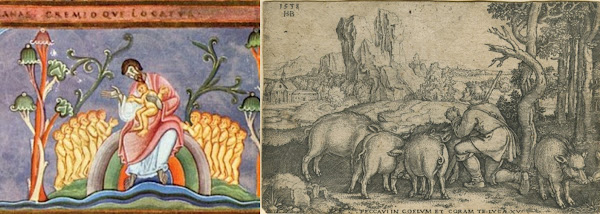
Before I conclude my series on the Lazarus allusion in Hamlet , let’s step back and consider his use of “Lazarus” and related terms in other plays. For today, consider: Shakespeare only uses the full word "Lazarus" once,* on the lips of Falstaff in Henry IV, Part I (1613). [* According to the Advanced Search Engine at OpenSourceShakespeare .] This single instance of "Lazarus" comes in a soliloquy in which Falstaff also happens to mention "prodigal," a reference to another tale from Luke's gospel. [Left: Detail from Lazarus and the Rich Man, Meister des Codex Aureus Epternacensis (1035-1040), via Wikipedia . Public domain. Right: Der verlorene Sohn beim Schweinehüten (The Prodigal Son tending the Swine), 1538, by (Hans) Sebald Beham (1500-1550), via Wikipedia . Public domain.] It so happens that there are allusions in Hamlet to both Lazarus ("lazar-like," 1.5.79, Folger) and the prodigal (Laertes 1.3.40, Polonius 1.3.1...

Preview: Other instances of Lazarus/lazar/beg/beggar/poor in Shakespeare (Part 19)

Image
We are still in the middle of a good raspberry-picking season, but here's a preview of what's coming: LAZARUS: The works of Shakespeare contain the word "Lazarus" only once, in 1 Henry IV, from Falstaff, who also mentions "prodigal" ("lazar" appears once in Hamlet, "prodigal" twice). This is interesting because both Hamlet and 1 Henry IV are about princes (Hamlet, Hal) with strained relationships with distant biological fathers; each finds an affectionate surrogate father in a fool/clown figure (Yorick, Falstaff). ("Prodigal" appears 25 times in Shakespeare's works.) LAZAR: Shakespeare's works use the word "lazar" (derived from the beggar Lazarus in Luke 16) five other times besides in the word "Lazarus": once in Hamlet; twice in Henry V; and twice in Troilus and Cressida. Often "lazar" may simply refer to leprosy or unattractive skin conditions associated with the poor and outcasts. ...