Posts

Showing posts with the label Fortinbras

TRANSCRIPT: Presentation for Post Graduates, N.S.S. College, Kerala, India, 7 December, 2023
Image
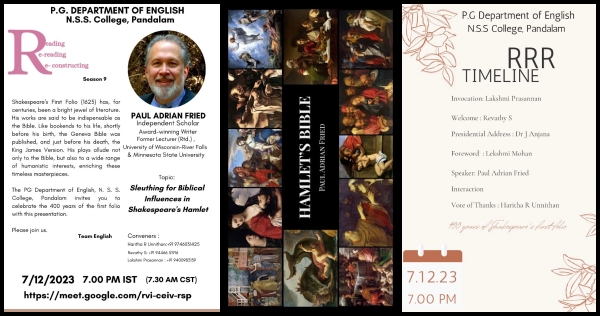
TRANSCRIPT: Presentation for Post Graduates, N.S.S. College, Kerala, India, 7 December, 2023 Edited planned transcript of remarks delivered on 7 December, 2023, in an online presentation for the Post Graduate program, N.S.S. College, Kerala, India, 7 P.M. IST, 7:30 A.M. CST. (A few words and points below were cut from the live presentation for time considerations, and I made a few additional extemporaneous remarks, but for the most part, this is the transcript.) (I did not have time to talk about allusions that fit into the theme of orphaned children who find transcendent parents in others or in a heavenly parent, but perhaps some other time....) ~~~~~~~~~~~~~~~~~~~~~~~~~~~~~ Informal outline (followed by transcript): INTRODUCTION: [Disclaimers] - Contested times, contested scripture LIST OF BOOKS cataloging Bible allusions in Shakespeare, some open-access: Sleuthing scripture allusions in Hamlet CHANGE THOSE NAMES WITH YOU: Servant-Prince, & Renunciation of Fruits DOUBTING ...

Part 26: Ophelia gives crowns instead of grasping & hoarding one

Image
According to Gertrude, Ophelia crowned willow branches with coronets (small crowns) of flowers, perhaps in the same spirit her giving away flowers and herbs to the court: QUEEN: There is a willow grows askant the brook That shows his hoar leaves in the glassy stream. Therewith fantastic garlands did she make Of crowflowers, nettles, daisies, and long purples [....] There on the pendant boughs her coronet weeds Clamb’ring to hang… 4.7.190-198 Coronets? Why does this detail matter? There are men in Ophelia’s Denmark (Claudius) and from Norway (Fortinbras) who have killed, or are very willing to kill, to keep or grasp at a crown. Claudius is a man willing to kill his own brother and king to gain his crown, willing to kill his nephew, and watch his own wife poison herself without stopping her, just to keep his crown. Fortinbras is willing to enter battle where thousands will die so that he can achieve his victory, and later, he hopes, his crown: HAMLET: Witness this army of s...

Pondering Polonius, again

Image
JSTOR Daily recently published a piece called “In Defense of Polonius,” which is a little misleading in its title and subtitle: “Shakespeare’s tedious old fool was also a dad just doing his best” (15 June, 2022). [1] The article admits that in Shakespeare’s Hamlet, Polonius is a poor father figure, but argues that the role is not only a good one, but an essential one to the play. I agree on that point. The article is by Jeffrey Wilson, also the author of an article I shared a few days ago which explored how today, Claudius would probably be considered an alcoholic. [2] In this 15 June piece, Wilson notes that Polonius apologizes twice, perhaps more convincingly the second time. And yet he softens the effect of the second apology by putting his own mistake in a larger context of mistakes often made by the young: “I am sorry that with better heed and judgment I had not quoted him. I fear'd he did but trifle And meant to wrack thee; but beshrew my jealousy! By heaven, it i...

Fortinbras, Jephthah, James: Stealthy, Allusive Triangulation (a Jephthah Postscript)

Image
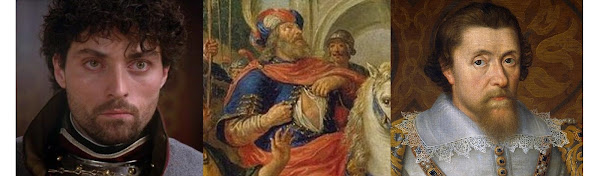
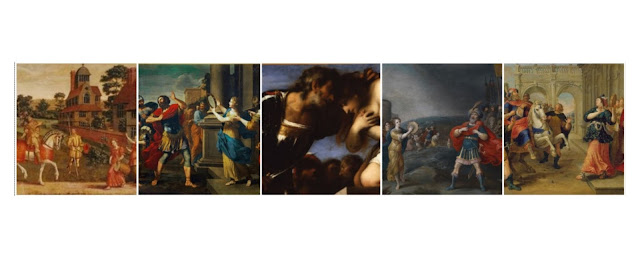
One of the most astonishing revelations for me during my limited recent research on the Jephthah allusion was how many correlations there were between many aspects of the Jephthah plot, and the character of Fortinbras. There is no literal sacrifice of a daughter, but hints of other kinds of sacrifice. Other scholarship on the Jephthah allusion in the play tends to focus on Polonius, the object of Hamlet's Jephthah remarks, or on unholy vows and the consequences to Ophelia. Some considers the hasty or unholy vows of other characters such as Hamlet or Laertes. But Shakespeare scholars have also noticed correlations, not only between Prince Hamlet and James VI and I of Scotland and England, but also between Fortinbras and James. So if Fortinbras points at least in part toward James, and also to Jephthah, was Shakespeare in a sense predicting that James was an ambitious Jephthah-type, the kind one could imagine sacrificing one of his children on the altar of his ambition? This see...

Jephthah/Polonius Series: "Pay Attention. Be Astonished. Tell About It." Index, Summaries, & Links

Image
For now , I have come to the end of my research and series of blog posts on Jephthah and Polonius. It has turned out to be very much like the poet Mary Oliver's "Instructions for living a life": Pay attention. Be astonished. Tell about it. This is far better than the vague and limited advice one hears more often: "Write what you know"; better to go on a quest to find out even more, and to be astonished in the process. Since at least last October I have been thinking and researching more methodically than I had in the past about Hamlet's Jephthah allusion in reference to Polonius. In paying attention, I’ve often  been astonished to find that the Jephthah allusion in Hamlet is much richer than many footnotes and other sources sometimes suggest (in my admittedly limited research).  So here is an index to my Jephthah/Polonius posts since last October, with links to those posts, and with some brief comments about the things I found that most astonished me in eac...