Posts

Showing posts with the label Protestant

Review: THE CORISCO CONSPIRACY: A Memoir of William Shakespeare, by Raphael Sóne

Image
In The Corisco Conspiracy , Raphael Sóne's has written a book of fanfiction that takes readers on a wonderful romp, exploring possibilities about the mystery that is Shakespeare. It can be a fun for any reader, but especially for those aware of four things: (1) Shakespeare authorship debate (and authorship collaboration research). (2) The Gunpowder Plot. (3) Shakespeare scholarship’s "turn to religion," circa 2000, considering (among other things) Catholic influences. (4) Awareness of how Shakespeare has been used as a tool of empire, mostly for the benefit of fair-skinned English people. The Corisco Conspiracy: A Memoir of William Shakespeare , combines some of these, as well as an awareness of how the author’s Jesuit predecessors attempted to overthrow the English government and return Protestant England to Catholicism. Many agree that Shakespeare collaborated with other writers far more than the First Folio would have us believe. What if some of them were African, or M...

Dennis Taylor notes via Paul Tillich on Protestant-Catholic complimentarity

Image
Shakespeare's age was marked in part by a Protestant-Catholic feud echoed perhaps in the feud between Capulets and Montagues in Romeo and Juliet . Dennis Taylor (author of Shakespeare and the Elizabethan Reformation: Literary Negotiation of Religious Difference ), has a web page of notes[1] (from which the following is taken) related to Shakespeare and Catholic-Protestant issues; under the year 1984, he has this interesting note on some ideas from Paul Tillich, which may offer a refreshing alternative to the Elizabethan Protestant-Catholic conflict: ~~~~~ Tillich, The Protestant Era: “The decrease in sacramental thinking and feeling in the churches of the Reformation and in the American denominations is appalling. Nature has lost its religious meaning and is excluded [from] participation in the power of salvation … The Protestant protest has rightly destroyed the magical elements in Catholic sacramentalism but has wrongly brought to the verge of disappearance the sacramental foun...

Titus Andronicus, revenge, and child-eating in Shakespeare's Bible

Image
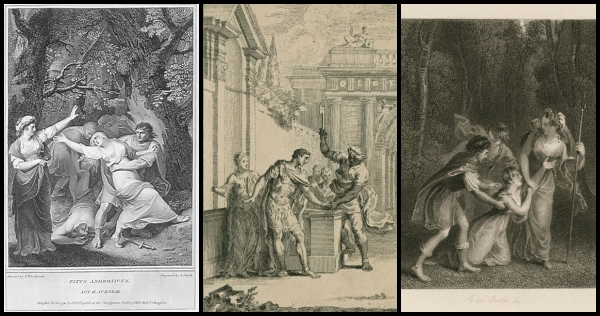
In Titus Andronicus, Titus has Chiron and Demetrius restrained and killed, to be baked up and served to their mother for revenge, a deception of cannibalism (vaguely similar to the deception at the end of The Spanish Tragedy). In The Bloody Banquet, by T.D., as punishment, an adulterer must eat the flesh of her lover.   Why the fascination with revenge and cannibalism? CANNIBALISM: Many Catholics believed in transubstantiation (that the bread and wine actually became the body and blood of Christ). Protestant polemics claimed it was a form of cannibalism, which Catholics denied. “EAT THEIR OWN CHILDREN” Deut 28:54-57 (Bishop’s Bible trans.) notes note people who are “delicate and tender” (entitled, pampered, spoiled), who - if the city were under siege and food limited - would eat their own children. [1] When Hamlet calls Fortinbras a “delicate and tender prince,” it is not a compliment, but a reference to this passage. Titus stabs his own daughter, and Tamora wants the mixed-race c...

Part 31: Gertrude as Protestant Allegory (Interlude A)

Image
[My previous post said that the next four would explore four different interpretations of Gertrude; this post explores the first of those interpretations in greater detail, an allegorical reading.] One of my least favorite interpretations of Gertrude in Shakespeare’s Hamlet is when people read her merely as a Protestant allegory for the corrupt Catholic church. In this reading, Gertrude (like the Roman church) is a slave to her passions; she cannot resist either her lust for Claudius or her desire for wine.[1] Many readers and playgoers today are too removed from Protestant-Catholic debates and propaganda in Shakespeare’s time, so to suggest this allegory often elicits only confusion. In the Bible, in Revelations 17, Protestants found an analogy for corruption in the Roman Catholic church, comparing it to a fallen woman selling favors, worshiping idols of pleasure instead of the “one true God.” It helps to know that Shakespeare and most everyone in England and on the continent were exp...

Part 30: A Tale of Four Gertrudes (Interlude/Prelude)

Image
There are as many interpretations of Gertrude as there are readers, spectators, and actors. My next four posts will explore just four readings of Gertrude, especially regarding motivations for drinking from what she may or may not know is the poison cup intended for her son. Whether Ophelia and Hamlet influence Gertrude or not can only be determined by scrutinizing what really happens with Gertrude. A brief summary of just four of many possibilities (I prefer # 4): 1. Gertrude as Protestant allegory for a corrupt Catholic Church. Gertrude drinks because she is a slave to her animal passions as mother, as incestuous adulterer, and as slave to drink. For an example of this reading, see Linda Kay Hoff, Hamlet's Choice: A Reformation Allegory. 2. A surprised Gertrude as queen of wishful thinking [1]: Gertrude sees “The Mousetrap” (with its mention of poison) and hears Hamlet accuse Claudius of murder, but thinks Hamlet is mad; she doesn’t tell Claudius of Hamlet’s accusations to protec...

John Drakakis on quasi-religious veneration of Shakespeare

Image
HAMLET  A man may fish with the worm that hath eat  of a king and eat of the fish that hath fed of that worm. KING  What dost thou mean by this? HAMLET  Nothing but to show you how a king may go a progress through the guts of a beggar. (4.3.30-35) (Some say this sounds like a threat, from Hamlet to Claudius; but it's also more simply a reminder to Claudius of his mortality....) In Shakespeare’s time, Protestants and Catholics still debated Eucharist. - Catholics are taught that in the prayers of the Mass, the Eucharistic bread becomes the “body of Christ,” but that this is not cannibalism. - Lutherans are taught that the bread becomes Christ but also remains bread, a position too Catholic for Calvin. - Calvinists believe those who eat of the Eucharistic received Christ spiritually, not physically. - Protestant polemics made fun of this, observing that if a church mouse ate crumbs of Catholic Eucharist, it would be ridiculous to claim that Christ, King of heaven, “m...

That season... Wherein our Saviour's birth is celebrated

Image
“...that season … / Wherein our Saviour's birth is celebrated…” There is a tendency at times for some to approach the Christmas reference in Hamlet as if it is merely about Catholic superstition. But it’s far richer than that. The ghost appears; the cock crows; the ghost disappears (an allusion to Peter’s denial during the passion [1]). Then: MARCELLUS: Some say that ever ’gainst that season comes Wherein our Savior’s birth is celebrated, This bird of dawning singeth all night long; And then, they say, no spirit dare stir abroad… (1.1.173-176) The cock crowing and season of Christmas point to a large sweep of Christian salvation history.   Even regarding the Christmas reference alone, we might treat it as an invitation to view the play in the mirror of the Christmas season tales, which are in part hospitality tales: Some welcome guests and strangers; others inconvenience, neglect, or kill them. There is a similar contrast in Hamlet : — The Christmas tale requires Annunciation and...

Part 27: Ophelia's Willow, Psalm 137, & Religious Refugees

Image
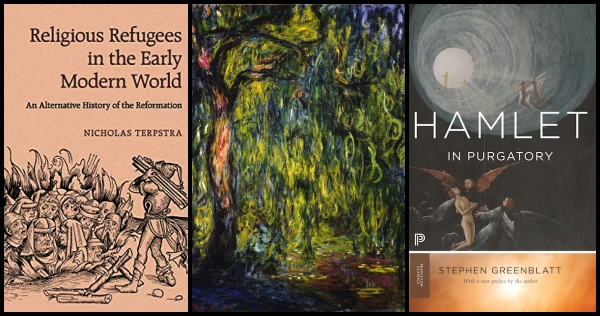
Ophelia hangs coronets on a willow . Why a willow? One of the older known willow poems is Psalm 137,[1] about Israelites taken captive to Babylon, forced to sing for their captors. They hung their harps on willows [2]: "How shall we sing [...] a song of the Lord in a strange land?" [3] “Babylon” became a Protestant metaphor for the corruption of Roman Catholicism in continental Europe and in England under Catholic monarch Mary I. Protestants were internal religious refugees, captives in their own lands. When Protestant Elizabeth became queen, Catholics and Puritans became the new internal religious refugees. [4] Hamlet wants to go back to Wittenberg (associated with Luther), but Claudius and Gertrude oppose it. The censors and master of revels would never allow a play about England’s internal religious refugees (Protestant, Catholic, or Puritan), but Shakespeare could have his prince and internal refugee say,  “Denmark’s a prison.” (2.2.262) For internal religious refugees ...

Hamlet Act I: "'Tis Strange," a Poisoned King, and a Poisoned Lord Strange

Image
In the first act of Hamlet, the first five uses of the word "strange" all refer to the poisoned king. HORATIO: 'Tis *strange.* (1.1.75) HORATIO: ...This bodes some *strange* eruption to our state. (1.1.80) HAMLET: 'Tis very *strange.* (1.2.233) GHOST: Murther most foul, as in the best it is; But this most foul, *strange,* and unnatural. (1.5.34) HORATIO: O day and night, but this is wondrous *strange*! (1.5.185) HAMLET: And therefore as a *stranger* give it welcome. (1.5.186) Shortly after that, some of the next occurrences of the word "strange" refer to the way Hamlet may act while feigning madness. Having spoken to the ghost and learned of the poisoning, Hamlet warns Horatio and the sentinels that he may act *strange* (1.5.190), but that they are to keep his secret (1.5.201-202). IT SO HAPPENS that until the death in 1594 of Lord Strange, Ferdinando Stanley, more than half of the actors in Shakespeare's playing company were "Strangers," or ...

Why resist pigeonholing Shakespeare and his religious allegiances? (Dr. Gillian Woods)

Image
Sometimes people debate Shakespeare’s religious allegiances as if cheering for a favorite football team. It can seem as if some secret truth about his religious beliefs is more important to them than the richness of the plays and poems. Instead of asking which team he was on, we might wonder if, at heart, he was perhaps a kind of "free agent," free to admire certain things in a variety of traditions, while passing as an obedient Protestant? It's true that Shakespeare was much more sympathetic in his portrayal of Catholic elements in his plays than many of his contemporaries, but this alone does not prove he was secretly Catholic. England had flip-flopped from Catholic to Protestant under Henry VIII and his son, then back to Catholic under Mary I, then to Protestant again under Elizabeth. Maybe Shakespeare embraced certain values in Christianity, but wanted to hedge his bets, since Catholics (and others) in England were being persecuted for being too outspoken on religion....

Why Rhenish, not Bread? Emmaus in Hamlet 5.1, Part 4

Image
Bread and wine. Wine and bread. To-MAY-to, To-MAH-to. [1] Does it matter what we emphasize or begin with? In previous posts, I’ve explored echoes in Hamlet 5.1 of the Emmaus tale from Luke 24:13-35 [2]. [Image: Altar of the Sienese cathedral, reverse, main register with scenes from Christ's passion, scenes: Christ appears to two pilgrim apostles in Emmaus. 1308-1311. Artist: Duccio di Buoninsegna (1255–1319). Collection: Museo dell'Opera del Duomo, Siena. Public domain, via Wikipedia .] Between Luke’s version of the tale and Shakespeare’s in Hamlet, we noted a difference of bread and wine: In the original story from Luke, the stranger on the road to Emmaus is not recognized as an appearance of the risen Jesus until they break bread with him. But in Hamlet 5.1 we noted that broken bread is replaced with spilled wine: Hamlet had been holding an unrecognized skull, and asked the gravedigger whose it was. The gravedigger replied, saying it belonged to Yorick, and ...

Linda Kay Hoff on Religious Bias in Hamlet Scholarship (part 14)

Image
"Shakespeare quotes the Bible roughly 1,350 times, considerably more than any other playwright of the period. Ignoring religion when discussing his work is a bit like ignoring an elephant sitting on your sofa sipping a martini." - John R. Yamamoto-Wilson (from an online comment on a post here ) From Hamlet's Choice: Hamlet—A Reformation Allegory , by Linda Kay Hoff (1990): Hamlet is a play in which religious elements loom large. As such it has attracted an inordinate number of Catholic and Protestant apologist critics who, more than any other, "botch the words up fit to their own thought" * in trying to make of Hamlet a religious drama compatible with the preconceived religious beliefs that moved them to respond to the religious elements within Hamlet in the first place, usually with the transparent ulterior motive of aligning Shakespeare with themselves as their coreligionist. While many of these apologist critics have contributed useful explanations...