Posts

Showing posts with the label Contrasting Interpretations

Part 36: Gertrude builds a better mousetrap for Claudius (Interlude D.3)

Image
In Hamlet 5.2, Gertrude suspects poison, [1] but doesn't know for certain — a dangerous mystery: she avoids openly accusing Claudius. This scene is a variation of King Aegeus, saving son Theseus from a poison cup from stepmother, Medea — with some genders switched and stakes raised.[2] Gertrude will test the wine by drinking it, without saying that is her reason for doing so. In this she sets a better, simpler mousetrap for Claudius: If it is poison, he could stop her and confess. If not, maybe “mad” Hamlet was mistaken about Claudius? Hamlet’s “Mousetrap” foreshadows (and sheds light on) Gertrude’s. She cannot pluck the mystery’s heart without drinking from the cup to test it, and to test Claudius. By drinking, in effect, Gertrude tells Claudius: If you would poison my son, you must go through me first. In her closet, Hamlet had told her that he would later beg a blessing of her [3]. Testing the wine for poison is the blessing she offers her son, without his having to ask. This ...

Part 30: A Tale of Four Gertrudes (Interlude/Prelude)

Image
There are as many interpretations of Gertrude as there are readers, spectators, and actors. My next four posts will explore just four readings of Gertrude, especially regarding motivations for drinking from what she may or may not know is the poison cup intended for her son. Whether Ophelia and Hamlet influence Gertrude or not can only be determined by scrutinizing what really happens with Gertrude. A brief summary of just four of many possibilities (I prefer # 4): 1. Gertrude as Protestant allegory for a corrupt Catholic Church. Gertrude drinks because she is a slave to her animal passions as mother, as incestuous adulterer, and as slave to drink. For an example of this reading, see Linda Kay Hoff, Hamlet's Choice: A Reformation Allegory. 2. A surprised Gertrude as queen of wishful thinking [1]: Gertrude sees “The Mousetrap” (with its mention of poison) and hears Hamlet accuse Claudius of murder, but thinks Hamlet is mad; she doesn’t tell Claudius of Hamlet’s accusations to protec...

Part 24: Ophelia, Gertrude, and Shifting Narratives of Marital Betrayal via Cristina León Alfar

Image
Instead of reading Ophelia’s love for Hamlet as unwise, too “free” [1], and viewing Gertrude as adulterous [2], it is possible to read both characters very differently. We might be nudged in this direction by certain feminist readings, one being a book by Cristina León Alfar called Women and Shakespeare's Cuckoldry Plays: Shifting Narratives of Marital Betrayal [3]. Although the focus of her book is not Hamlet, many of her insights apply. Alfar’s focus involves six plays in which male claims of female adultery play a central role. These include Merry Wives of Windsor, Much Ado About Nothing, Othello, and The Winter’s Tale. Alfar carefully tracks a trend: Men (at times misled by men like Iago and Don John) make false claims of women’s infidelity, claiming wives or fiances have made them “cuckolds.” But these claims are fictions or lies based on male anxiety. Women, often with help of female allies, can shift these narratives, accusing the men of slander for their false claims. In ...

Part 1: The Controversy over Ophelia's Death in Hamlet

Image
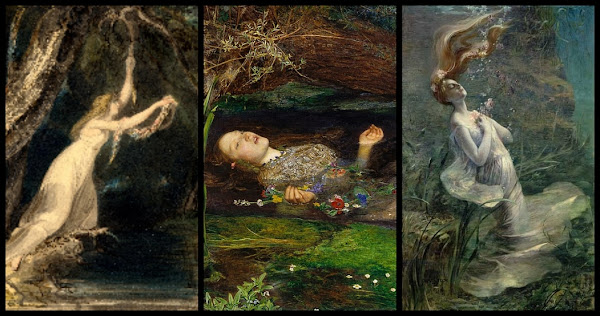
If you ask an average Shakespeare reader or viewer to tell you how Ophelia dies in Hamlet, many might say “suicide,” or “she drowns herself.” But the play presents a controversy of at least seven interpretations of her death, ranging from accident to suicide. [1] These are represented by 1. Gertrude; 2. the king (implied); 3. the Coroner’s Inquest; 4. the Gravedigger-clowns; 5. Hamlet; 6. the “churlish priest”; and 7. Laertes. Some of these agree more with the others, some not. Educators often say it’s good to “teach the controversy,” so instructors might have students seek, document, and reflect on the position of each party, as well as other possibilities (with or without evidence). 1. GERTRUDE offers the earliest account of Ophelia’s death, saying Ophelia fell in the brook while decorating a willow with flowers, when an “envious sliver” of a bough broke [2]. Her garments helped her float for a while [3], but they became “heavy with their drink” and “Pulled” her “To muddy...

IS HAMLET DAMNED OR NOT? Four (or five?) approaches

Image
There are two kinds of people in the world: Those who think there are only two kinds, and those who are sane. The joke applies to all generalizations, but if I had to list categories for types of interpretations of Hamlet, these would come to mind: 1. The Ghost is released from purgatory by God to commission Hamlet to execute a usurping, incestuous murderer, Claudius. If Hamlet refuses to kill Claudius, he disobeys heaven. Hamlets main flaws: He waits too long, hurts and kills too many, but is right to kill Claudius in the end. [Popular with Catholic critics.] 2. The Ghost is from hell; Hamlet is tricked into killing Claudius & causing other deaths. Vengeance is God’s alone, so Hamlet is hell-bound. Some in this group think Claudius is a pretty effective king. Kill him and be damned. Many of these also consider any hint of turning in Hamlet after the sea voyage and graveyard scene to be superfluous or delusory on Hamlet's part. [Roy Battenhouse ( Shakespear...

Versions of Hamlet: Quartos, Folios, Edited

WHICH HAMLET? Many choices, Shakespeare fans: 1. The First (“bad”/unauthorized) Quarto (1602-3) reflects perhaps an early draft, or a shorter script for countryside touring while playhouses were closed? 2. Later came the Second (expanded, approved) Quarto (1604). 3. Still later came the First Folio (1623). 4. Eventually, some scholars created editions of Hamlet that combined most of the unique passages from both the Second Quarto and the First Folio, making a MUCH longer text overall— as if each word from Shakespeare were from an angel. (The Kenneth Branagh version uses this long, combined text.) But Shakespeare was no angel. Some prefer the First Folio because it might represent Shakespeare’s “last word” on the final (best?) text. This is also limiting: Perhaps he tailored each reversion to his changing times, and the last draft was not the best/last word, but more relevant to its times—and careful of its censors? 5. So this justifies what #dramaturgs and #directo...
SCIENCE INFLUENCED & RESTRICTED ANALYSIS OF BIBLICAL ALLUSIONS IN SHAKESPEARE'S PLAYS — AND INFLUENCED THE PLAYS AS WELL The long shadow of science had a restrictive influence on Shakespeare critics who tried to catalog biblical allusions in his plays: Perhaps caught up in enthusiasm for the scientific method, some literary scholars rejected what they viewed as too-subjective biblical allusions and influences (paraphrase and plot echo), and favored instead what seemed to them more like objective data: allusions that contained exact or nearly-exact bible quotes that could be matched with bible translations available at the time: See books by Charles Wordsworth (1864), Thomas Carter (1905), Richmond Noble (1935), and Naseeb Shaheem (1987-1999). Yet in “Truth and Method,” his famous book on interpretation/hermeneutics, Hans Georg Gadamer stressed that the arts and scholars of the arts should not feel obligated to conform to so-called scientific methods. I agree. Also, Natal...

HAMLET & CONTRASTING CRITICAL TRADITIONS

Some interpreters of Hamlet assume that ~Hamlet’s praise of his father should be trusted (that King Hamlet was mostly good); and that ~the prince was obliged to avenge his father's murder. Yet Horatio describes the king as “pricked on by a most emulate pride”; the ghost describes himself as in a state of sin when he died, not having confessed or received the sacraments. This leads some to question the king’s legacy. Hamlet's hyperbolic praise compares his father to pagan gods: Idolatry, or mere Renaissance tradition? Does this merit scrutiny? The dead king doesn't seem to have been a loving father involved in the life of his son; he seems harsh and demanding, while Yorick seems the loving surrogate father. The prince’s analogies of pagan gods might imply that he idolizes his father too much before the sea-voyage, after which Hamlet is silent about his father. This would support the Jonah plot echo: From the belly of the fish, Jonah mentions vanity (or in some tr...
EMMAUS PLOT ECHOES IN SHAKESPEARE When Jesus appears to two disciples on the road to Emmaus, was this a resuscitated corpse using super-powers, or just cleverness, to go unrecognized? Or was it not a resuscitated corpse at all? If we assume Jesus supernaturally altered his appearance, might we look for a plot echo in Bottom, altered by fairies in Midsummer Night's Dream? If we assume Jesus clouded the minds of the disciples, might we try magical characters, such as Prospero in The Tempest? Or better: If we think Jesus wore a white hood for shade and a cloth wrap to keep desert dust from nose and mouth, we might look for disguise: In Merchant of Venice, like two disciples, Bassanio & Gratiano fail to recognize Portia as the lawyer who “became man” to save their friend. What if a mere stranger did for two disciples the kinds of things Jesus had done? Listening with empathy, explaining scriptures, breaking bread? What if they found in him similar stuff as they had found in...
PRODUCTION OF HAMLET WITH ESPIONAGE TWIST IN D.C. Interview regarding a production of Hamlet with (appropriately) an espionage twist, around the corner from (a-ha!) a spy museum, located in (of course) Washington D.C. Claudius claims that planting Ophelia as bait and eavesdropping is OK, since, because he's king, they are "lawful espials," because, as Nixon used to say, if the president does it, that makes it legal. Polonius sends Reynaldo to spy on Laertes; Rosencrantz & Guildenstern spy on Hamlet; and Hamet and Horatio spy on Claudius and his reaction to "The Mousetrap" play-within-the-play.... This also brings to mind the excellent 2006 film, "The Lives of Others," about electronic surveillance and meddling in formerly communist countries.... Funny how a very old play can still prove to be very relevant. ~~~~~~~~~~ Shakespeare Theatre Company stages ‘Hamlet’ with modern espionage twist By Jason Fraley | @JFrayWTOP February 5, 201...
HAMLET & THE NECESSARY COMPOST OF THE IMAGINATION In early variorum editions of Hamlet, one finds that some readers/critics took an approach to the plays that tried to decipher which single historical figure seemed to be represented by which character in the play: Many thought Hamlet a stand-in for Sir Philip Sidney, or Essex, etc. But it seems more accurate to say that Shakespeare made composite characters, combining features of various historical figures; he also split up qualities of historical figures among various characters. So “decoding” usually falls very short, plagued by a kind of celebrity-reductionist mentality, a People Magazine approach to interpreting the plays. This sense of fracturing and combining elements from sources and historical figures (as I’ve mentioned before) seems to represent better how the compost of the imagination works in the plays. It’s also how the imagination may *need* to work in a harsh climate of censorship, where not masking thing...

SUICIDAL CLAUDIUS?

In the David Tennant Hamlet, in the final scene, Hamlet tries to stab Claudius with the "envenomed" sword, but Claudius (played by Patrick Stewart), ever trying to maintain control, grasps the blade that Hamlet is wielding (perhaps still poisoned). Hamlet pulls and Claudius cuts his hand. People at court cry "Treason," and some (not all) rush to restrain Hamlet from hurting the king. But this restraint keeps Hamlet from forcing the rest of the poison wine down Claudius' throat, which is a sort of long-standing tradition, and which some claim goes back to the original performances (but which some dispute). So how does Claudius get the cup? Hamlet offers it, Claudius takes it. Claudius realizes his game is up, he's been exposed as a murderer and coward (not stopping Gertrude from drinking), and he has no more reason to live. He drinks of his own volition, choosing the "Roman" way of suicide that Hamlet soon asks Horatio to reject. In the 1988...

SHOULD HAMLET'S MOM SUSPECT POISON, OR NOT?

In Shakespeare's Hamlet, do we want Gertrude to suspect poison in the "chalice" of wine into which Claudius drops a fine pearl? Or not? Various critics (like J. Dover Wilson in his book, "What Happens in Hamlet") have claimed that an older tradition believes Queen Gertrude likes immediate gratification of her desires. To them, this explains in part why she marries her dead husband's brother so quickly (get me sex!), and why she drinks the cup of wine that Hamlet refuses (she claims she's thirsty), in spite of the urgings from Claudius for her not to do so. In the Kenneth Branagh Hamlet and the Franco Zeffirelli Hamlet (starring Mel Gibson), Gertrude in both of these films seems unsuspecting of poison, and is later shocked at the realization of Claudius' foul play as the poison takes effect. But in both the David Tennant version and the Ethan Hawke version, the queen clearly suspects poison, and clearly volunteers herself (and risks her life). ...
HOW MACHIAVELLIAN DO YOU LIKE YOUR POLONIUS? In Shakespeare's Hamlet, how much Machiavelli should we imagine in the king's key adviser, Polonius? Is Polonius an aging and self-absorbed old man— a bootlicker too concerned about his daughter’s virginity? (Then why is he the key adviser?) Or is he a manipulator who purposefully withholds his daughter's affections so they will be more desired by Hamlet, so that the match will get royal approval, and so that she might marry into royalty? (Does he lead Gertrude to want her son’s heart mended by the return of Ophelia’s once-denied love, so his daughter will then be the next queen —implied perhaps in the David Tennant version?) In 2.2, Polonius is certain that the denial of his daughter's affections has caused Hamlet's madness, in spite of Claudius' inclinations otherwise. In 3.1, Gertrude, manipulated by Polonius, says, "for your part, Ophelia, I do wish That your good beauties be the happy cause ...

HOW WOULD YOU LIKE YOUR OPHELIA & FORTINBRAS?

Of the many aspects of Branagh's Hamlet that critics noted, one involved images of Hamlet and Ophelia, naked in bed (plucking the heart from the mystery of the question of whether they had been lovers, or whether—as Ophelia tells her father—Hamlet had merely expressed his love in "honorable fashion").  Another involves the entry of an attacking Fortinbras at the end of the play, with an army. An older tradition assumes Ophelia is a virtuous, virginal and obedient daughter who alludes to scripture in conversation with her brother, but as women were considered the "weaker vessel" (a-hem), she goes insane and perhaps (contrary to Gertrude's account?) commits suicide. Others have noted the presence of abortifacient herbs among the flowers she names in her mad scene, and claim that she is pregnant with Hamlet's child, but that this could not be stated explicitly due to the censors. Another old tradition likes to believe that the diplomatic overtures  ...