Posts

Showing posts with the label Cain

INDEX: Good Friday echoes in Hamlet

Image
Since at least 2022, I've done a post around the time of Good Friday, sharing what seem to be either direct allusions, or at least echoes of the Good Friday gospel stories (the Passion of Christ) in Shakespeare's Hamlet .  The index link below is to blog posts about allusions in Hamlet to the Good Friday stories (which Shakespeare and others in England would have been required to hear via mandatory church attendance. The index covers related posts on this subject from 2022-2026. The 2022 post [1] collected a few general allusions or plot echoes. For people interested in a list of detailed, short references in the text of the play, this is a good place to start.  - A post in December of 2023 related to these by way of Ophelia's "willow" [2];  - Good Friday posts in 2024 [3] and in 2025 [4] continued this, each with new insights.  INDEX: Good Friday echoes in Hamlet - April 03, 2026. https://pauladrianfried.blogspot.com/2026/04/index-good-friday-echoes-in-hamlet...

Philip II of Spain through the lens of Claudius (Claudius series, Part 21)

Image
What if we consider Claudius, uncle of Hamlet, through the lens of Philip II of Spain, or vice versa?  Philip was married to Mary I, older half-sister of Elizabeth I, and as such, he also enjoyed the title of King of England.  As Elizabeth’s brother-in-law, she was Philip’s “sometime-sister,” a phrase Claudius uses to describe Gertrude, widow of his brother King Hamlet [1].  Philip had offered a marriage proposal to Elizabeth (1559) two months after the death of Mary I (hasty remarriage), in spite of being the widower of Elizabeth’s half-sister (which would have required special dispensation from Rome, as did the marriage of Henry VIII to his first wife, Katherine of Aragon, mother of Mary I); this would have been considered a biblically incestuous marriage.  [Edit: Elizabeth *did not accept*. ]  There were coins of England during the monarchy of Mary I that featured images of Mary and Philip, some of which are still in existence, although Elizabeth had a majo...

Cain and Jesus in Gertrude's Closet, Hamlet 3.4 (Good Friday post)

Image
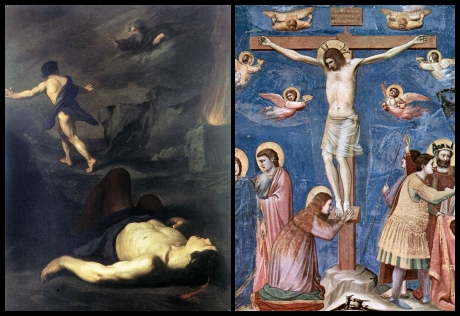
GOOD FRIDAY & CAIN IN GERTRUDE'S CLOSET Compare: Hamlet 3.4.31-32, after Hamlet kills Polonius unseen: Queen:  O me, WHAT HAST THOU DONE? * Hamlet:  Nay, I KNOW NOT. Is it the King? * [1] Genesis 4:9-10, Geneva trans.: Then the Lord said unto Cain, Where is Abel thy brother? Who answered, I cannot tell. Am I my brother’s keeper? Again he said, WHAT HAST THOU DONE? * the voice of thy brother’s blood crieth unto me, from the earth. Luke 23:34, Geneva, Jesus from the cross: Then said Jesus, Father, forgive them: for THEY KNOW NOT what they do. * (* Emphasis mine) - Queen Gertrude echoes God to Cain: What hast thou done? - Hamlet echoes Jesus from the cross: I know not (what I've done). AT LEAST TWO IMPLICATIONS: 1. By killing a human being, Hamlet has sinned, like Cain killing his brother. 2. By stabbing the person hidden behind the arras, blind to who he was stabbing, Hamlet fits what Jesus says from the cross: They know not what they do. WHY HAS THIS BEEN MISSED by previous...

LAMETH and the 10th Day of Christmas in Churches of Shakespeare's Time, January 3 - Series, Part 10

Image
10TH DAY OF CHRISTMAS IN SHAKESPEARE’S TIME, JANUARY 3: Matthew 2 revisits the Epiphany’s wise men, star, and Herod, from the December 28 gospel [1]; Genesis 3 tells of the serpent deceiving Adam and Eve, a Hamlet theme [2]; Romans 2 repeats “circumcision of the heart” (v.29), already heard on January 1. Two readings involve vengeance: - David in Psalm 3 calls upon a vengeful God (has avenged him before) to save him from the rebellion of his son, Absalom [3]. - One mentions a descendant of Cain whose name is an anagram for Hamlet: Genesis 4, at evening prayer, mentions Lamech/Lameth [4], who boasts of his vengeance, and in legend, accidentally kills his ancestor Cain, triggering God’s curse [5]. The Danish source for Hamlet has the prince named Amleth. “Amleth” an anagram of “Hamlet,” but so is “Lameth.” In 5.2, Hamlet regrets acting badly toward Laertes at Ophelia’s grave, and tries to apologize for blindly killing Polonius behind the arras, without publicly admitting his intended ...

The 7th day of Christmas, December 31, in churches of Shakespeare’s time (Series, Part 7)

Image
The 7th day of Christmas (December 31 in Shakespeare’s time as now, also St. Sylvester’s Day [1]), used these Bible readings: Psalm 30 (repeated from previous): House of David, prayer in prosperity, trouble, and restoration (not exactly King Lear, but implied character arc) [2]. MORNING PRAYER Isaiah 65 - the prophet is sought by Gentiles, condemns sins; “seed of Jacob” (a name used five times in two plays); new heaven and new earth (Antony: “Then must thou needs find out new heaven, new earth” [3]); four animals with rich associative meanings whose names appear in Shakespeare: wolf (38 times), lamb (59), lion (224), serpent (39) [4]. Acts 28 - The shipwrecked prisoner Paul and others are shown kindness by "Barbarians" of Malta: - hospitality for strangers, key theme in Greek and biblical literature, and in Shakespeare as for example in King Lear, A Winter’s Tale, Hamlet, and others (violated hospitality, a strong theme in Macbeth). - 12 “at Syracuse, we tarried… three da...

Does Shakespeare’s Hamlet depict religiously shaped or motivated regicide?

Image
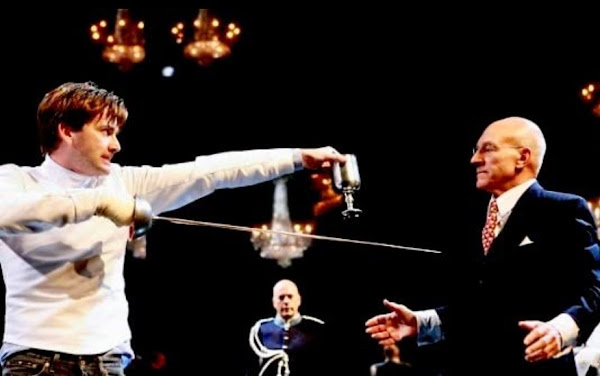
Does Shakespeare’s Hamlet depict religiously shaped or motivated regicide? [1] Given its many religious and biblical allusions and plot echoes, I would argue that it does. [David Tennant (L) as Hamlet and Patrick Stewart (R) as Claudius in the 2009 film, Hamlet , dir. Gregory Doran. Source: IMDB . Fair use.] Dr. Arthur F. Marotti gave a talk at Fordham in late October of 2013 in which he noted, “In the last years of Elizabeth’s rule people believed something was rotten in England—though perhaps not rotten enough to justify regicide. ” [2] Marotti has written numerous books [3] about Early Modern literature and religion, including a 2004 essay with Ken Jackson on “The Turn to Religion” in Shakespeare studies. In an abstract for a more recent (2017) essay [4], Marotti notes that “Shakespeare's plays may not stage religiously motivated regicides…,” with “may” being the operative word here: Scholars may disagree on this point. But what about Hamlet? Recognizing that H...

Jewell's Homily V & Lazarus-Hamlet-Claudius Correlations (part 12 in Lazarus series)

Image
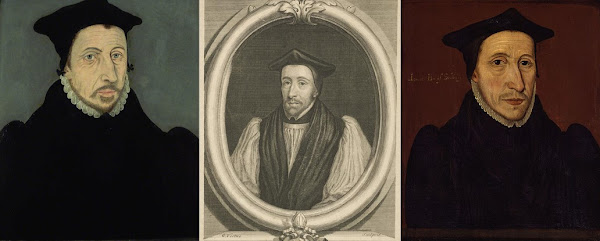
Two Early Modern texts - each in their own ways well-known in their time - both touch upon all the following themes: adultery, lust, drunkenness, selfish ambition, sedition, envy, murder, incest, madness, and poison. They also allude to the following historical or Biblical-mythical characters: Alexander the Great, Herod John the Baptist The Beggar Lazarus and the selfish rich man The Serpent in the Garden Adam Cain King David St. Bernard of Clairvaux What are those two Early Modern texts? If you guessed (1) Homily V. from Book II of the official English Church homilies, "Against Gluttony and Drunkenness" (usually attributed to John Jewell), and (2) Shakespeare’s Hamlet , you are correct. The general idea in the homily is that any excess pursuit of pleasure in sex, food, or drink, is sinful, while all the things Christians receive as gifts from God in a spirit of thanksgiving and moderation are good. (Jewell might therefore disagree with Mae West, oft...