Posts

Showing posts with the label Lazarus & the Rich Man

Dives and Pauper, Hamlet, Ten Commandments, and Falstaff (Series)

Image
Dives and Pauper [1] was an English text from early 1400s, probably by a Franciscan, and although there are no direct allusions in the play to this Middle English text, it has interesting connections to Shakespeare and Hamlet, as well as representing the general influence of the Ten Commandments [2] on the evolution of English religious culture. The title is an allusion to Luke 16:19-31 in which a rich man (Latin: "Dives") neglects the beggar Lazarus and suffers eternal punishment while Lazarus goes to heaven [3]. Lazarus, whose body had sores that were licked by dogs, was often thought to have been a leper (hence "Lazar houses," hospitals for lepers in England). The ghost in Hamlet 1.5 thinks a “leperous distillment” of poison that his brother poured in his ear made his skin all "lazar-like" [4]. Ophelia's reference to the story of the owl and the baker's daughter is a folktale retelling, where a baker is rich in bread, but his daughter is r...

DIVINE RIGHT OF KINGS IN SHAKESPEARE CHALLENGED BY SCRIPTURE ALLUSIONS

Image
Divine right of monarchs is challenged by Shakespeare's scripture allusions, especially in Hamlet. 1. When Hamlet spares Claudius at prayer [1], this echos of 1 Samuel 24 and 26, where David has chances to kill King Saul, but will not raise a hand against “God’s anointed.” - But years before Saul’s death, Saul acted badly and fell to disfavor with God, whose prophet chose David as successor (1 Sam 16) while Saul was still alive. This challenges unrestricted divine right.  2. St. Paul in Romans 13 urges obedience to rulers, as it is their job to maintain civil order, but does not include obedience to immoral orders of tyrants [2]. 3. Darren Freebury-Jones recently noted key ideas from John Neville Figgis’ book on the Divine Right of Kings, [3], including that the monarch is accountable to God alone. 4. More fundamentally, however, scriptures quote Jesus as saying, “whatever you do unto the least of these, you do unto me” [4]. By this logic, when monarchs treat “the least” badly, t...

Why "Hugger Mugger" & "Impostume" are in Hamlet

Image
HUGGER-MUGGER: Shakespeare has Claudius use these words to describe the burial of Polonius in Hamlet 4.5. "Hugger-mugger" means "secret," "chaotic," "clandestine, sly," or "disorderly, chaotic" [1].  Shakespeare consulted the 1579 Thomas North translation of Plutarch, which used “hugger-mugger” to describe the burial of Julius Caesar [2]. Polonius once played Julius Caesar in a play production, as he reveals to Hamlet in 3.2.  HUGGER-MUGGER as HOARDING a SECRET:  To do something secretly is to hoard the knowledge of the thing: Claudius hoards not only knowledge of the secret burial of Polonius, but also of his murder of his own brother.  IMPOSTUME:  Observing Norway’s troops ready to invade Poland, Hamlet notes:  This is th’ impostume of much wealth and peace, That inward breaks and shows no cause without Why the man dies. (4.4.28-30) An impostume is an abscess, as if the body is secretly hoarding puss from an infection. Hamlet impli...

Links to Lepers in Hamlet

Image
LINKS TO LEPERS IN HAMLET: References to tales of famous lepers, confusion about them, and those who cared for them: 1. The ghost says the poison made his skin lazar-like (1.5), like that of the beggar Lazarus in Luke 16:19–31 [1];  - Claudius poured “the leperous distillment" in the “porches" of the ghost's ear (1.5): In some art, the beggar Lazarus is left untended on the porches of the rich man’s house.  - Ophelia’s “the owl was a baker’s daughter” (4.5) references a folktale retelling of the Luke 16 gospel tale;  - Horatio’s “angels sing thee to thy rest” (5.2) references the Requiem Mass lines based on the Lazarus story. 2. The saint-namesake of the sentinel Francisco (1.1) is Francis of Assisi, who cared for lepers, and famously kissed one [2]. (Katherine of Aragon’s confessor was a Franciscan, John Forest, burned at the stake for opposing Henry’s divorce.)   3. In medieval and Elizabethan times, leprosy and venereal disease were confused, and leprosy thou...

At Christmas be Merry - 1557 rhyme

Image
At Christmas be mery, and thanke god of all: and feast thy pore neighbours, the great with the small. Yea, al the yere long, have an eie to the poore: and god shall sende luck, and bring you much more. - Thomas Tusser, 1557   Via Brigitte Webster on Instagram @tudor_experience https://www.instagram.com/p/DD9Apq-oIOF/?utm_source=ig_web_copy_link ~~~~~~~~~~~~~~~~~~~~~~~~~~~~~~~ ~~~~~~~~~~~~~~~~~~~~~~~~~~~~~~~ YOU CAN SUPPORT ME on a one-time "tip" basis on Ko-Fi: https://ko-fi.com/pauladrianfried IF YOU WOULD PREFER to support me on a REGULAR basis, you may do so on Ko-Fi, or here on Patreon: https://patreon.com/PaulAdrianFried ~~~~~~~~~~~~~~~~~~~~~~~~~~~~~~~ ~~~~~~~~~~~~~~~~~~~~~~~~~~~~~~~ Disclaimer: If and when I quote or paraphrase bible passages or mention religion in many of my blog posts, I do not intend to promote any religion over another, nor am I attempting to promote religious belief in general; only to explore how the Bible and re...

Me at Eight: St. Martin of Tours and Hamlet

Image
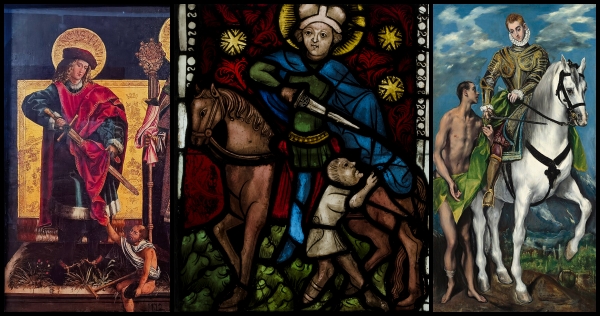
Raised Catholic but no longer observant, I still recall 3rd grade - 8-years old? -  preparation for confirmation, and having to choose a confirmation name. I'd been given a book ( Sixty Saints for Boys , 1948) - a tale about Martin of Tours appealed to me. It claimed Martin was a Roman soldier with a large, warm, not unattractive cloak. It was cold. He cut his cloak to give half to a beggar he encountered on his way. Fellow soldiers made fun of him. But in a dream, the beggar revealed himself as Jesus. What a strange choice, for an 8-year old to choose this name! Was I choosing that I should commit to being generous, even if peers made fun of me? (Today, November 11, is the Feast Day of St. Martin of Tours.*) Many years later, I now research and write about Shakespeare's 𝘏𝘢𝘮𝘭𝘦𝘵, a play in which the ghost says the poison that killed him made his skin "Lazar-like," a reference to the gospel tale of the rich man who neglects the beggar Lazarus; after they die, the ...

Part 55: Ophelia's Overlapping Biblical allusions and plot echoes

Image
Many biblical allusions (or biblical plot and theme echoes) associated with Ophelia overlap in her character. All of these were well-known in Elizabethan times. (Not an exhaustive list): 1. Hebrews 12: 6-11 (suffering as a sign of God’s love for the “chosen” who will be “saved).[1] 2. JACOB, ESAU, AND RACHEL (lower right): the “double blessing” for Laertes, and the frustration of Hamlet and Ophelia’s hopes for a match, point to the bible tale of how Jacob wins the birthright by deceit, Esau gets the second blessing, and Jacob’s hopes to marry Rachel are at first frustrated.[2] 3. SALOME (top left): Claudius wants Ophelia and her brother Laertes to dance to his tune and serve his purposes: He uses Ophelia a bait to spy on Hamlet, and Laertes as co-conspirator to to kill Hamlet, who protests the incestuous marriage. Salome danced pleasingly for her stepfather, Herod Antipas, who offered almost any reward. His wife, Salome’s mother (divorced wife of his brother) told her to ask for the he...

Part 50: Ophelia Pregnant with Mystery

Image
As I said at the end of Part 48 [1], I do like that a pregnancy for Ophelia is suggested but not conclusive in Hamlet, and that such mysteries and ambiguities may be something like a presence of God: "Who's there?" - the play’s opening question, would have been appropriate for the rich man who neglects the beggar Lazarus to whom the Ghost refers [2], as well as for the baker’s daughter referred to by Ophelia [3]. In both cases, those who neglect the beggar at the door neglect the presence of God. How do we face the presence of mystery in the beggar, the stranger? In Ophelia? Did Ophelia miscarry, and in postpartum depression, commit suicide, which Gertrude generously conceals in a story about an “envious sliver” and a death in faith [4]? Would the Ophelia we come to know in the play have killed herself and an unborn child? Can we know for certain, or is such a quest for certitude like a form of self-idolatry? How might we consider the mystery of Ophelia in the context of ...

Austin Tichnor on "Shakespeare’s sources transformed"

Image
Austin Tichenor offers a good, brief article on Shakespeare's repurposing of sources , available at the Folger Shakespeare Library website. He writes: "Charlotte Artese, author of Shakespeare and the Folktale, explained on the Folger’s Shakespeare Unlimitedpodcast that Shakespeare frequently refers to things that have little meaning to us now but would have been familiar to his audience then. Among her many examples, Artese cites Ophelia’s odd-seeming non-sequitur “They say the owl is a baker’s daughter” from her mad scene in Hamlet as referring to a folktale in which Jesus turns a baker’s daughter into an owl for giving him a meager portion of bread..." And as I've argued before, the tale of the baker's daughter changed to an owl might best be considered as a repurposing/transformation of the gospel tale about the rich man and the beggar Lazarus - which is referred to by the ghost regarding his "lazar-like" skin after poisoning - and also referred to...

TRANSCRIPT: Presentation for Post Graduates, N.S.S. College, Kerala, India, 7 December, 2023

Image
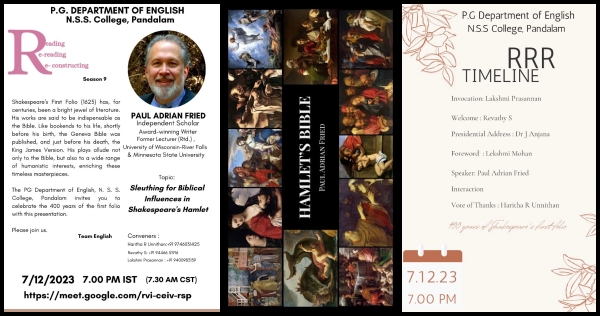
TRANSCRIPT: Presentation for Post Graduates, N.S.S. College, Kerala, India, 7 December, 2023 Edited planned transcript of remarks delivered on 7 December, 2023, in an online presentation for the Post Graduate program, N.S.S. College, Kerala, India, 7 P.M. IST, 7:30 A.M. CST. (A few words and points below were cut from the live presentation for time considerations, and I made a few additional extemporaneous remarks, but for the most part, this is the transcript.) (I did not have time to talk about allusions that fit into the theme of orphaned children who find transcendent parents in others or in a heavenly parent, but perhaps some other time....) ~~~~~~~~~~~~~~~~~~~~~~~~~~~~~ Informal outline (followed by transcript): INTRODUCTION: [Disclaimers] - Contested times, contested scripture LIST OF BOOKS cataloging Bible allusions in Shakespeare, some open-access: Sleuthing scripture allusions in Hamlet CHANGE THOSE NAMES WITH YOU: Servant-Prince, & Renunciation of Fruits DOUBTING ...