Posts

Showing posts with the label Emmaus

Lear and Cordelia as "God's Spies": Tropes and cognitive framing - Series

Image
When Lear speaks with Cordelia in 5.3 of being "God's spies" [1], this draws on a common trope, which activates a kind of cognitive framing. The trope is present in the tale to which Ophelia alludes in Hamlet 4.5: “the owl was a baker’s daughter,” a tale about Jesus or a fairy in disguise as a beggar at the baker’s door.  It is also present when Henry V (in 4.1) moves disguised among his troops on the eve of the Battle of Agincourt, and when Hamlet in 5.1 does not at first reveal to the gravedigger that he is the “mad” prince [2]: Sermons urged that monarchs should be obeyed like God’s representatives on earth, but king and prince purposefully conceal their identities, like spies. The trope was in medieval tales: King Arthur goes among his people disguised [3], as he does centuries later in Mark Twain's novel, A Connecticut Yankee in King Arthur's Court (1889). Shakespeare was fond of Ovid’s Metamorphoses in which the gods Zeus and Hermes, disguised like spi...

Delay in four Hamlet biblical echoes

Image
At least four biblical echoes in Hamlet besides the fall of Adam and Eve involve delay, and Elizabethans would have known each story[1]: 1. After King David’s affair with Bathsheba and arranging for the death of her husband, the prophet Nathan could have simply confronted David with his sins, but delayed to use a story to catch the king’s conscience (2 Sam 12:1-7). [2] - This is echoed in Hamlet’s use of the play to catch the conscience of the king [2.2.634]. ~~ 2. David spared King Saul when he had two chances to kill him, which delayed David’s ascension to the throne [3]. - These David-Saul tales are echoed (with a dark twist) in Hamlet’s choice not to kill Claudius at prayer [3.3.80-100]. ~~ 3. Jonah fled west to Tarshish when he was called to prophesy to Nineveh (Jonah 1:1-3), delaying his prophecy. After a storm and being thrown overboard, Jonah is swallowed by a fish God sends to take him back east to do his task [4]. - Jonah’s westward voyage and east-bound transfer from ship ...

Yorick, the Gravedigger, Emmaus, and St. George (Emmaus Postlude, Part 8)

Image
The name Yorick [1] may come from the same root as St. George [2], patron saint of England since 1348 : from the Greek “Georgios”: from ge (γῆ)  - 'earth, soil' - and ergon (ἔργον), 'work' [3]. Yorick, as “earth worker.”   The gravedigger in Shakespeare’s Hamlet is called “Goodman Delver” by his friend (5.1.14). - So the gravedigger and Yorick echo one another in more ways than foolery… This relates also to my series on the Emmaus echo in 5.1, the graveyard scene: the story of Jesus’ appearance to the disciples on the road to Emmaus [4] was a gospel read in church on the first Monday after Easter every year of Shakespeare’s life [5]. In that gospel, two disciples on the road are mourning the death of Jesus. They meet a stranger (somehow a real or figurative Jesus, unrecognized [6]) who shows them compassion, listens, scolds them for their flawed thinking, and gives them hope, explaining the scriptures to them. These are all things Jesus had done for them. The disciple...

Me at Eight: St. Martin of Tours and Hamlet

Image
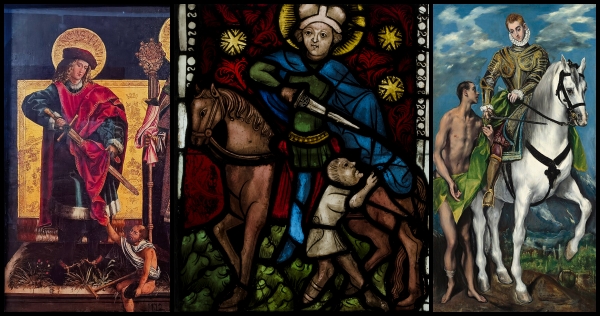
Raised Catholic but no longer observant, I still recall 3rd grade - 8-years old? -  preparation for confirmation, and having to choose a confirmation name. I'd been given a book ( Sixty Saints for Boys , 1948) - a tale about Martin of Tours appealed to me. It claimed Martin was a Roman soldier with a large, warm, not unattractive cloak. It was cold. He cut his cloak to give half to a beggar he encountered on his way. Fellow soldiers made fun of him. But in a dream, the beggar revealed himself as Jesus. What a strange choice, for an 8-year old to choose this name! Was I choosing that I should commit to being generous, even if peers made fun of me? (Today, November 11, is the Feast Day of St. Martin of Tours.*) Many years later, I now research and write about Shakespeare's 𝘏𝘢𝘮𝘭𝘦𝘵, a play in which the ghost says the poison that killed him made his skin "Lazar-like," a reference to the gospel tale of the rich man who neglects the beggar Lazarus; after they die, the ...

INDEX: Emmaus in Hamlet's Graveyard (and a Venice Courtroom)

Image
At some point in my work on Hamlet, I realized that the first part of the graveyard scene resembles the gospel tale of the appearance of Jesus as a stranger to the two disciples on the road to Emmaus: In the graveyard scene, instead of two disciples, it's two Danes, and instead of being on the road to Emmaus, they're on the road to Elsinore. Instead of recognizing a supernatural being in the breaking of bread (one of the actions at the Last Supper), they recognize the skull of Yorick (fool of "infinite jest" -a sort of god of fools) in the clown/gravedigger's tale of poured wine (a flagon of Rhenish wine Yorick poured on the gravedigger's head). Something similar occurs in the courtroom scene of The Merchant of Venice, where Portia is the disguised stranger later to be recognized, not in the breaking of bread, but in the breaking of ring-vows, when rings that two men had promised never to part with until death are given away. The Jonah echo in Hamlet's sea...

INDEX: Holding up The Odyssey as mirror in Hamlet

Image
From August 4-23, 2022, I did a series exploring how Shakespeare seems to have had The Odyssey in mind when he named Ophelia's brother Laertes (the father of Odysseus also had that name): In the same way that the family of Odysseus tries to defend his wife Penelope against suitors while he is away at war, Polonius and Laertes try to defend Ophelia against suitors. This was prompted in part by Asimov's book on Shakespeare, in the section on Hamlet , where he briefly mentions this name, Laertes, which stand out like a sore thumb, and which does not sound very Danish. Below is the INDEX to these posts: 1. Laertes in Hamlet & the Odyssey - Part 1: https://pauladrianfried.blogspot.com/2022/08/laertes-in-hamlet-odyssey-part-1.html 2. Laertes in Hamlet & the Odyssey - Part 2: https://pauladrianfried.blogspot.com/2022/08/laertes-in-hamlet-odyssey-part-2.html 3. Seeking Penelope in Ophelia & Hamlet: Laertes & The Odyssey - Part 3: https://pauladrianfried...

Part 46: In Gertrude's final choices, Ophelia lives on

Image
Ophelia and Hamlet influence Gertrude's final choices; they live in her: If we have followed Gertrude’s progress closely (allowing her to be at least as intelligent as the men in the play), we might note: She may have been deceived to marry Claudius, and done so as much for the safety of Denmark facing a threat from Norway [1], as for lust (contrary to what her son and the Ghost say [2]). She understands her son’s “Mousetrap” and its implications: Claudius poisoned his brother and wooed his brother’s wife [3]. Hamlet’s scolding in her closet has “cleft [her] heart in twain” [4]. She feels guilty facing Ophelia after her father’s death and her reported madness [5]. She reports Ophelia’s death not as suicide, but as an accident caused by crown-envy: the breaking of a sliver of willow envious for a crown [6], hinting at Claudius as the ultimate cause [7]. She probably suspects that Claudius poisoned the cup when dropping in a pearl and asking Hamlet to drink [8]. But she can’t know fo...

TRANSCRIPT: Presentation for Post Graduates, N.S.S. College, Kerala, India, 7 December, 2023

Image
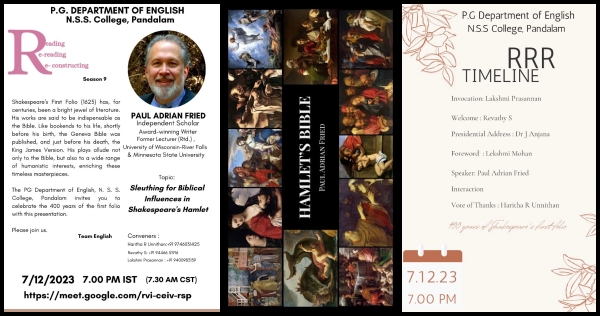
TRANSCRIPT: Presentation for Post Graduates, N.S.S. College, Kerala, India, 7 December, 2023 Edited planned transcript of remarks delivered on 7 December, 2023, in an online presentation for the Post Graduate program, N.S.S. College, Kerala, India, 7 P.M. IST, 7:30 A.M. CST. (A few words and points below were cut from the live presentation for time considerations, and I made a few additional extemporaneous remarks, but for the most part, this is the transcript.) (I did not have time to talk about allusions that fit into the theme of orphaned children who find transcendent parents in others or in a heavenly parent, but perhaps some other time....) ~~~~~~~~~~~~~~~~~~~~~~~~~~~~~ Informal outline (followed by transcript): INTRODUCTION: [Disclaimers] - Contested times, contested scripture LIST OF BOOKS cataloging Bible allusions in Shakespeare, some open-access: Sleuthing scripture allusions in Hamlet CHANGE THOSE NAMES WITH YOU: Servant-Prince, & Renunciation of Fruits DOUBTING ...