Posts

Showing posts with the label Greenblatt

Frank Kermode on New Historicism and Stephen Greenblatt

Image
Stephen Greenblatt is the author of a number of books, one of them 𝘏𝘢𝘮𝘭𝘦𝘵 𝘪𝘯 𝘗𝘶𝘳𝘨𝘢𝘵𝘰𝘳𝘺 (2001), an important book in Hamlet studies and also in Shakespeare and Religion. He is also one of the scholars most associated with New Historicism. Greenblatt's approach in this book, exploring many manifestations of the long history of the idea of purgatory in literature and art, influenced my own approach in many ways: - When I go digging for historical associations that could have made very meaningful the choice of sentinel names (Francisco and Bernardo), this is like Greenblatt's approach. - When I dig for famous examples of "poison cup" known in Elizabethan times, like King Aegeus knocking from his son's hand the cup poisoned by Medea, this follows a well-worn path that Greenblatt trod before me. - When I explore various pre-1600 paintings of the boy Jesus, lost in Jerusalem, found astonishing the elders in the temple - to shed light on a Hamlet allusion...

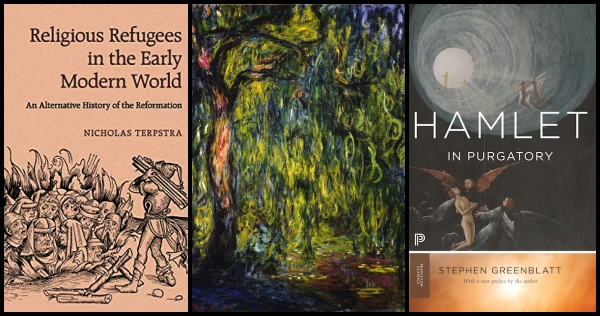
Part 27: Ophelia's Willow, Psalm 137, & Religious Refugees

Image
Ophelia hangs coronets on a willow . Why a willow? One of the older known willow poems is Psalm 137,[1] about Israelites taken captive to Babylon, forced to sing for their captors. They hung their harps on willows [2]: "How shall we sing [...] a song of the Lord in a strange land?" [3] “Babylon” became a Protestant metaphor for the corruption of Roman Catholicism in continental Europe and in England under Catholic monarch Mary I. Protestants were internal religious refugees, captives in their own lands. When Protestant Elizabeth became queen, Catholics and Puritans became the new internal religious refugees. [4] Hamlet wants to go back to Wittenberg (associated with Luther), but Claudius and Gertrude oppose it. The censors and master of revels would never allow a play about England’s internal religious refugees (Protestant, Catholic, or Puritan), but Shakespeare could have his prince and internal refugee say,  “Denmark’s a prison.” (2.2.262) For internal religious refugees ...

Part 3: ALL I NEED TO KNOW ABOUT PURGATORY I LEARNED FROM SHAKESPEARE’S HAMLET (& Stephen Greenblatt)

Part 3: ALL I NEED TO KNOW ABOUT PURGATORY I LEARNED FROM SHAKESPEARE’S HAMLET (& Stephen Greenblatt) Thought experiment: Three aging monarchs realize some past decisions & sins have caused innocent suffering. What to do? Repent? Monarch A donates money to a monastery where the monks have never spoken critically of the royal family. The king’s youngest brother was recently made abbot. After death, hundreds of masses will be said to reduce his time in purgatory. But perhaps the gift doesn’t rebalance the good to outweigh harm he has caused in the world. Monarch B donates to a convent where none of her relatives live or serve, in spite of the fact that the nuns have sometimes been critical of the choices of the royal family. Their primary mission is to serve needs of the sick and poor, to house the homeless, give them productive work, and teach useful skills. Monarch C reforms laws to be more fair and just, to reduce prison sentences when possible, and to raise wages and ...

ALL MY FAVORITE THINGS ABOUT PURGATORY I LEARNED FROM SHAKESPEARE'S HAMLET (purgatory part 1)

ALL MY FAVORITE THINGS ABOUT PURGATORY I LEARNED FROM SHAKESPEARE'S HAMLET (with a little help from S. Greenblatt): Part I Hamlet toys with purgatory: English church adherents could think the ghost is a demon in disguise; secret Catholics, that he’s from purgatory. But note that Hamlet uses his last breaths to heal wounds that he and his father had created in life: —He offers an apology to Laertes, which Laertes rejects at first, but they later reconcile before dying. —Hamlet uses his dying breaths to give the throne to Fortinbras,* son of the man his father killed, healing a wound his father had created (and helping what remains of Dad, among the living, out of “purgatory”; some call this re-imagining metaphysics as phenomenology). (*In one sense, of course, Young Fortinbras is James, whose parent, Mary QoS, had been executed by Elizabeth, just as Old Hamlet killed Old Fortinbras.) This sort of change of heart and reconciliation works far better than causing many wou...

HAMLET & OLIVIA: Mourning too long?

Image
Stephen Greenblatt ("Shakespearean Negotiations") is among those scholars who note that Twelfth Night 's Olivia is a caricature of Elizabeth I, mourning the death of her father (HenryVIII, whom she idolized) and brother (young King Edward), and making excuses to avoid being courted for marriage. https://en.wikipedia.org/wiki/Twelfth_Night_(1996_film) Olivia's steward, Malvolio, may therefore be a caricature of William Cecil, Lord Burghley, who in the play is toyed with as being possessed and gets a mock-exorcism (!), which (in the eyes of some, like Essex) Cecil deserved, of course. If the unnaturally mourning Olivia can be Eliz I, what about Hamlet? If Viola, and MofV's Portia, and AYLI's Rosalind, etc., can disguise themselves as males, then Hamlet can stand (at least in part) for an idealized Elizabeth, a recipe for how Elizabeth I might end her life and reconcile with James, that prince from the north, the son of her enemy, as Hamlet does with Fo...