Posts

Showing posts with the label envious sliver

Part 35: Why Gertrude likely suspects a poison cup (Interlude D.2)
Image
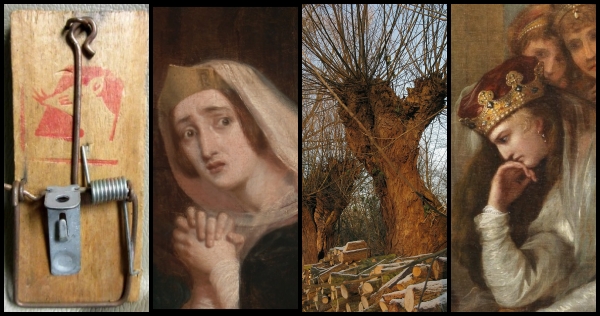
Why might Gertrude suspect a poison cup in Hamlet 5.2? 1. In 3.2, she saw The Mousetrap, arranged by her son, showing a man poisoning a king, then wooing his victim’s widow. The analogy implies that Claudius poisoned King Hamlet to usurp the throne and marry Gertrude. Gertrude tells Hamlet in her closet that the play “much offended” [1] Claudius, meaning they understood perfectly what Hamlet implied that Claudius had done. 2. Hamlet makes this more clear in his mother’s closet, and Gertrude says, O Hamlet, speak no more! Thou turn’st my eyes into my very soul, And there I see such black and grainèd spots As will not leave their tinct.[2] Gertrude knows she is caught up in the sins of her envious, murderous, usurping husband. 3. Just before she speaks to Ophelia in 4.5, Gertrude says, “To my sick soul (as sin’s true nature is), Each toy seems prologue to some great amiss. So full of artless jealousy is guilt, It spills itself in fearing to be spilt.[3] Gertrude fears to spill the secret...
Part 34: Why Gertrude personifies the envious sliver of willow (Interlude D.1)

Image
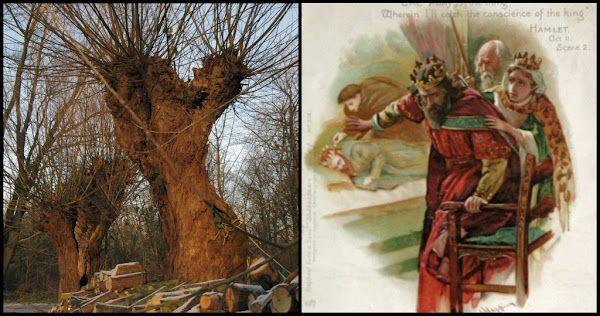
The fact that Gertrude personifies the sliver of willow that sends Ophelia to her death is curious and deserving of more attention. She says an envious sliver breaks [1], sending Ophelia into the water — meaning that it was not Ophelia’s choice to set in motion the events that would lead to her drowning, but that these were caused by an act of envy by something outside herself. Why envious? Envious that it was not given a floral crown (“coronet”) [2] like other branches. Tree branches or slivers can’t feel envy, so Gertrude’s personification of the sliver as “envious” implies a belief that human envy was ultimately the cause of Ophelia’s drowning. Who in the play was envious of another’s crown? - Primarily Claudius, who poisoned his brother, usurped the throne and stole his brother’s wife.[3] Ophelia had bestowed crowns on branches and triggered the envy of one “sliver”; she could have been Hamlet’s wife and borne him another heir, helping to bestow that heir’s crown. What does this en...

Part 32: A Surprised and Sentimental Gertrude (Interlude B)

Image
[An earlier post said that the next set would explore four different interpretations of Gertrude; this post explores the second of those interpretations in greater detail, a Gertrude who is surprised at finding herself poisoned, blinded by her own sentimentality.] Productions that portray Gertrude as unsuspicious and surprised to find in 5.2 that the cup from which she drank had been poisoned are not convincing to me: They ignore too many textual details. But many find it compelling.[1] We might well ask: Why do some people prefer an unsuspicious Gertrude who is surprised at the poison? - Do they prefer to view her as an unwitting victim of Claudius? - As being punished for alleged adultery and an "incestuous" marriage? - As lacking intelligence or wisdom enough to be suspicious? - As lacking agency, so they don't want her to be A) secretly acting as her son's wine-tester, testing for poison, B) setting a mousetrap deliberately for Claudius by choosing to drink, a...