Posts

Showing posts with the label Pyrrhus

Hamlet's Use of the Trojan War & Consequences of the Judgment of Paris

Image
Why does Shakespeare’s “Hamlet” refer to the Trojan war? Some may think that Trojan War references in Shakespeare merely represented a Renaissance obsession with things Greek. But the Trojan War speech in Hamlet also alludes to (1) a Greek-themed Marlow play [1]; (2) the widow Hecuba’s grief [2] (a contrast with Gertrude); (3) the pause of Pyrrhus (like Hamlet hesitating to kill Claudius at prayer) [3]. When the players arrive in Elsinore and perform a speech at Hamlet’s request, he asks for a speech about Hecuba, mother of Paris, witnessing the revenge killing of her husband, King Priam. Priam is about to be killed by Pyrrhus, son of Achilles, in revenge for Priam's son Paris having killed Pyrrhus’ father. Revenge begets revenge and more grieving widows, a terrible cycle. Appropriate for Hamlet. “The Judgment of Paris” involves Paris having to choose the fairest goddess. Each goddess offers bribes, with Aphrodite promising Helen of Troy. Paris chooses Aphrodite, and soon abducts ...

Hamlet and Homer - part 8 (Louden, Aguirre, Hornback)

Image
Names, common themes, and similar incidents in Homer* and Hamlet are too explicit and numerous to avoid (Laertes, Hyperion, Pyrrhus, Priam, Hecuba... See my previous posts in this series).[1] The text of Hamlet expects readers and audiences to view Hamlet through the lens of Homer, both for its similarities and for the ways it diverges from the old heroic texts. (*When I say Homer in this instance, it's shorthand for all the sources Shakespeare used, including Virgil, Ovid; Chaucer, and Chapman's partial translation of the Iliad, as well as other secondary sources.) Bruce Louden observes [2] that among the many new characters and plot elements in Hamlet that are not found in the Saxo Grammaticus and Belleforest sources, four of them are found in Homer: 1. the Ghost; 2. the coming of the actors to Elsinore; 3. the play-within-the-play; 4. the pirates who intercept the ship…. (33-34) Louden notes that Hamlet identifies with Pyrrhus, who wears black in mourning for the d...

Hamlet Nunnery Scene Haunted by Homily VI, Book 2, & Lazarus (part 14)

Image
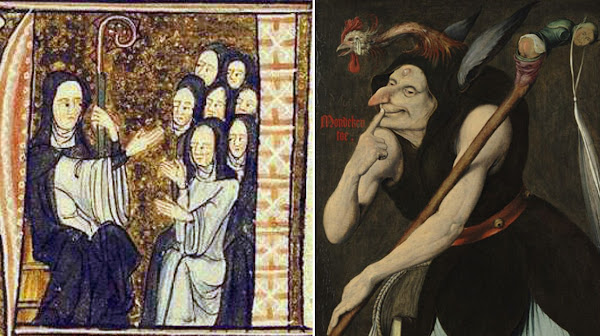
The nunnery scene (3.1) in Shakespeare's Hamlet is among the most famous of the play's scenes, with Hamlet telling Ophelia to get to a nunnery, criticizing women for painting themselves faces other than the one God gave them, and offering as a "plague for thy dowry" that, if she must marry, she should marry a fool. [NUNS AND A FOOL. Left: Hildegard von Bingen and her nuns, 13th Century, public domain here . Right: An Allegory of Folly, early 16th century, by Quentin Matsys (1456/1466–1530), New York, J. Held Collection. Image public domain, here .] All of these things - and Pyrrhus, and worm's suppers - also appear in Homily VI, "AN HOMILIE AGAINST excesse of Apparrell," from Book 2 of the official homilies used during Shakespeare's lifetime. The same homily also makes a connection between the sin of excess committed by the rich man in the Luke 16 Lazarus tale, and the excess of people wearing extravagant clothing, or we...

What's Jephthah to Hecuba, or She to Him?

Image
Hamlet's references to Jephthah and Hecuba may have more to do with each other in the broader context of the tales of the Trojan War than Hamlet footnotes lead one at first to believe. Many students today make up the largest group of fresh audiences or readers of Shakespeare's Hamlet . As such, most come to the play without knowing who Jephthah or Hecuba were (I certainly did not when I first read the play in high school). Both Jephthah and Hecuba are alluded to by the prince in Act 2, scene 2, a long scene.* Hamlet remains on stage consistently from the Jephthah reference through all the Hecuba speech and references ("What's Hecuba to him, or he to Hecuba?").                [Dame Judi Dench as Hecuba in Hamlet , 1996, directed by Kenneth Branagh. Image via HamletsCloud . Fair use.] Shakespeare's original audiences fresh to the play would have included a greater percent of people more familiar with the Bible and ...