Posts

Showing posts with the label willow

Part 38: Christ figures in Hamlet: Ophelia, Gertrude, Hamlet (Good Friday 2024 post)

Image
Today is Good Friday. In Shakespeare’s England, church rituals spoke of baptism as a dying to self in Christ, so as to be made new in him [1]. Contrary to some Shakespeare scholars who explicitly resist the idea of Christ-figures in the plays (including Harold Jenkins, Arden editor), all the baptized are called to be Christ-figures [2], imitators of Christ. The spiritual rhythm in medieval mystery, morality and miracle plays assumes all are sinners, but if they express sorrow for their sins, they can know God’s mercy and be saved. [3] Any drama in which a person who dies is saved, is a comedy; the only tragedies are those in which a sinner resists salvation. In her madness, Ophelia expresses regret through her story of the baker’s daughter [4]. Gertrude explains that Ophelia falls in the brook because of an “envious sliver” of willow [5]. Willows in Psalm 137 were incorporated weekly in Christian vespers and associated by St Benedict of Nursia [6] and Martin Luther [7] with the cruci...
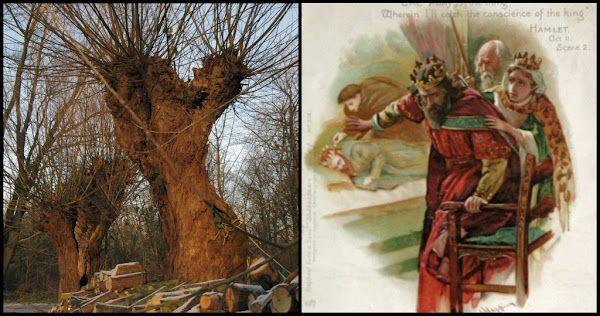
Part 34: Why Gertrude personifies the envious sliver of willow (Interlude D.1)

Image
The fact that Gertrude personifies the sliver of willow that sends Ophelia to her death is curious and deserving of more attention. She says an envious sliver breaks [1], sending Ophelia into the water — meaning that it was not Ophelia’s choice to set in motion the events that would lead to her drowning, but that these were caused by an act of envy by something outside herself. Why envious? Envious that it was not given a floral crown (“coronet”) [2] like other branches. Tree branches or slivers can’t feel envy, so Gertrude’s personification of the sliver as “envious” implies a belief that human envy was ultimately the cause of Ophelia’s drowning. Who in the play was envious of another’s crown? - Primarily Claudius, who poisoned his brother, usurped the throne and stole his brother’s wife.[3] Ophelia had bestowed crowns on branches and triggered the envy of one “sliver”; she could have been Hamlet’s wife and borne him another heir, helping to bestow that heir’s crown. What does this en...

Part 27: Ophelia's Willow, Psalm 137, & Religious Refugees

Image
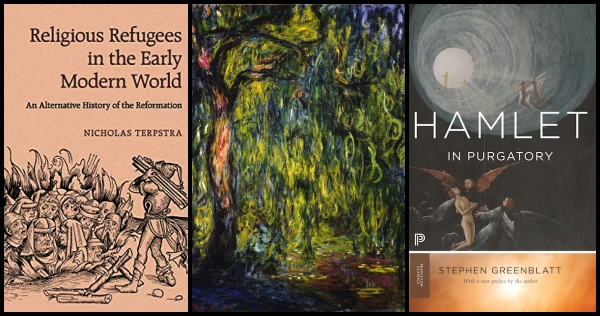
Ophelia hangs coronets on a willow . Why a willow? One of the older known willow poems is Psalm 137,[1] about Israelites taken captive to Babylon, forced to sing for their captors. They hung their harps on willows [2]: "How shall we sing [...] a song of the Lord in a strange land?" [3] “Babylon” became a Protestant metaphor for the corruption of Roman Catholicism in continental Europe and in England under Catholic monarch Mary I. Protestants were internal religious refugees, captives in their own lands. When Protestant Elizabeth became queen, Catholics and Puritans became the new internal religious refugees. [4] Hamlet wants to go back to Wittenberg (associated with Luther), but Claudius and Gertrude oppose it. The censors and master of revels would never allow a play about England’s internal religious refugees (Protestant, Catholic, or Puritan), but Shakespeare could have his prince and internal refugee say,  “Denmark’s a prison.” (2.2.262) For internal religious refugees ...

Part 26: Ophelia gives crowns instead of grasping & hoarding one

Image
According to Gertrude, Ophelia crowned willow branches with coronets (small crowns) of flowers, perhaps in the same spirit her giving away flowers and herbs to the court: QUEEN: There is a willow grows askant the brook That shows his hoar leaves in the glassy stream. Therewith fantastic garlands did she make Of crowflowers, nettles, daisies, and long purples [....] There on the pendant boughs her coronet weeds Clamb’ring to hang… 4.7.190-198 Coronets? Why does this detail matter? There are men in Ophelia’s Denmark (Claudius) and from Norway (Fortinbras) who have killed, or are very willing to kill, to keep or grasp at a crown. Claudius is a man willing to kill his own brother and king to gain his crown, willing to kill his nephew, and watch his own wife poison herself without stopping her, just to keep his crown. Fortinbras is willing to enter battle where thousands will die so that he can achieve his victory, and later, he hopes, his crown: HAMLET: Witness this army of s...