Posts

Showing posts with the label Clowns

Part 7: Ophelia's Gravedigger: They "sat on her"

Image
We should resist the temptation to treat the gravediggers and their clowning in Hamlet 5.1 as mere comic relief: They prepare audiences and readers to view the “churlish priest” more critically. GRAVEDIGGER  Is she to be buried in Christian burial, when she willfully seeks her own salvation? [1] (Shouldn’t all people seek their own salvation? “Willfully” suggests a parody of the Protestant idea that we are saved by “faith alone,” not by works. But by Gertrude's account, it is not at all clear that Ophelia committed suicide - it is a mystery - so why assume?)   OTHER  I tell thee she is. Therefore make her grave straight. The crowner hath sat on her and finds it Christian burial. GRAVEDIGGER  How can that be, unless she drowned herself in her own defense? [2][3] (The gravedigger mangles “The coroner’s inquest sat to consider her death,” which becomes “The crowner hath sat on her.” Funny but disturbing, to sit on the corpse of a drowned woman. The original spelling wa...
Part 1: The Controversy over Ophelia's Death in Hamlet

Image
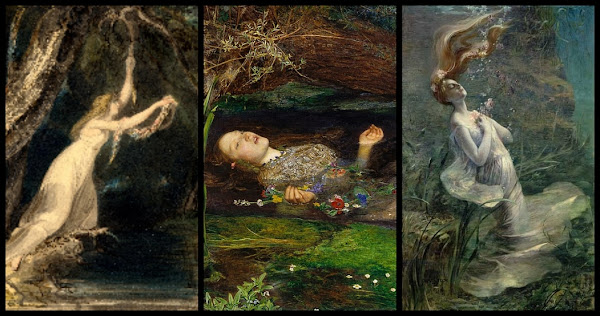
If you ask an average Shakespeare reader or viewer to tell you how Ophelia dies in Hamlet, many might say “suicide,” or “she drowns herself.” But the play presents a controversy of at least seven interpretations of her death, ranging from accident to suicide. [1] These are represented by 1. Gertrude; 2. the king (implied); 3. the Coroner’s Inquest; 4. the Gravedigger-clowns; 5. Hamlet; 6. the “churlish priest”; and 7. Laertes. Some of these agree more with the others, some not. Educators often say it’s good to “teach the controversy,” so instructors might have students seek, document, and reflect on the position of each party, as well as other possibilities (with or without evidence). 1. GERTRUDE offers the earliest account of Ophelia’s death, saying Ophelia fell in the brook while decorating a willow with flowers, when an “envious sliver” of a bough broke [2]. Her garments helped her float for a while [3], but they became “heavy with their drink” and “Pulled” her “To muddy...

Coroner's Drowning Inquest as "Crowner's Quest" in Hamlet

Image
In David Bevington's book Murder Most Foul: Hamlet Through the Ages, Bevington includes the following parenthetical observation regarding suicides: (Coroners in Shakespeare's day were instructed to issue of suicide in such dubious cases, partly because swimming was regarded as reckless self-endangerment and thus virtually a suicidal act, but more importantly because the estate of the deceased would then go to the crown.) (60) Bevington died last summer in his late 80s, and the book was first published in 2011 when he was about 80. On this point in the parenthetical above, there is no footnote, no mention in the end notes. (If this is a commonly-known understanding, and if many other sources confirm it, and if you are aware of some of those, please let me know). The general logic is that suicide is self-murder, and murder violates one of the ten commandments ("thou shalt not kill"), so a suicide (or even an attempted suicide) is therefore a criminal, and the land...