Posts

Showing posts with the label Bernard of Clairvaux

Hamlet's Transcendent paths of Francis, Bernard, & Yorick, vs. Freud's Oedipal path

Image
Shakespeare's Hamlet offers glimpses of two ways of transcending dysfunctional parentage: a) The limited path of Freud's Oedipal complex, or b) Yorick and the paths of Francis of Assisi and Bernard of Clairvaux. In the first, the son kills the father-figure to reclaim a lost closeness to the mother. If the father is a tyrant and the son resorts to violence to replace him, this is a very limited, temporary transcendence, with the son too much like the father he replaces [1]. Francisco and Bernardo are the names of sentinels, the first two characters on stage in the play. Together, they are the names of the Pazzi assassins [2], but individually they are names of saints: - Francis of Assisi and Bernard of Clairvaux didn't kill their fathers, but Francis famously renounced his abusive father before the bishop, stripping off his clothes and giving them back to his father, saying that he had a father in heaven. - St. Bernard’s biological father and brothers eventually joined t...

How is Shakespeare's Hamlet a Reformation play?

Image
HOW IS SHAKESPEARE’S HAMLET A REFORMATION PLAY, pointing to efforts by Catholics and Protestants to reform Christian institutions and hearts? 1. First on stage is Francisco. Francis of Assisi was a famous church reformer [1] (demonstrating that "reformation" - reforming the church - was a popular  topic centuries before Martin Luther). 2. Second is Bernardo. Bernard of Clairvaux was a famous Cistercian monastic reformer [2]. 3. Hamlet goes to university at Wittenberg, where Martin Luther nailed his theses to the door [3]. 4. The ghost tells Hamlet that he is being purged of sins (purgatory, believed in by many Catholics, doubted by many Protestants) [4]. 5. Hamlet tells the players not to overact. The actors say they have "reformed" that; Hamlet replies, "reform it altogether" [5], reformation wordplay. 6. Hamlet mentions a "convocation of politic worms," ‘your only emperor for diet” [6]: A council, the “Diet of Worms,” questioned Luther’s orthod...

Part 19: Ophelia's Parley in Polonius' War

Image
Cassidy Cash of That Shakespeare Life podcast fame recently posted regarding occurrences of the word “parley” in Shakespeare.[1] She explains that we may have heard the word from Pirates of the Caribbean films. In a parley, opposing sides cease hostilities, sometimes to clear the battlefield of wounded and dead, or to discuss terms of a truce.  In Hamlet , Polonius uses the word “parley” in an interesting way in his statements to Ophelia, discouraging her from believing Hamlet’s expressions and vows of love. It is clear in their discussion that Ophelia wishes to believe Hamlet’s vows and “tenders” of his affection, while Polonius repeatedly assumes that Hamlet is waging an adversarial war to win Ophelia as a prize and to violate her chastity as an enemy might violate an opponent’s borders.   Polonius tells Ophelia, From this time Be something scanter of your maiden presence. Set your entreatments at a higher rate Than a command to *parley.* (1.3.129-132) [2]   The contra...

Hamlet's Jewish & Christian Reformers

Image
In Shakespeare’s lifetime (as in ours for some), there was an anti-Semitic tendency among Christians to view Judaism as an inferior faith and to view Jesus, Son-figure of a Trinitarian God, as Judaism’s promised messiah sent to redeem humanity from their sins, establishing a "one true faith." An alternative view: Jesus was a Jew, and a reformer, who lived and preached at a time when Judaism had been corrupted in large part by the Roman occupation. Reformers like Jan Hus, Luther and Calvin may have thought it too proud to consider their own reformer-roles analogous to that of Jesus (Luther once referred to tales of medieval monks, including one about a monk who destroyed a chair he had made because he believed he had become too proud of it). But in fact we might consider that they attempted to do for Christianity something analogous to what Jesus attempted to do for Judaism. Hamlet contains references to many reformers: - St. Gis (Jesus). - Wittenberg, where Luthe...

Jewell's Homily V & Lazarus-Hamlet-Claudius Correlations (part 12 in Lazarus series)

Image
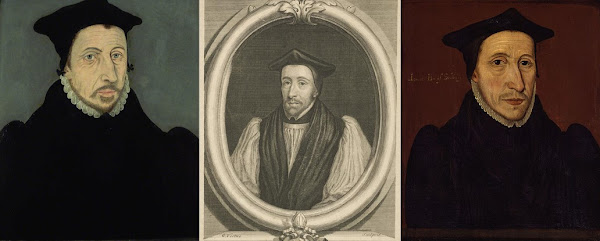
Two Early Modern texts - each in their own ways well-known in their time - both touch upon all the following themes: adultery, lust, drunkenness, selfish ambition, sedition, envy, murder, incest, madness, and poison. They also allude to the following historical or Biblical-mythical characters: Alexander the Great, Herod John the Baptist The Beggar Lazarus and the selfish rich man The Serpent in the Garden Adam Cain King David St. Bernard of Clairvaux What are those two Early Modern texts? If you guessed (1) Homily V. from Book II of the official English Church homilies, "Against Gluttony and Drunkenness" (usually attributed to John Jewell), and (2) Shakespeare’s Hamlet , you are correct. The general idea in the homily is that any excess pursuit of pleasure in sex, food, or drink, is sinful, while all the things Christians receive as gifts from God in a spirit of thanksgiving and moderation are good. (Jewell might therefore disagree with Mae West, oft...