Posts

Showing posts with the label R. Chris Hassel Jr.

Part 22: Ophelia's Opening Questions

Image
Shakespeare occasionally reminds us of the Elizabethan slang, that men have a “thing” and women a “nothing.” Ophelia’s name begins with an “O,” an emptiness at least potentially waiting to be filled. Questions are analogous to this. Nature abhors a vacuum; many questions seek answers, or are at least open to mysteries, first attempts to name their boundaries. Hamlet is famous for asking, To be or not? But he also resists certain questions, telling Rosencrantz and Guildenstern not to assume they can pluck the heart of his mystery. Bridget Gellert Lyons (1977), R. Chris Hassel, Jr. (1998),  Katharine Goodland (2006), and Ruben Espinosa (2011) are among those who notice in Ophelia early in the nunnery scene an echo of the ubiquitous images of Mary reading a book, perhaps of psalms, when visited by the angel at the Annunciation. In Luke’s gospel, Mary’s first sentence to the angel is a question: ““How shall this be?” But Mary is open to the angel’s mystery: “be it unto me accordi...
Reactions to R. Chris Hassel, Jr.'s "Painted Women: Annunciation Motifs in Hamlet"

Image
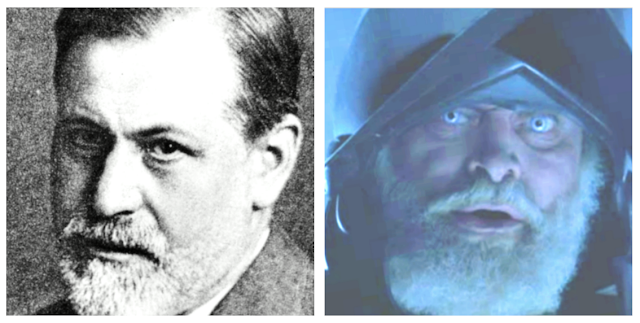
[MORE THAN A PASSING RESEMBLANCE? Was Freud reincarnated as Brian Blessed, who played the Ghost of Hamlet's Father in Branagh's 1996 Hamlet ? YOU DECIDE!] I had planned to blog this week about whether Horatio benefits from gratitude or regret (or whether he is more simply a foil for Hamlet) , and I still plan to blog on that topic soon. But I’m always looking for new books and articles to read about Shakespeare, Hamlet, and religious issues in the Early Modern period, and I came across the article, “Painted Women: Annunciation Motifs in Hamlet” by R. Chris Hassel Jr. It was published in the journal, Comparative Drama (Volume 32, Number 1, Spring 1998, pp. 47-84). I'll summarize some favorite ideas and use his essay as a spring-board for some of my own. I have been wrestling with Hassel’s insights, and there are many. As I’ve noted before in light of work by Katherine Goodland and Ruben Espinosa, when Polonius gives a prayer book to Ophelia, he wants her to appear li...