Posts

Showing posts with the label crowing of the cock

Religious and Biblical Allusions in Hamlet 1.1

Image
Many viewers and readers of Shakespeare's Hamlet (including me) approach the play from a secular point of view. Yet historians and Shakespeare scholars know that the play was written at a time when there were many religious controversies: Shakespeare's older sister had been baptized Catholic under "Bloody" Mary I, when Protestants had been burned at the stake as heretics. Shakespeare had been baptized under Protestant Elizabeth I, during whose reign many Catholics were executed as traitors, hung until nearly dead and disemboweled so they could see their organs ("drawn and quartered"). Catholics believed in transubstantiation, that the host was actually the body of Christ, but English Protestants took that language less literally. Catholics believed in purgatory, that imperfect but mostly good souls might be purified before entry into heaven, while Protestants believed that at the moment of death, one's fate was sealed, bound for heaven or hell at th...
Good Friday/Christ’s Passion Allusions in Hamlet

Image
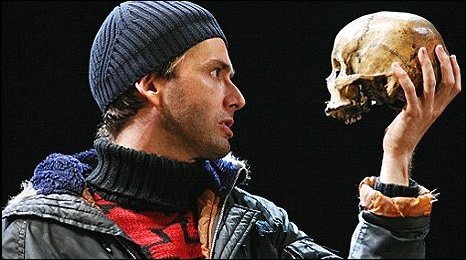
Christianity has long used the Friday before Easter to commemorate the story of the betrayal, torture, crucifixion, and death of Jesus. These stories are retold in the Bible (Mark 14-15, Matthew 26-27, Luke 22-23, John 18-19). [Image: David Tennant in 2008 RSC production of Hamlet, directed by Gregory Doran. Via BBC . Fair use.] Shakespeare’s Hamlet echoes a number of details from these stories and from larger Christian tradition. (See also Shaheen.) A few examples: [1] 1.1.125-137: Horatio describes the dead rising and strange signs in the heavens upon the death of Julius Caesar, but Matthew 27:53 similarly describes the dead raised at the moment of Jesus' death, and Luke 23:44-45 describes an eclipse. 1.1.162 and 163-4: The ghost hears the cock crow, and Horatio comments, “it started like a guilty thing / Upon a fearful summons.” Each of the gospels tells of Jesus predicting that Peter will deny him, and later, that the prediction comes true, marked by the crowing of a...