Posts

Showing posts with the label Prophet

ON THE SIGNIFICANCE OF HAMLET 3.4 “BLESSING BEG OF YOU” and 1-2 KINGS WIDOW TALES

On the Significance of HAMLET 3.4 and 1-2 KINGS Elijah/Elisha, widow tales Here are some of the possibilities for this allusion’s significance:  - If Gertrude (aware of her sick soul and guilt in 4.5) desires to be blessed, then we must ask: What blessings do Hamlet (or his surrogates) beg of her, or what blessings does she offer, perhaps without even being asked (as mothers are sometimes prone to do)?  - Gertrude is faithful to her promise to keep Hamlet’s secret from Claudius (3.4.219-221).  - She overcomes her own reluctance and greets an apparently mad Ophelia (4.5.21).  - When Ophelia drowns, she portrays it not as suicide, but as a holy death, with Ophelia chanting lauds (4.7.202); Gertrude blames crown-envy for Ophelia’s fall into the brook: Ophelia had been placing “coronet weeds” (4.7.197, small floral crowns) on branches, and the sliver on which she stood was envious (4.7.98 envious about not receiving a crown like others). Gertrude figuratively and careful...

Suicide, Survival, Adaptivity, & Resistance: Notes on Asimov on Hamlet, Part 4

Image
In the second volume of his 1970 book on Shakespeare, Isaac Asimov has some interesting comments about Hamlet and his thoughts on suicide (considerations others have raised as well), and in particular about his "To be or not to be" speech, often assumed (perhaps incorrectly) to be about suicide. THE EVERLASTING FIXED HIS CANON 'GASINST SELF-SLAUGHTER Before considering Asimov's remarks, let's consider Hamlet's references to suicide in the play: We know that in the second scene of Act One, Hamlet endures the show Claudius puts on justifying his hasty marriage to Gertrude, and when alone, he begins: Oh, that this too too solid flesh would melt, Thaw, and resolve itself into a dew! Or that the Everlasting had not fixed His canon 'gainst self-slaughter! (1.2.313-316) Hamlet is saying: If only God had not made laws that not only prohibited killing others, but also prohibited suicide! At least at this moment of the play, he wishes he could k...

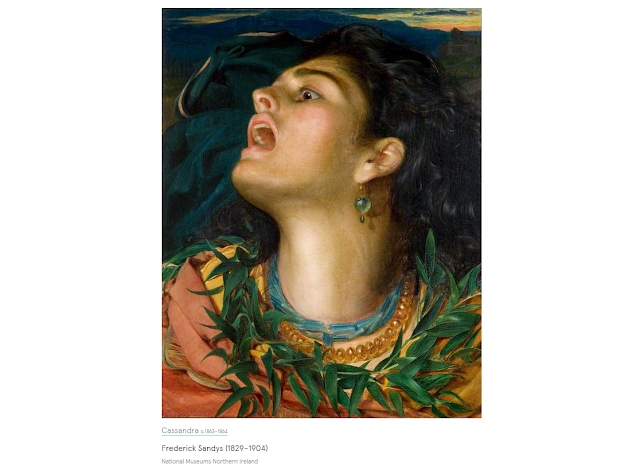
Hamlet as Cassadra

Image
Shakespeare’s Hamlet doesn’t merely have a number of allusions to prophets among its many biblical allusions; the play may serve as a reflection on what it means to be prophetic, and to strive to be more effectively and authentically prophetic, for both individuals and for art, and perhaps especially in politically dangerous contexts.  What does it help to oppose immoral and criminal behavior among the powerful, or in a corrupt system, if the result is that one’s life is snuffed out without reforming the corruption one spoke out against? What does it help to claim one is a prophet, sent to correct injustices and corruption, if one is part of the corruption (prince Hamlet in a reckless moment kills Polonius), or if one drives people away (Hamlet bids Ophelia get to a nunnery, offends his mother and uncle) instead of winning them over to one’s view? (In this way, many prophets are dismissed because they are imperfect messengers. Instead of heeding or debating the message, the st...

William Rossky on Hamlet & the Prophet Jeremiah

Image
In the fall of 1979, Hamlet Studies published a wonderful essay by William Rossky of Temple University titled, "Hamlet as Jeremiah." You can find it here: look for the October 1979 Volume 1.2 . The list of essays below that October issue seems to have the numbering wrong, as 2.1 instead of 1.2, so look for this: Rossky, William. “Hamlet as Jeremiah.” Hamlet Studies 1.2. (1979): 101-108. I have posted in the past on this blog regarding Jonah ( here and here ), and also  John the Baptist (a prophet figure from the Christian scriptures, or "New Testament"), as well as  the prophet Nathan in the King David stories of the Hebrew scriptures (or "Old Testament"). But Rossky's essay wonderfully makes clear that ideas and language from the Book of Jeremiah also influenced the language and ideas of the play. [The Prophet Jerimiah, painted by Michelangelo, circa 1508-12, Sistine Chapel, Vatican Palace, Vatican City; photo public domain by The Yorck Pro...

Two Late-Elizabethan Plays with Royal Incest & Jonah Themes

Image
[1] THE THEME OF SCANDALOUS ROYAL INCEST was to people of that late Elizabethan times something like the themes of resource wars and government lies about weapons of mass destruction after the US invasion of Iraq in 2003: The blockbuster film, Avatar, was released in December of 2009, about earthlings fighting a resource war for an energy source against the native population of a distant planet. About five months later, in May of 2010, Disney released the film, Prince of Persia, which was rightly criticized for casting too many Caucasian actors as the main characters and not enough of Middle Eastern descent; but a notable aspect of the plot involved lies about weapons of mass destruction possessed by a country that Persia would invade. The folly of corrupt government was on people’s minds, and therefore became a topic of popular entertainment. [2] IN THE LAST DECADE of the life of Elizabeth I , there were two very popular plays with a theme of incestuous royalty. Both of these...