Posts

Showing posts with the label Annunciation

Part 55: Ophelia's Overlapping Biblical allusions and plot echoes

Image
Many biblical allusions (or biblical plot and theme echoes) associated with Ophelia overlap in her character. All of these were well-known in Elizabethan times. (Not an exhaustive list): 1. Hebrews 12: 6-11 (suffering as a sign of God’s love for the “chosen” who will be “saved).[1] 2. JACOB, ESAU, AND RACHEL (lower right): the “double blessing” for Laertes, and the frustration of Hamlet and Ophelia’s hopes for a match, point to the bible tale of how Jacob wins the birthright by deceit, Esau gets the second blessing, and Jacob’s hopes to marry Rachel are at first frustrated.[2] 3. SALOME (top left): Claudius wants Ophelia and her brother Laertes to dance to his tune and serve his purposes: He uses Ophelia a bait to spy on Hamlet, and Laertes as co-conspirator to to kill Hamlet, who protests the incestuous marriage. Salome danced pleasingly for her stepfather, Herod Antipas, who offered almost any reward. His wife, Salome’s mother (divorced wife of his brother) told her to ask for the he...

Part 47: Ophelia's “O” and the Virtues of Nothingness

Image
Ophelia in Hamlet represents a paradox about both the injustice and virtue of nothing, emptiness, poverty: Ophelia is an intelligent young woman [1], lectured, silenced [2], taken for granted [3], told what to do, where to go [4], and whose death is linked to crown-envy [5], a cautious way for Gertrude to blame the envious actions of Claudius for Ophelia’s death. When Hamlet makes bawdy remarks at the playlet, “The Mousetrap,” Ophelia says, “I think nothing” [6]. In Elizabethan slang, women have “nothing” between their legs, while men have a “thing.”[7] “Nothing” is a theme in other Shakespeare plays: - A self-centered Richard II, losing his throne, says, “I must nothing be” [8]. - King Lear wants his favorite daughter Cordelia to be best at expressing her love for her father, but she refuses to play the game. Lear tells her “Nothing can come of nothing” [9]. By the end, Lear will be emptied and learn poverty. Many world religions emphasize the virtue of humility and spiritual povert...

Rethinking Ophelia and the Virgin Mary

Image
It is said that in the patriarchy of Shakespeare’s world, characters like Hamlet sort women into two categories: Virgin or whore. Ophelia and Gertrude can’t live up to an iconic model like the Virgin Mary. [1] In this way, we may view the Virgin Mary in a class by herself, sinless “Mother of God” who conceived Jesus by the Holy Spirit, and not by any man, and therefore to view Ophelia and Gertrude as far lesser mortals. [2] I will focus this post on Ophelia. I have come to believe, however, that it’s better to consider some of the many things Ophelia has in common with the Virgin Mary story rather than how Mary is in a class by herself. The story claims that Joseph, after a dream, did the honorable thing and married her (Matt 1:18-25). So the story is not merely about virginity, but also about treating a pregnant woman with compassion. If Hamlet had learned that he had made Ophelia pregnant, would he have acted in love to marry her? From his graveside declaration of his love (5.1.285...

Christmas and the sweep of the incarnation narratives in Hamlet

Image
It is often noted that in its first scene, Shakespeare's Hamlet contains one of the only explicit references to Christmas: Some say that ever ’gainst that season comes Wherein our Savior’s birth is celebrated, This bird of dawning singeth all night long; And then, they say, no spirit dare stir abroad, The nights are wholesome; then no planets strike, No fairy takes, nor witch hath power to charm, So hallowed and so gracious is that time. (1.1.173-179) [1] But the Christmas narrative is actually much longer than merely the story of Jesus' birth. It includes numerous other stories or episodes, each celebrated in gospel readings assigned to particular days in the church calendar. If we don't include all of Judaeo-Christian salvation history but merely the conception, birth, and childhood of Jesus, it begins with Mary being told by the Angel Gabriel that she has conceived by the Holy Spirit. This is called the Annunciation. Shakespeare's Hamlet alludes t...

Halloween Hamlet and SCSC conference in Minneapolis

Image
With, hoo! such bugs and goblins in my life... Hamlet 5.2.25 [1] This is my favorite Halloween-themed line in Hamlet , from the last scene, at the start of which Hamlet describes to Horatio how he discovered the letter with orders from Claudius for England to execute Hamlet (by beheading) upon their ship's arrival there. In the USA, we are approaching Halloween, the evening of 31 October, "All Hallows Eve," before All Saints Day. Children dress in costumes, go door to door and ask, "Trick or treat?" and often receive a treat of some kind. Usually too much manufactured sugary-candy (one of the reasons the USA has so many diabetics...). 2022 SCSC, Minneapolis: This Year, the Sixteenth Century Society and Conference has its convention in Minneapolis, Minnesota, only about an hour's drive from where I live. I will be giving a paper/presentation touching on how Shakespeare had to carefully encode his critique of government and the state religion, and h...

Religious and Political Meanings of the Annunciation and Susanna Allusions in Hamlet 3.1

Image
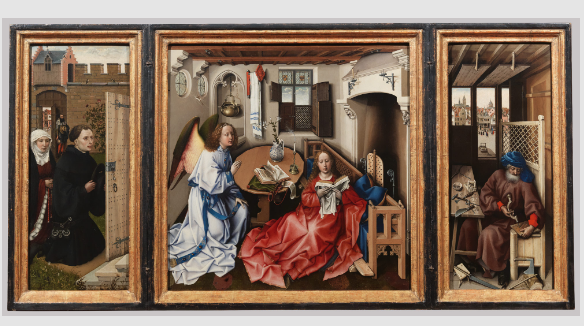
To prepare Ophelia as bait for eavesdropping, Polonius in 3.1 tells her, Read on this book, [...] [....] We are oft to blame in this, [...] that with devotion's visage And pious action we do sugar o'er The Devil himself. (49-55) So just look as if you’re devoted to reading, not bait for spying. But why “devotion's visage / And pious action”? “The Devil”? I’ve posted before about how Katharine Goodland (2006) [1] and Ruben Espinoza (2011) recognized that Polonius made Ophelia resemble a common image from old prayer books: the Virgin Mary is portrayed as reading a book of psalms when the angel Gabriel tells her that she is pregnant with Jesus (Lk 1: 26-38). [Robert Campin, Annunciation Triptych (Merode Altarpiece) in the MET museum (ca. 1427–32). Public domain. Image via Google Arts and Culture .] In Catholic prayer, the "Hail Mary" says, “Holy Mary, mother of God, pray for us sinners....” On seeing Ophelia, Hamlet says (aside), “in thy orisons...

Reactions to R. Chris Hassel, Jr.'s "Painted Women: Annunciation Motifs in Hamlet"

Image
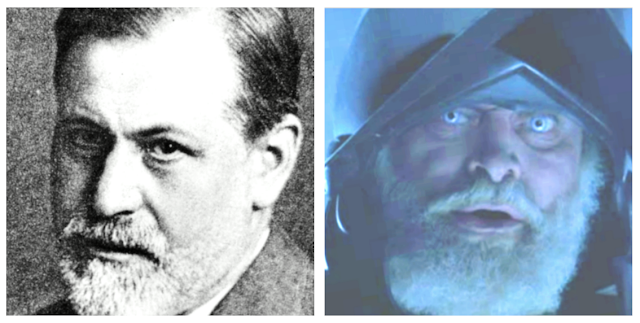
[MORE THAN A PASSING RESEMBLANCE? Was Freud reincarnated as Brian Blessed, who played the Ghost of Hamlet's Father in Branagh's 1996 Hamlet ? YOU DECIDE!] I had planned to blog this week about whether Horatio benefits from gratitude or regret (or whether he is more simply a foil for Hamlet) , and I still plan to blog on that topic soon. But I’m always looking for new books and articles to read about Shakespeare, Hamlet, and religious issues in the Early Modern period, and I came across the article, “Painted Women: Annunciation Motifs in Hamlet” by R. Chris Hassel Jr. It was published in the journal, Comparative Drama (Volume 32, Number 1, Spring 1998, pp. 47-84). I'll summarize some favorite ideas and use his essay as a spring-board for some of my own. I have been wrestling with Hassel’s insights, and there are many. As I’ve noted before in light of work by Katherine Goodland and Ruben Espinosa, when Polonius gives a prayer book to Ophelia, he wants her to appear li...

Ophelia's Prayer Book & the Annunciation of Mary

Image
In Hamlet act 3, scene 1, Ophelia's father Polonius asks her to read a book so that she might project "devotion's image" and "pious action" as well as her own loneliness when Prince Hamlet first sees her. In other words, he is using her for bait to trap Hamlet into conversation while Claudius and Polonius eavesdrop. I have written about this scene in a previous blog post regarding the echoes of the story of Suzannah and the Elders , from the book of Daniel. But today I want to note a visual echo of the Annunciation of Mary, when an angel visits to tell her that she is to bear a son, Jesus. [See Bridget Gellert Lyons, "The Iconography of Ophelia," page 61: "The woman with a book was reminiscent of countless representations of the Virgin, who was most commonly shown reading when the Angel of the Annunciation came to visit her." ELH , Spring, 1977, Vol. 44, No. 1, pp. 60-74 https://www.jstor.org/stable/2872526 ] In her remarka...