Posts

Showing posts with the label Servant-Prince

Part 47: Ophelia's “O” and the Virtues of Nothingness

Image
Ophelia in Hamlet represents a paradox about both the injustice and virtue of nothing, emptiness, poverty: Ophelia is an intelligent young woman [1], lectured, silenced [2], taken for granted [3], told what to do, where to go [4], and whose death is linked to crown-envy [5], a cautious way for Gertrude to blame the envious actions of Claudius for Ophelia’s death. When Hamlet makes bawdy remarks at the playlet, “The Mousetrap,” Ophelia says, “I think nothing” [6]. In Elizabethan slang, women have “nothing” between their legs, while men have a “thing.”[7] “Nothing” is a theme in other Shakespeare plays: - A self-centered Richard II, losing his throne, says, “I must nothing be” [8]. - King Lear wants his favorite daughter Cordelia to be best at expressing her love for her father, but she refuses to play the game. Lear tells her “Nothing can come of nothing” [9]. By the end, Lear will be emptied and learn poverty. Many world religions emphasize the virtue of humility and spiritual povert...
TRANSCRIPT: Presentation for Post Graduates, N.S.S. College, Kerala, India, 7 December, 2023

Image
TRANSCRIPT: Presentation for Post Graduates, N.S.S. College, Kerala, India, 7 December, 2023 Edited planned transcript of remarks delivered on 7 December, 2023, in an online presentation for the Post Graduate program, N.S.S. College, Kerala, India, 7 P.M. IST, 7:30 A.M. CST. (A few words and points below were cut from the live presentation for time considerations, and I made a few additional extemporaneous remarks, but for the most part, this is the transcript.) (I did not have time to talk about allusions that fit into the theme of orphaned children who find transcendent parents in others or in a heavenly parent, but perhaps some other time....) ~~~~~~~~~~~~~~~~~~~~~~~~~~~~~ Informal outline (followed by transcript): INTRODUCTION: [Disclaimers] - Contested times, contested scripture LIST OF BOOKS cataloging Bible allusions in Shakespeare, some open-access: Sleuthing scripture allusions in Hamlet CHANGE THOSE NAMES WITH YOU: Servant-Prince, & Renunciation of Fruits DOUBTING ...

Hamlet, Footwashing, Maundy Thursday, Hobbits, and Revelation

Image
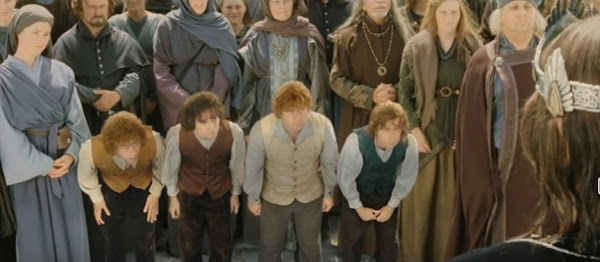
Echoes of Maundy Thursday in Hamlet (and Hobbits): [Image: Screen capture from YouTube clip of The Lord of the Rings: The Return of the King (2003), directed by Peter Jackson, Warner Bros. based on the book by J.R.R. Tolkien. Fair use.] [UPDATED 26 March, 2026] Maundy Thursday (or Holy Thursday, 2 April, 2026) begins what the Catholic Church calls the Triduum (Paschal or Easter Triduum).  “Maundy” comes from the Latin word for “command,” so Maundy Thursday gets its name from the Latin words once used at the opening of the Thursday service during Holy Week, and the gospel in which Jesus commands his disciples to love and serve others as he loved and served them.  It includes a ritual remembrance of Jesus washing the disciples’ feet  (John 13:1–17), with Jesus “New Commandment” to love and serve, an idea used by (sometimes antisemitic) Christians to differentiate from the Ten Commandments of Moses. [1] There are echoes of this in Hamlet 1.2, when Horatio enters, he has t...

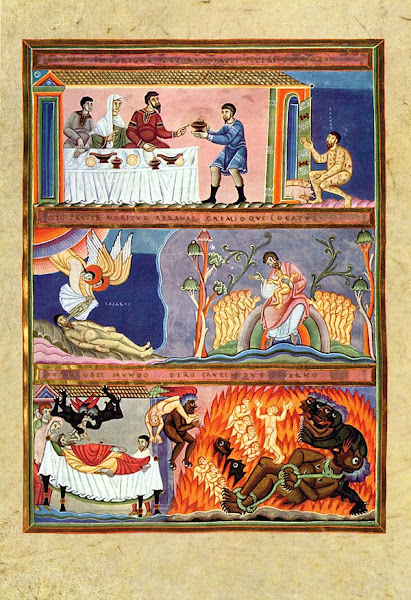
In service of art: How visual arts may have influenced the Lazarus theme in Hamlet - part 18

Image
VISUAL ART INFLUENCING THE LAZARUS THEME IN HAMLET Scholars often think of how texts influence other texts. But what about other arts influencing texts? Some scholars consider this, but it seems that they are not in the majority. By the time Shakespeare wrote or revised his version of Hamlet for the stage, the Luke 16 tale of the rich man and Lazarus already had centuries of history of being interpreted in many forms, perhaps not only for a folksong-ballad whose origins may be older than Shakespeare ,* but also by sculptors and artists. * ( Another reference regarding an Elizabethan version of the ballad, noted by Bronson : "Bronson (Vol. II, p. 17) writes: "CHILD NO. 56: As Child's note informs us, something on the order of this ballad was in print in early Elizabethan times, and seventy-five years later was still matter for common allusion as 'the merry ballad of Diverus and Lazarus.' No early text survived, how ever, and Child had to resort to nineteenth-c...