Posts

Showing posts with the label projecting

NO ONE TELLS OPHELIA that Hamlet killed her father (Ophelia Postlude)

Image
Ophelia and Laertes know their father’s burial was abbreviated and secretive [1]. Claudius says, For good Polonius’ death, and we have done but greenly In hugger-mugger to inter him… [2] Claudius confides in Laertes that Hamlet killed his father [3]: This suits his purposes, to enlist the help of Laertes to kill Hamlet without Claudius revealing that he killed his brother, the king. But Claudius does not reveal to Ophelia how her father died. While he confides in Laertes, Ophelia is drowning [4]. There is no scene in Hamlet in which a character tells Ophelia that Hamlet killed her father. None. No character refers to Ophelia having been told, or knowing it, or finding out via gossip from Elsinore guards or servants. This may *not* be a small point: It is one thing to assume that Ophelia should be defined mostly by her familial and romantic relationships, and to have gone mad merely because of them. Yet it is very different for her to be defined by political awakenings, to have - lov...

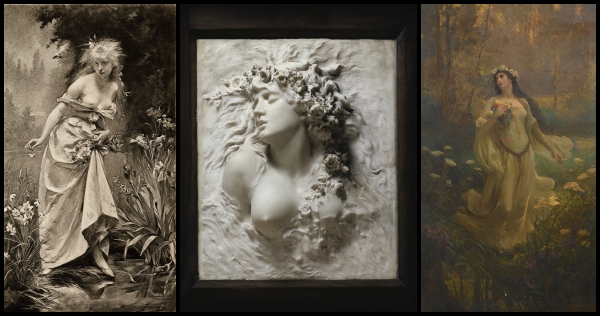
Part 10 (B): Ophelia via Elaine Showalter’s 1985 “Representing”

Image
Excerpts from Elaine Showalter, “Representing Ophelia: Women, Madness, and the Responsibilities of Feminist Criticism” [1]: …Though she is neglected in criticism, Ophelia is probably the most frequently illustrated and cited of Shakespeare’s heroines.(282) …Why has she been such a potent and obsessive figure in our cultural mythology? [...] how should feminist criticism represent Ophelia in its own discourse? What is our responsibility towards her as character and as woman? …Shakespeare gives us very little information from which to imagine a past for Ophelia.  [...] Her tragedy is subordinated in the play; unlike Hamlet, she does not struggle with moral choices or alternatives. [283] [PF note: Showalter’s essay is an important one, but on this point I would disagree: Ophelia struggles to know what to think of Hamlet’s love and perhaps her good fortune, to grasp what it may mean to become Denmark’s next queen; she struggles against disapproval of her brother and father, against ...

Part 10: Ophelia via Elaine Showalter’s 1985 “Representing”

Image
Excerpts from Elaine Showalter, “Representing Ophelia: Women, Madness, and the Responsibilities of Feminist Criticism” [1]: …Though she is neglected in criticism, Ophelia is probably the most frequently illustrated and cited of Shakespeare’s heroines.(282) …Why has she been such a potent and obsessive figure in our cultural mythology? [...] how should feminist criticism represent Ophelia in its own discourse? What is our responsibility towards her as character and as woman? …Shakespeare gives us very little information from which to imagine a past for Ophelia.  [...] Her tragedy is subordinated in the play; unlike Hamlet, she does not struggle with moral choices or alternatives. [283] [PF note: Showalter’s essay is an important one, but on this point I would disagree: Ophelia struggles to know what to think of Hamlet’s love and perhaps her good fortune, to grasp what it may mean to become Denmark’s next queen; she struggles against disapproval of her brother and father, against her...