Hamlet's Real or Feigned Grief - via Rebecca Mead on Andrew Scott in Robert Icke's Hamlet
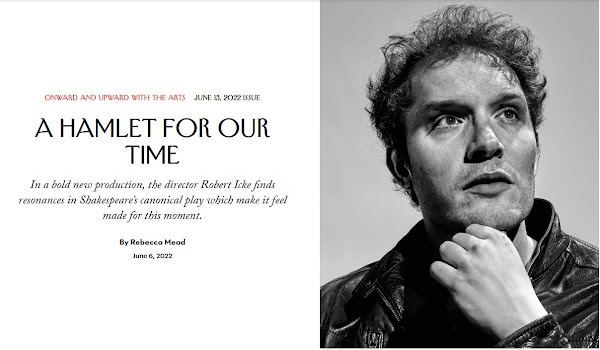
When Hamlet is seen for the first time in the first act, second scene of Shakespeare's play that bears his name, is he wearing black because he is just a spoiled boy having a tantrum because he didn't get to be king, or can we take him at his word that he is in deep grief? Excerpts from Rebecca Mead’s 6/6 New Yorker article on Robert Icke’s Hamlet stood out to me in part because of the emphasis on real rather than feigned grief, or “Hamlet as neurotically indecisive or Oedipally compromised”: [Photo by Jeff Brown for the Ney Yorker. Fair use.] ~~~~~ [...] Icke first staged “Hamlet” in 2017 [...] with Andrew Scott in the lead role [...]. Scott was then best known for his performance as Moriarty, on “Sherlock” [...] The production, in which Denmark was imagined as a chilling surveillance state, incorporated the use of video to powerful effect—the Ghost is initially observed on grainy security footage—and was heralded for its emotional veracity. Especially praised was the i...
