Posts

Showing posts with the label gravedigger

Yorick, the Gravedigger, Emmaus, and St. George (Emmaus Postlude, Part 8)

Image
The name Yorick [1] may come from the same root as St. George [2], patron saint of England since 1348 : from the Greek “Georgios”: from ge (γῆ)  - 'earth, soil' - and ergon (ἔργον), 'work' [3]. Yorick, as “earth worker.”   The gravedigger in Shakespeare’s Hamlet is called “Goodman Delver” by his friend (5.1.14). - So the gravedigger and Yorick echo one another in more ways than foolery… This relates also to my series on the Emmaus echo in 5.1, the graveyard scene: the story of Jesus’ appearance to the disciples on the road to Emmaus [4] was a gospel read in church on the first Monday after Easter every year of Shakespeare’s life [5]. In that gospel, two disciples on the road are mourning the death of Jesus. They meet a stranger (somehow a real or figurative Jesus, unrecognized [6]) who shows them compassion, listens, scolds them for their flawed thinking, and gives them hope, explaining the scriptures to them. These are all things Jesus had done for them. The disciple...
Shepherds in Shakespeare, Oedipus, Hamlet, and the Bible

Image
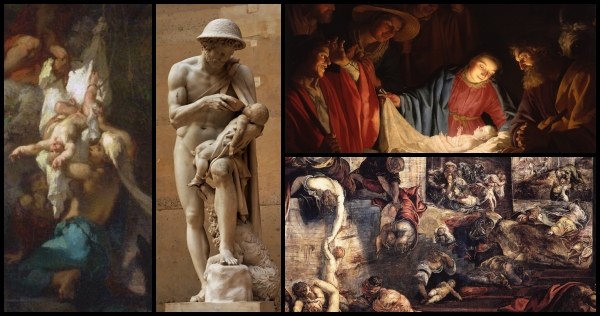
Shakespeare’s Hamlet is often analyzed in terms of Freud’s theories that draw upon the Greek tale of Oedipus. When Hamlet blindly stabs Polonius behind the arras, this may resemble Oedipus unknowingly killing his own estranged and bullying father on the road. Hamlet refers to Herod, possibly Herod the Great or his son, Herod Antipas. A few days after Christmas, Christian churches commemorate Herod the Great’s slaughter of innocent boys. The tale claims that Herod heard of the birth of a new king of Israel, so he tried to avoid being replaced by killing all young male infants (collage, bottom right) [1]. Shepherds in the gospel tale choose a different path: They hear from angels of the birth and go to adore the infant Jesus (collage, top right) [2]. The shepherds could be said to mediate between angels and Jesus, who will come to be called a “good shepherd.” . In the Oedipus tale, Laius, father of Oedipus, fears a prophecy that his son will one day kill him; he tells his wife Jocasta...

Part 13: Ophelia, Hamlet, and 13 ways of looking at madness

Image
Often we speak of Ophelia as having really gone mad, while Hamlet only pretends . But in fact the play uses the word “mad” in many ways, as do critics. So, with a nod to Wallace Stevens’ poem title [1], a list: MADNESS AS DEMONIC POSSESSION: Horatio worries that the ghost is demonic and “might deprive [Hamlet] sovereignty of reason / And draw [him] into madness” (1.4.77-82). MADNESS AS FEIGNED: After meeting with the ghost (1.5), Hamlet says he will “put on” “an antic disposition” (1.5.189-192), as did Odysseus, King David, and Amleth in the Saxo Grammaticus source; but Hamlet’s encounter with the ghost may actually be driving him insane… [Edit 9/24/2023: In 3.1.7-10, Guildenstern also comments on Hamlet's feigned madness: "Nor do we find him forward to be sounded, But with a crafty madness keeps aloof When we would bring him on to some confession Of his true state." ] MADNESS AS WHAT LOST LOVE CAN DO: Polonius believes Hamlet has been made insane by the los...

Part 7: Ophelia's Gravedigger: They "sat on her"

Image
We should resist the temptation to treat the gravediggers and their clowning in Hamlet 5.1 as mere comic relief: They prepare audiences and readers to view the “churlish priest” more critically. GRAVEDIGGER  Is she to be buried in Christian burial, when she willfully seeks her own salvation? [1] (Shouldn’t all people seek their own salvation? “Willfully” suggests a parody of the Protestant idea that we are saved by “faith alone,” not by works. But by Gertrude's account, it is not at all clear that Ophelia committed suicide - it is a mystery - so why assume?)   OTHER  I tell thee she is. Therefore make her grave straight. The crowner hath sat on her and finds it Christian burial. GRAVEDIGGER  How can that be, unless she drowned herself in her own defense? [2][3] (The gravedigger mangles “The coroner’s inquest sat to consider her death,” which becomes “The crowner hath sat on her.” Funny but disturbing, to sit on the corpse of a drowned woman. The original spelling wa...

Part 1: The Controversy over Ophelia's Death in Hamlet

Image
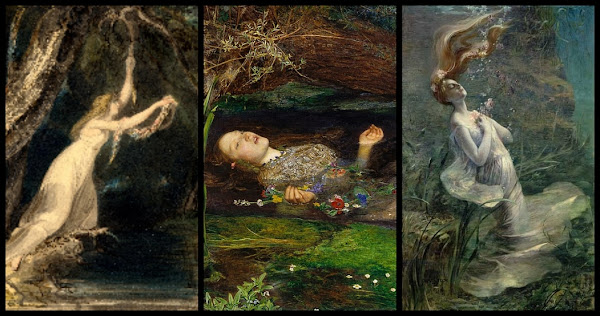
If you ask an average Shakespeare reader or viewer to tell you how Ophelia dies in Hamlet, many might say “suicide,” or “she drowns herself.” But the play presents a controversy of at least seven interpretations of her death, ranging from accident to suicide. [1] These are represented by 1. Gertrude; 2. the king (implied); 3. the Coroner’s Inquest; 4. the Gravedigger-clowns; 5. Hamlet; 6. the “churlish priest”; and 7. Laertes. Some of these agree more with the others, some not. Educators often say it’s good to “teach the controversy,” so instructors might have students seek, document, and reflect on the position of each party, as well as other possibilities (with or without evidence). 1. GERTRUDE offers the earliest account of Ophelia’s death, saying Ophelia fell in the brook while decorating a willow with flowers, when an “envious sliver” of a bough broke [2]. Her garments helped her float for a while [3], but they became “heavy with their drink” and “Pulled” her “To muddy...

"The rest is silence": Musical Notation, Nihilism, and Ambiguity

Image
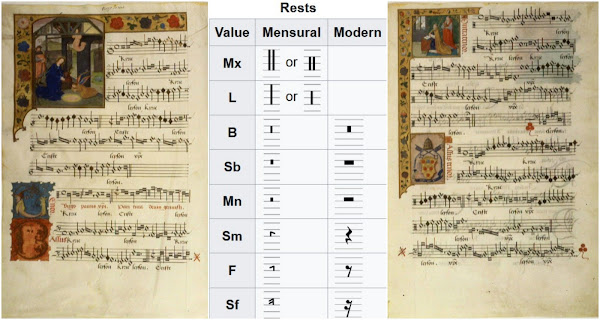
"The rest is silence." When Shakespeare scholars write about Hamlet's last words, more often than not, their focus is that Hamlet is being serious, even nihilistic. Too few critics and scholars consider that Hamlet is making a musical pun for Horatio (and for theater audiences) with his last breath: The rest (in musical notation) is silence. Hamlet is, after all, not only the son of King Hamlet and Queen Gertrude, but also the spiritual offspring of Yorick the fool. His first words in the play involve a sarcastic pun: His uncle Claudius calls Hamlet his son, and Hamlet says he is “too much in the sun.” (1.2.69) [1] He makes fun of Polonius, who deserves it: POLONIUS: What do you read, my lord? HAMLET: Words, words, words. POLONIUS What is the matter, my lord? HAMLET Between who? POLONIUS I mean the matter that you read, my lord. HAMLET Slanders, sir; for the satirical rogue says here that old men have gray beards, that their faces are wrinkled,...

Emmaus Key Change in Hamlet & Merchant of Venice (Emmaus in Hamlet, part 6)

Image
When a song or orchestral piece changes keys, we not only hear it with our ears, but also feel it in our bodies, our bones, vibrating at a new frequency. Shakespeare accomplishes something similar, not only in Hamlet , but also in The Merchant of Venice when he sets up one character as a Christ-figure, then changes key, shifting to a new (improved) Christ figure. [Image: “Supper at Emmaus” (French: Le Repas d'Emmaüs), 17th century, by Matthias Stom (1615–1649). Collection: Museum of Grenoble. Public domain, via Wikimedia .] In Luke 24:13-35, after Jesus dies and rises, he later appears as a stranger on the road to Emmaus. I’ve noted previously how in Hamlet , biblical allusions suggest the ghost is a flawed Christ-figure/victim, with divine attributes.[1] But in the graveyard scene (5.1), instead of the ghost appearing as the stranger[2], our expectation is redirected: Yorick’s skull and the gravedigger-clown fill the role of the stranger in whom divine "infinite jest...

Heresy in Hamlet 5.1 Emmaus figures: Part 2

Image
My last post explained potentially blasphemous implications of offering a fool (Yorick or the gravedigger) as the Emmaus figure in Hamlet 5.1. I will explore other heretical or atheistic implications of the graveyard scene’s Emmaus echo in this post. [Image: Painting by Caravaggio(1571–1610) "Supper at Emmaus," 1606. Collection: Pinacoteca di Brera. Pubic domain, via Wikipedia .] If you missed that previous post, you can find it here : https://pauladrianfried.blogspot.com/2022/05/blasphemy-and-heresy-in-hamlets-emmaus.html In Shakespeare’s time (as now), the tale of Jesus’ appearance to the disciples on the road to Emmaus after his crucifixion [1] was commonly read as a tale of miraculous power. This Jesus, supernaturally and gloriously resuscitated, was one with God, omnipotent and capable of anything: to appear in a locked room, or to prevent disciples from recognizing him. This may have distorted the original meaning of the tale: The disciples may have met a st...