Posts

Showing posts with the label Henry VIII

Hamlet's Use of the Trojan War & Consequences of the Judgment of Paris

Image
Why does Shakespeare’s “Hamlet” refer to the Trojan war? Some may think that Trojan War references in Shakespeare merely represented a Renaissance obsession with things Greek. But the Trojan War speech in Hamlet also alludes to (1) a Greek-themed Marlow play [1]; (2) the widow Hecuba’s grief [2] (a contrast with Gertrude); (3) the pause of Pyrrhus (like Hamlet hesitating to kill Claudius at prayer) [3]. When the players arrive in Elsinore and perform a speech at Hamlet’s request, he asks for a speech about Hecuba, mother of Paris, witnessing the revenge killing of her husband, King Priam. Priam is about to be killed by Pyrrhus, son of Achilles, in revenge for Priam's son Paris having killed Pyrrhus’ father. Revenge begets revenge and more grieving widows, a terrible cycle. Appropriate for Hamlet. “The Judgment of Paris” involves Paris having to choose the fairest goddess. Each goddess offers bribes, with Aphrodite promising Helen of Troy. Paris chooses Aphrodite, and soon abducts ...

Hamlet, John the Baptist, and Jesus as Symbolically Political

Image
My previous post noted that Hamlet alludes to John the Baptist [1]. Consider the religious, symbolic, and political significance of John baptizing at the Jordan [2], for Jews who knew their founding story by heart, that Moses led their ancestors through parted waters of the Red Sea to freedom and a promised land, escaping a foreign oppressor [3].  John at the Jordan plays into the same tropes, where Rome (not Egypt) is the foreign oppressor (which in part explains why Rome and Herod Antipas saw him as a threat). England’s Henry VIII claimed he needed to repent of incest, had seen action in battle, but was thought to have died a sinful man, guilty of foul crimes. Hamlet deals with an incestuous king and the ghost of a king, fearsome in battle, who died with sins on his soul, foul crimes. Same tropes. Hamlet alludes to both Julius Caesar and Jesus. Consider Jesus, preaching where Roman coins bore the image of a Roman emperor [4] with an inscription calling the emperor “son of a go...

Why Claudius as a (Thomas) "More" was an insult in Hamlet 3.4

Image
Thomas More and Hamlet’s uncle Claudius were both, in their own ways, defenders of incestuous marriage. More would not agree to Henry VIII’s plan to break from Rome to get his divorce from his first wife, a marriage that the church had considered incestuous from the start: Henry and Catherine had to ask Rome for special permission to marry in the first place [1]. So for Hamlet to refer to Claudius as a “moor” - meaning also a “More” - would be entirely appropriate.  In Act 3, scene 4, when Hamlet refers to his father favorably as a “fair mountain” and his uncle insultingly as a "moor," to the Elizabethan ear, audiences heard no difference between "moor," or "Moor," or the last name of Thomas More [2].  Today, many may consider Thomas More a martyr for conscience who opposed Henry’s quest for divorce [3]. There is nothing wrong with this view, but it is incomplete: It doesn’t consider how some Elizabethans understood More.  By the end of her life, Elizabe...

Does our Sir Thomas More differ from Hamlet's?

Image
How might a 21st century view of Sir Thomas More differ from Hamlet’s?  Catholic worship was illegal in England until 1791 [1]. More was beatified in 1886, canonized a saint in 1935.  In 1960 JFK became the first Catholic US president [2].  Robert Bolt's “A Man for All Seasons,” a play about More that won a 1962 Tony Award, had by the time of JFK’s 1963 assassination finished a successful Broadway run of 637 shows since 1961 after its London debut [3]. The hero of the play, More would not support Henry VIII's quest for a divorce from his first wife, resulting in his execution, a martyr for conscience.  Henry had sought special permission (‘dispensation’) to marry his dead brother’s widow (the church usually considered such marriages incestuous), but after 24 years of marriage and a daughter, Henry famously changed his mind after his affair with Anne Boleyn, and no thriving male heirs.  Shakespeare used More’s historical writing as a basis for Richard III, and ...

Claudius as Truths Told Slant (Claudius series, Part 23)

Image
Emily Dickinson famously wrote, “Tell the truth, but tell it slant” [1]. In the character of Claudius, Shakespeare does this in a number of ways: He retells an old Danish tale about a murderous king who married his brother’s widow (echoes of Henry VIII [2]). He changes the uncle’s name from Feng to Claudius, associating him not only with literary villains in Arthurian tales [3.a., 3.b.] and in Chaucer [4], but also with Rome and two Roman emperors - Claudius II, who ordered the execution of St. Valentine (as King Claudius ordered the execution of Ophelia’s Valentine) [5], and Claudius I, who married his niece and invaded England [6]. Shakespeare associated the uncle with Rome in these ways during the English Reformation, when Protestantism and Rome were at odds, executing traitors and heretics; when Elizabeth had been excommunicated by two Roman Catholic popes [7]; and when Rome enlisted Philip II of Spain (who had proposed to Elizabeth in 1559) and its Armada to attempt invasions of...

WHY CLAUDIUS GOES UNNAMED EXCEPT IN STAGE DIRECTION (part 16, Claudius series)

Image
CLAUDIUS UNNAMED: Why – at the end of the reign of Elizabeth I – would Shakespeare have characters in Hamlet be silent regarding the king’s name, in a play involving an “incestuous marriage” in which the king marries his older brother’s widow? Some things could not be named. In the minds of audiences, the incestuous marriage would seem uncomfortably close to the first marriage of Henry VIII. For similar reasons, Richard II could not include the deposition scene when first published [1], and Shakespeare’s collaboration with John Fletcher on Henry VIII was not written or enacted until 1613 [2]. Why? Censorship, fear, and tact. Everyone knew that - Henry VIII, Elizabeth’s father, had married his older brother’s widow, and later divorced her, claiming it an incestuous marriage… - and that Elizabeth was sometimes called a “bastard queen”: Henry and Anne Boleyn had conceived Elizabeth out of wedlock; Elizabeth was born only three months after a secret marriage, making her ineligible in th...

The 5th Day of Christmas - Rewriting History To Erase the Assassination of Thomas Becket (Series, Part 5.a.)

Image
Thomas Becket, Archbishop of Canterbury and Primate of England, was assassinated in the middle of the Christmas season, on 29, December, 1170. He was canonized quickly in February of 1173, considered a martyr and a kind of folk hero for resisting expansion of royal authority over things then believed to be matters of the church. Henry II was forced to apologize and to do penance for his role (intentional or not) that prompted Becket’s killing. Nearly four centuries later, about five years after Henry VIII had first sought annulment from his first wife to marry his mistress, Anne Boleyn, Henry broke from Rome, became head of England’s church, and received an English annulment instead of a Roman one. In another five years, he (along with Protestant reformers) suppressed Becket veneration and pilgrimage, claiming it idolatrous, disliking the idea of superstitious miracles that transcended scriptural truth. Henry didn’t want his power over his church to be challenged or limited by a Beck...

Part 41: Love Madness: Ophelia, Gertrude, and Helen of Troy

Image
QUEEN: [...] for your part, Ophelia, I do wish That your good beauties be the happy cause Of Hamlet’s wildness. So shall I hope your virtues Will bring him to his wonted way again, To both your honors. OPHELIA  Madam, I wish it may.  (3.1.42-47)   Queen Gertrude expresses hope that Ophelia’s father Polonius may be correct in thinking that Hamlet is mad for the loss of Ophelia’s love. Shakespeare often described love as a madness in need of a cure.[1] This may be more significant than one might assume at first glance, for at least three reasons.   First, Gertrude’s comments apply not only to her son but also to her new husband, even if she doesn’t know it. For Claudius to kill his brother and take the throne and his brother’s wife seems a kind of madness. Gertrude’s “virtues” were not enough to cure him. Secondly, “The face that launched a thousand ships” is the famous Christopher Marlowe line describing the beauty of Helen of Troy. To steal her, Paris risked war, w...

The Affair of Gertude and Claudius in light of Anne Boleyn

Image
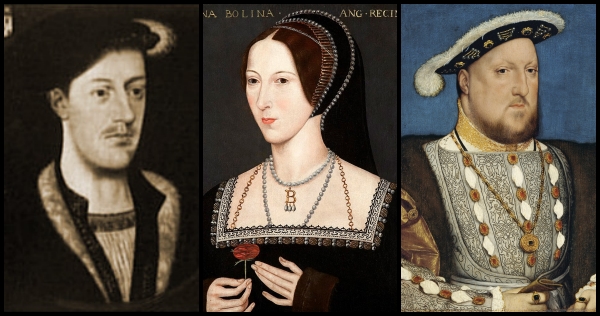
When audiences and readers in our time encounter Hamlet, they may wonder: What is the fuss about a royal affair, and a queen marrying the brother of her dead husband? Royals had affairs often, and it’s now legal in many places to marry the sibling of a deceased spouse. I have blogged in the past about Claudius, Gertrude, and the adulteries and alleged incest of Henry VIII [1], but it is also important to consider Gertrude and Claudius in light of the accusations of adultery and incest against Anne Boleyn. Many know that Henry’s second wife, Anne Bolelyn, was accused of adultery, incest, and treason, and beheaded for it. Fewer are aware that five men were accused of various things in association with Anne’s scandal (adultery, incest, treason, plotting assassination), and were also executed. These included George Boleyn, Viscount Rochford (the Queen’s brother); Henry Norris, Mark Smeaton (musician at court), William Brereton, and Francis Weston (thought to be his image at left). So not o...

Three challenges to teaching about incestuous marriage in Hamlet

Image
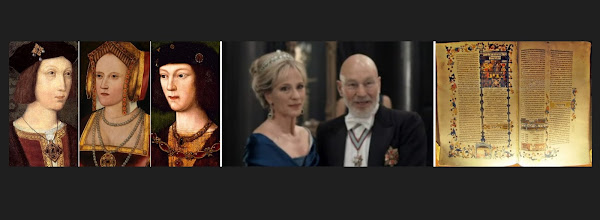
There are always challenges to teaching Hamlet, in part due to the historical and cultural gaps between the original audiences for whom Shakespeare was writing, and that of today’s students. When teaching about the “incestuous” marriage of Claudius and Gertrude, one may find challenges especially in at least three areas: Definitions, religious considerations, and trigger warning issues. [Left to right: Arthur Tudor, Prince of Wales (1486-1502), "regarded as the only surviving contemporary portrait"; circa 1500. Anglo-Flemish School. Private collection, Hever Castle, Kent. Public domain. Image via Wikimedia. Catherine of Aragon (1485–1536), originally identified as Catherine Parr, but now recognized as Catherine of Aragon. Unidentified painter. 16th Century. Lambeth Palace. Public domain, via Wikimedia. Henry VIII of England (1491-1547), circa 1509. Attributed to Meynnart Wewyck. Denver Art Museum. Public domain. Image via Wikimedia. Penny Downie as Gertrude, and Patri...