Posts

Showing posts with the label Ironic Bible Allusions

(Part 6) Hamlet in 3.2 as boy Jesus: Plucking mysteries' hearts?

Image
~~~~~~~~~~~~~~~~~~~~~~ INDEX OF POSTS IN THIS SERIES: https://pauladrianfried.blogspot.com/2023/01/index-hamlet-in-32-as-boy-jesus-lost.html ~~~~~~~~~~~~~~~~~~~~~~~~~~~~~~~~~~~~~~~~~~~~~~~~ When Hamlet implies after The Mousetrap that he and his parents are like (or ironically unlike) the boy Jesus and the Holy Family, [1] we have an analogy: Hamlet, his mom Gertrude and uncle/stepdad Claudius on one side, Jesus, his mother Mary and stepdad Joseph on the other.  Some analogies may seem simple and straightforward: The moon is like a pearl in the night. But what if both elements of the analogy are mysterious, ambiguous, moving targets? That is the case with Hamlet and Jesus. HAMLET IS NOT YOUR AVERAGE REVENGER: He wants to be sure his uncle is guilty, to avoid killing the wrong man.[2] Soon after Hamlet thinks he can be sure, he kills the wrong man - Polonius, by accident.[3] This is not your average revenger. Peter Lake says that Hamlet the play is a hybrid of four genres: Rev...
(Part 5) The targets of Hamlet's 3.2 ironic allusion to Luke 2:46-52

Image
~~~~~~~~~~~~~~~~~~~~~~ INDEX OF POSTS IN THIS SERIES: https://pauladrianfried.blogspot.com/2023/01/index-hamlet-in-32-as-boy-jesus-lost.html ~~~~~~~~~~~~~~~~~~~~~~~~~~~~~~~~~~~~~~~~~~~~~~~~ As previously suggested in this series (especially Part Four),[1] Hamlet’s subtle allusion [2] to the boy Jesus among the temple elders [3] is an ironic allusion, perhaps deeply ironic, rich and complex. But who is the target of this irony, and who is aiming it? AIMED BY HAMLET AT ROSENCRANTZ Rosencrantz had been sent to tell Hamlet that his uncle is angry and his mother is upset that Hamlet angered his uncle. So Hamlet jokes that he amazed and astonished his mother Gertrude, like Jesus did his parents and the temple elders. Eager to please king and queen, Rosencrantz may not get the joke. (More irony.) BY HAMLET, AT HIMSELF Hamlet may be aware that as a revenger, perhaps called to his task by heaven and hell [4], he is no Jesus among temple elders. BY HAMLET, AT MOTHER & UNCLE Hamlet...

(Part 4 ) Dissonance and Irony in Hamlet's 3.2 Allusion to Luke 2

Image
~~~~~~~~~~~~~~~~~~~~~~ INDEX OF POSTS IN THIS SERIES: https://pauladrianfried.blogspot.com/2023/01/index-hamlet-in-32-as-boy-jesus-lost.html ~~~~~~~~~~~~~~~~~~~~~~~~~~~~~~~~~~~~~~~~~~~~~~~~ IRONY: In the third act, Hamlet makes a subtle allusion, implying that he astonishes his mother like the boy Jesus astonished his mother the Virgin Mary and amazed the temple elders. - But in spite of all the points of similarity listed in my last post [1] regarding Hamlet’s allusion, there may be even more ways in which Hamlet is quite different from the boy Jesus. The tension or dissonance between these similarities and differences is an important source of irony. (For a comparison of the relevant Hamlet text [2] to the relevant gospel text from Luke, [3], see Part 1 of this series [4].) HOW IS HAMLET UNLIKE THE BOY JESUS? A non-exhaustive list: 1. Hamlet is a revenger. Audiences may assume that a revenger is so controlled by passion for revenge that he risks his own damnation. Not like Jes...

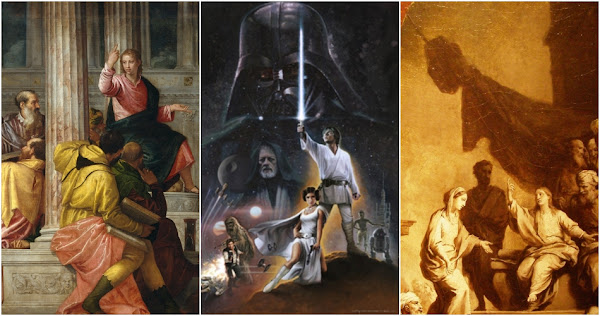
(Part 2) Hamlet as boy Jesus among Temple Elders: Historical-Artistic Background

Image
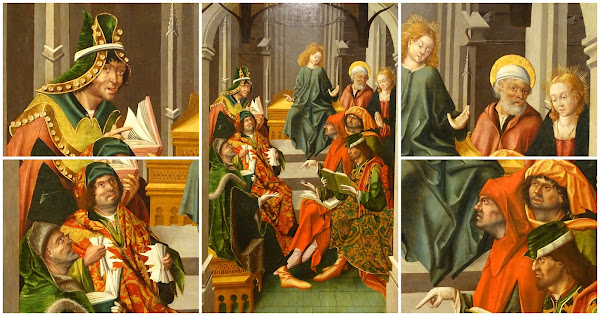
~~~~~~~~~~~~~~~~~~~~~~ INDEX OF POSTS IN THIS SERIES: https://pauladrianfried.blogspot.com/2023/01/index-hamlet-in-32-as-boy-jesus-lost.html ~~~~~~~~~~~~~~~~~~~~~~~~~~~~~~~~~~~~~~~~~~~~~~~~ Because of our past experience (in school, at performances, or even familiarity with past critical tradition), we may assume too quickly that we fully understand the possible meanings that we discover when we encounter a scene with an allusion in the Shakespeare text . Often we also assume too quickly that we understand fully what is being alluded to and it's significance. Reading more critical commentary on Shakespeare, or researching, or discussing a play, has the potential to jolt us out of our perhaps too-limiting assumptions about the text. In the case of biblical allusions (as Stephen Greenblatt explores in Hamlet in Purgatory), looking at historical paintings and illustrations also has the potential to jolt us out of too-limiting assumptions and reveal helpful insights. Some might sa...