Posts

Showing posts with the label Laertes

What does it feel like to be Laertes in Hamlet 5.2.324?

Image
What does it feel like to be wrong? In Shakespeare's Hamlet, Claudius had conspired with Laertes to poison Hamlet with a rapier and a chalice of wine. Hamlet apologizes for the death of Polonius: “I shot mine arrow over the house and hurt my brother” - an accident, blaming madness [1]. Laertes sees the queen drink deeply from the poison chalice. Laertes knows she will die. Witnessing her, Laertes hesitates. Kill Hamlet, now? He says in an aside:  “yet it is almost against my conscience.” (5.2.324) But he is too committed to the plan, so he goes ahead. What does it feel like to be Laertes in that moment?  In her book, “Being Wrong” (2010), award-winning author Kathryn Schulz notes that being wrong often feels exactly like being right. When Laertes goes ahead with the murderous poisoning plan, when the crucifier follows orders and nails Jesus to the cross, when the Nazi starts up the gas chamber, some people are so committed to a false ideology that they don’t realize (as Lae...

NO ONE TELLS OPHELIA that Hamlet killed her father (Ophelia Postlude)

Image
Ophelia and Laertes know their father’s burial was abbreviated and secretive [1]. Claudius says, For good Polonius’ death, and we have done but greenly In hugger-mugger to inter him… [2] Claudius confides in Laertes that Hamlet killed his father [3]: This suits his purposes, to enlist the help of Laertes to kill Hamlet without Claudius revealing that he killed his brother, the king. But Claudius does not reveal to Ophelia how her father died. While he confides in Laertes, Ophelia is drowning [4]. There is no scene in Hamlet in which a character tells Ophelia that Hamlet killed her father. None. No character refers to Ophelia having been told, or knowing it, or finding out via gossip from Elsinore guards or servants. This may *not* be a small point: It is one thing to assume that Ophelia should be defined mostly by her familial and romantic relationships, and to have gone mad merely because of them. Yet it is very different for her to be defined by political awakenings, to have - lov...

Seven ways Hamlet might see a mirror of himself in Laertes

Image
It is often said that Laertes is a foil for Hamlet. Hamlet says he sees his own image in Laertes: But I am very sorry, good Horatio, That to Laertes I forgot myself, For by the image of my cause I see The portraiture of his. (5.2.85-88) Later in the scene, the word “foil” is used five times, usually by Hamlet, punning on foil as weapon and as mirror image. Jesus claimed that the greatest commandment is to love God, and the second, "like it," to love neighbor as self (Mark 12:28-31; Matthew 22:34-40). One’s neighbor may be a sort of concrete local manifestation of God, “the least of these,” or of transcendence and mystery. To love neighbor as self, it helps to look with compassion, willing and able to see oneself in one’s neighbor, and one's neighbor in oneself. But how might Hamlet see his image in Laertes? How might we? Consider seven ways, the last of which Hamlet may recognize only too late: 1. Both have fathers unjustly killed, and both are inclined toward revenge. 2....

INDEX: Holding up The Odyssey as mirror in Hamlet

Image
From August 4-23, 2022, I did a series exploring how Shakespeare seems to have had The Odyssey in mind when he named Ophelia's brother Laertes (the father of Odysseus also had that name): In the same way that the family of Odysseus tries to defend his wife Penelope against suitors while he is away at war, Polonius and Laertes try to defend Ophelia against suitors. This was prompted in part by Asimov's book on Shakespeare, in the section on Hamlet , where he briefly mentions this name, Laertes, which stand out like a sore thumb, and which does not sound very Danish. Below is the INDEX to these posts: 1. Laertes in Hamlet & the Odyssey - Part 1: https://pauladrianfried.blogspot.com/2022/08/laertes-in-hamlet-odyssey-part-1.html 2. Laertes in Hamlet & the Odyssey - Part 2: https://pauladrianfried.blogspot.com/2022/08/laertes-in-hamlet-odyssey-part-2.html 3. Seeking Penelope in Ophelia & Hamlet: Laertes & The Odyssey - Part 3: https://pauladrianfried...

Part 54: Ophelia, like Jesus, preaching against hypocritical libertines (deconstructed?)

Image
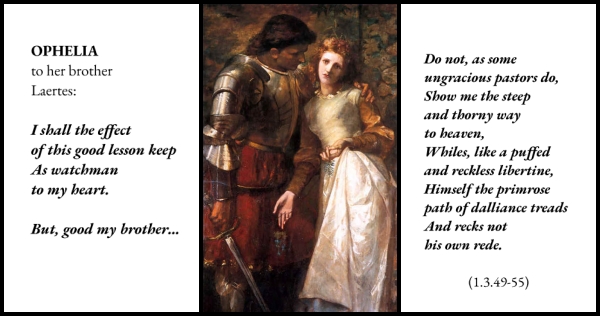
Ophelia’s first biblical allusion made her sound, to Elizabethan ears, like Jesus condemning hypocrisy and corruption of authorities. She targets her brother as a potential hypocrite and “libertine.” Laertes warns her not to get too close to Hamlet, that he is above her station, warning her not to lose her chastity to him. Ophelia responds kindly but strongly: I shall the effect of this good lesson keep As watchman to my heart. But, good my brother, Do not, as some ungracious pastors do, Show me the steep and thorny way to heaven, Whiles, like a puffed and reckless libertine, Himself the primrose path of dalliance treads And recks not his own rede.[1] In Matt. 7:13-14, Jesus’ cautions: Avoid the “wide gate” (of too much freedom). “Straight and narrow” for Ophelia becomes “steep and thorny.” In Matt. 23:1-4 Jesus says, do all that “teachers of the law” and Pharisees teach, as they sit in the “seat of Moses” as authorities, but not to do as they do, for they are hypocrites.[2]  ...

Part 22: Ophelia's Opening Questions

Image
Shakespeare occasionally reminds us of the Elizabethan slang, that men have a “thing” and women a “nothing.” Ophelia’s name begins with an “O,” an emptiness at least potentially waiting to be filled. Questions are analogous to this. Nature abhors a vacuum; many questions seek answers, or are at least open to mysteries, first attempts to name their boundaries. Hamlet is famous for asking, To be or not? But he also resists certain questions, telling Rosencrantz and Guildenstern not to assume they can pluck the heart of his mystery. Bridget Gellert Lyons (1977), R. Chris Hassel, Jr. (1998),  Katharine Goodland (2006), and Ruben Espinosa (2011) are among those who notice in Ophelia early in the nunnery scene an echo of the ubiquitous images of Mary reading a book, perhaps of psalms, when visited by the angel at the Annunciation. In Luke’s gospel, Mary’s first sentence to the angel is a question: ““How shall this be?” But Mary is open to the angel’s mystery: “be it unto me accordi...

Part 20: Ophelia and the Mousetrap of her Family’s Protectiveness

Image
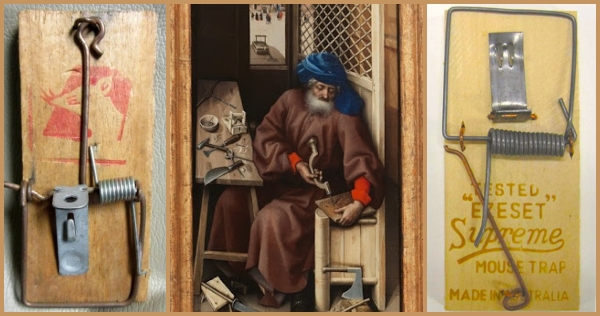
Shakespeare makes a mousetrap for the audience regarding Ophelia’s family and Hamlet. We could call this mousetrap, “Much Ado About Ophelia Marrying Hamlet.” Near the play’s end, Gertrude says in 5.1 that she’d rather have decorated Ophelia and Hamlet’s wedding bed with flowers than Ophelia’s grave. The Queen seems to have liked Ophelia and thought her a good match for her son.  Rewind to the start: After seeing the ghost, Horatio and the sentinels think so highly of Prince Hamlet that they report the sighting to him, and not to King Claudius or Polonius. [1] In 1.2, Horatio calls Prince Hamlet “my lord,” presenting himself to his friend as “your servant ever.” Hamlet replies that he would “change those names” [2]: He’d rather be Horatio’s servant, and Horatio his lord. When Horatio and the sentinels speak of their duty to him, Hamlet would rather have them think of their mutual love.[3]  Shakespeare presents Hamlet as a prince who desires to serve, to love and to be loved, ...

Part 19: Ophelia's Parley in Polonius' War

Image
Cassidy Cash of That Shakespeare Life podcast fame recently posted regarding occurrences of the word “parley” in Shakespeare.[1] She explains that we may have heard the word from Pirates of the Caribbean films. In a parley, opposing sides cease hostilities, sometimes to clear the battlefield of wounded and dead, or to discuss terms of a truce.  In Hamlet , Polonius uses the word “parley” in an interesting way in his statements to Ophelia, discouraging her from believing Hamlet’s expressions and vows of love. It is clear in their discussion that Ophelia wishes to believe Hamlet’s vows and “tenders” of his affection, while Polonius repeatedly assumes that Hamlet is waging an adversarial war to win Ophelia as a prize and to violate her chastity as an enemy might violate an opponent’s borders.   Polonius tells Ophelia, From this time Be something scanter of your maiden presence. Set your entreatments at a higher rate Than a command to *parley.* (1.3.129-132) [2]   The contra...

Part 17: Ophelia's "Owl" and "False Steward" Allusions: Why in that order?

Image
In her alleged madness, Ophelia says things that seem merely mad ramblings. But to original audiences, these may have been allusions to well-known tales, and there may be a reason for their ordering. First: OPHELIA: They say the owl was a baker’s daughter. Lord, we know what we are but know not what we may be. God be at your table. (4.5.47-49) [1] Second: OPHELIA:  You must sing “A-down a-down”—and you “Call him a-down-a.”—O, how the wheel becomes it! It is the false steward that stole his master’s Daughter. (4.5.194-197) Consider: “THE OWL WAS A BAKER’S DAUGHTER” is a reference to a tale in which a baker’s daughter is turned into an owl after being repeatedly ungenerous with a beggar at the door - who was Jesus in disguise. This is a folktale retelling of the gospel tale of the Rich Man (Dives) and the beggar Lazarus.[2] Ophelia summarizes: “Lord, we know what we are but / know not what we may be.” Ophelia may feel punished, like the baker’s daughter, and as people in Denmark’s ...

Part 14: Ophelia's figuratively incestuous family

Image
Ophelia’s brother and father are overly protective of her chastity [1], too suspicious that Hamlet might take advantage of her. Like a lover or spouse, Laertes leaving for France tells Ophelia, “do not sleep, But let me hear from you” [2]. Biblical sayings urge welcome for strangers, which involves risk; but they also discourage fear [3]. Laertes, in contrast, repeatedly urges Ophelia to fear Hamlet [4]. After warning her to be chaste, Laertes tells Ophelia to remember his advice. Ophelia replies, "'Tis in my memory lock'd, / And you yourself shall keep the key of it."[5] Chastity can be a virtue, keeping something of great value secret, disclosed only in an intimate, faithful relationship. Ophelia’s promise to Laertes is analogous: she has the feminine lock and he the masculine key, suggesting a figuratively incestuous relationship. Polonius mistrusts his children’s secret, so he figuratively rapes Ophelia's memory by demanding she disclose it. [6] Ten lines ea...

Part 11: "Mad" Ophelia grasps "tricks i' th' world" and Denmark's corruption

Image
Too many critics, readers and viewers of Shakespeare’s Hamlet assume that Ophelia’s madness is merely an inability to deal with emotions, mostly about her father and Hamlet. Showlater cites Theodore Lidz (a typical example of this) who claims “Ophelia goes mad because she fails in the female developmental task of shifting her sexual attachment from her father ‘to a man who can bring her fulfillment as a woman.’” (294) [1] Too few consider that her madness may have been as much, or more, caused by a startling epiphany about Denmark’s corruption, understanding it perhaps even better than her father. Why would (mostly male) critics have neglected this possibility for so long? A tendency among critics to keep Ophelia out of politics, like keeping women out of voting booths? A “GENTLEMAN” and Horatio speak about Ophelia the first we hear of her having gone mad: GENTLEMAN: She speaks much of her father, says she hears There’s tricks i’ th’ world, and hems, and beats her heart, Spurns envious...