Posts

Showing posts with the label Medici

Part 54: Ophelia, like Jesus, preaching against hypocritical libertines (deconstructed?)
Image
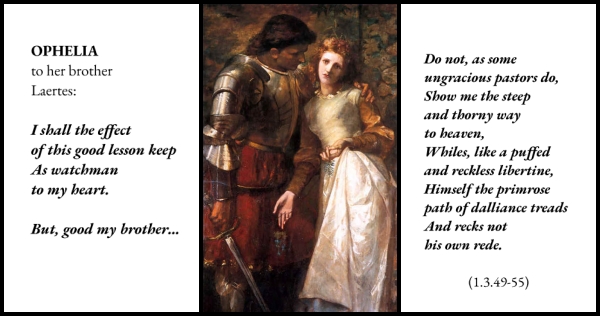
Ophelia’s first biblical allusion made her sound, to Elizabethan ears, like Jesus condemning hypocrisy and corruption of authorities. She targets her brother as a potential hypocrite and “libertine.” Laertes warns her not to get too close to Hamlet, that he is above her station, warning her not to lose her chastity to him. Ophelia responds kindly but strongly: I shall the effect of this good lesson keep As watchman to my heart. But, good my brother, Do not, as some ungracious pastors do, Show me the steep and thorny way to heaven, Whiles, like a puffed and reckless libertine, Himself the primrose path of dalliance treads And recks not his own rede.[1] In Matt. 7:13-14, Jesus’ cautions: Avoid the “wide gate” (of too much freedom). “Straight and narrow” for Ophelia becomes “steep and thorny.” In Matt. 23:1-4 Jesus says, do all that “teachers of the law” and Pharisees teach, as they sit in the “seat of Moses” as authorities, but not to do as they do, for they are hypocrites.[2]  ...
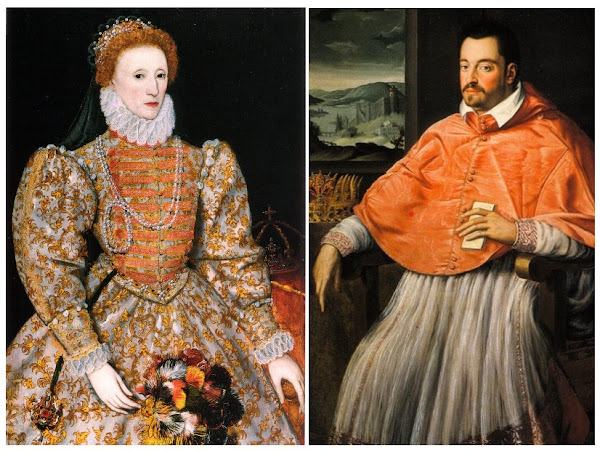
Elizabeth I, Popes, & Ferdinando I de' Medici in Love's Labor's Lost

Image
Love’s Labor’s Lost was Christmas entertainment (1593) for Elizabeth I and her court. It's about a bunch of guys who try to be celibate, and who keep a princess and her attending ladies locked out of their castle. The men fall in love with the women, but the women get the last word. Sort of like popes (some who failed at the celibacy thing) who excommunicated Elizabeth, keeping her out of the “castle” of the Roman Church, but never getting what they desired of her. Many scholars note that the character of King Ferdinand is based on King Henry III of Navarre, who had been raised Protestant, and who Elizabeth I had supported in French wars of religion. He converted to Catholicism (“Paris is worth a mass”) to consolidate his power as the next king of France, disappointing Elizabeth. Of the nine popes during Elizabeth’s reign,* one of them, Gregory XIII (1572-85), had a child out of wedlock (like Armado and Jaquenetta in the play) before his ordination. In their oaths and the...