Posts

Showing posts with the label drowning

NO ONE TELLS OPHELIA that Hamlet killed her father (Ophelia Postlude)

Image
Ophelia and Laertes know their father’s burial was abbreviated and secretive [1]. Claudius says, For good Polonius’ death, and we have done but greenly In hugger-mugger to inter him… [2] Claudius confides in Laertes that Hamlet killed his father [3]: This suits his purposes, to enlist the help of Laertes to kill Hamlet without Claudius revealing that he killed his brother, the king. But Claudius does not reveal to Ophelia how her father died. While he confides in Laertes, Ophelia is drowning [4]. There is no scene in Hamlet in which a character tells Ophelia that Hamlet killed her father. None. No character refers to Ophelia having been told, or knowing it, or finding out via gossip from Elsinore guards or servants. This may *not* be a small point: It is one thing to assume that Ophelia should be defined mostly by her familial and romantic relationships, and to have gone mad merely because of them. Yet it is very different for her to be defined by political awakenings, to have - lov...

Part 49: Ophelia, Hamlet, Water, and Rites of Passage

Image
Ophelia and Hamlet are an interesting variation on a recurring Shakespeare theme, almost willing to elope like Romeo and Juliet, or Othello and Desdemona, but not willing to disobey Polonius’ parental authority once he expresses disapproval. In stark contrast with the sins of Claudius, at first the play displays children submitting to authority: Ophelia to Polonius [1]; Hamlet to his mother (no return to Wittenberg [2]) and to the ghost (to obey and avenge [3]); Laertes seeking parental and royal approval before returning to France [4]. Forbidden contact with Hamlet [5], but used as bait for spying [6], Ophelia resembles Viola disguised as Cesario in Twelfth Night , tasked as messenger for Duke Orsino, but in love with the duke. Blameless, obedient, but scolded, ordered “to a nunnery” [7], she resembles Hero in Much Ado About Nothing , victim of deception and misunderstanding, rejected by her betrothed.  Hamlet made to her “almost all the holy vows of heaven” [8], probably a be...

Part 44: Ophelia, Ariadne, Aegeus: Rejection, Ecstasy, Drowning

Image
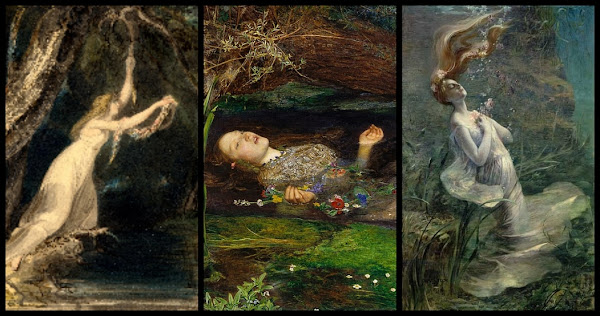
Part 44: Ophelia, Ariadne, Aegeus: Rejection, Ecstasy, Drowning After Ophelia’s father Polonius tells her to reject Hamlet [1], she obeys; later Hamlet is unkind to her and tells her, “Get thee to a nunnery” [2]. But the fact that her father forbade her to see him could not erase her feelings for him [3], or her hurt at being rejected. The story of Theseus, son of King Aegeus, and how he killed the Minotaur with help from Ariadne, was quite familiar in Shakespeare’s time, and the playwright even has Theseus as a character in “A Midsummer Night’s Dream.” Ariadne loved Theseus, as Ophelia seems to have loved Hamlet. But like Polonius, Ariadne’s father, King Minos, would not have approved. In the Greek myth, Theseus takes Ariadne with him when he leaves the island of Crete after defeating Ariadne’s half-brother, the Minotaur [4]. He later abandons her on the island of Naxos. Ophelia may feel similarly abandoned after Hamlet leaves for England [5] and her father is found dead and given...

Part 34: Why Gertrude personifies the envious sliver of willow (Interlude D.1)

Image
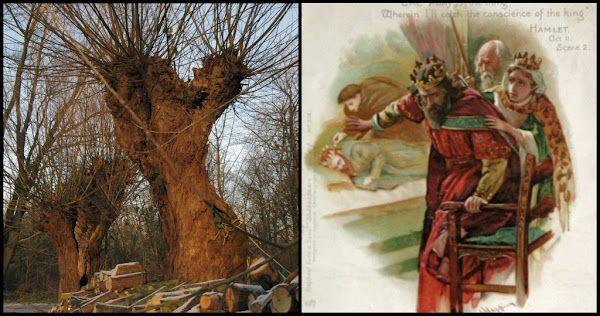
The fact that Gertrude personifies the sliver of willow that sends Ophelia to her death is curious and deserving of more attention. She says an envious sliver breaks [1], sending Ophelia into the water — meaning that it was not Ophelia’s choice to set in motion the events that would lead to her drowning, but that these were caused by an act of envy by something outside herself. Why envious? Envious that it was not given a floral crown (“coronet”) [2] like other branches. Tree branches or slivers can’t feel envy, so Gertrude’s personification of the sliver as “envious” implies a belief that human envy was ultimately the cause of Ophelia’s drowning. Who in the play was envious of another’s crown? - Primarily Claudius, who poisoned his brother, usurped the throne and stole his brother’s wife.[3] Ophelia had bestowed crowns on branches and triggered the envy of one “sliver”; she could have been Hamlet’s wife and borne him another heir, helping to bestow that heir’s crown. What does this en...

Part 5: Ophelia Drowning in Conflicting Authorities

Image
When Ophelia says, “ “I do not know, my lord, what I should think” (1.3.113), people in Early Modern England would have assumed that, at least in part, she may have felt torn between apparently contradictory biblical injunctions. In Act 1, scene 3, Ophelia has her first brief lines, spoken to her long-winded brother Laertes and her even more long-winded father, Polonius. She says that Hamlet has made her “almost all the holy vows of heaven” [1]: She could be the next queen of Denmark. Laertes suspects Hamlet may be tempted to use and abandon her, needing to marry someone else to secure a treaty [2]. But the play gives no evidence of treaty-marriages, or that Hamlet would take love lightly: He wants to return to university in Wittenberg, while Laertes wants to return to France where his father suspects he will be “drabbing” (whoring), and where Ophelia suspects he will be a hypocrite for not heeding his own strict advice. Ophelia’s father similarly suspects bad intentions on Hamlet’s pa...

Part 2: Ophelia’s drowning shrouded in lies, like other deaths in Hamlet

Image
Deaths in Hamlet are shrouded in lies, including Ophelia’s. The play offers a king murdered by his brother, but the murderer’s lie claims it was by snake bite [1], and an Ophelia who died from the accident of a broken branch [2], but the “churlish priest” insists that she died by suicide.[3] The ghost says, "… the whole ear of Denmark Is by a forged process of my death Rankly abus’d Upon my secure hour thy uncle … … … in the porches of my ears did pour The leperous distilment Thus was I, sleeping, by a brother’s hand Of life, of crown, of queen at once dispatch’d (1.5.36–8, 61–4, 74–5) So the king was killed by Claudius with intent, but the truth was obscured by his murderer’s lies of accidental death. Ophelia drowned by accident, but the truth was obscured by claims that she died by intent, suicide. A reversed echo? One could say (paraphrasing), "… the whole ear of Denmark Is by a forged process of (Ophelia'sdeath Rankly abus’d..." I tend to believe Gertrude’s stor...

Part 1: The Controversy over Ophelia's Death in Hamlet

Image
If you ask an average Shakespeare reader or viewer to tell you how Ophelia dies in Hamlet, many might say “suicide,” or “she drowns herself.” But the play presents a controversy of at least seven interpretations of her death, ranging from accident to suicide. [1] These are represented by 1. Gertrude; 2. the king (implied); 3. the Coroner’s Inquest; 4. the Gravedigger-clowns; 5. Hamlet; 6. the “churlish priest”; and 7. Laertes. Some of these agree more with the others, some not. Educators often say it’s good to “teach the controversy,” so instructors might have students seek, document, and reflect on the position of each party, as well as other possibilities (with or without evidence). 1. GERTRUDE offers the earliest account of Ophelia’s death, saying Ophelia fell in the brook while decorating a willow with flowers, when an “envious sliver” of a bough broke [2]. Her garments helped her float for a while [3], but they became “heavy with their drink” and “Pulled” her “To muddy...