Posts

Showing posts with the label historical context

Historical reasons for Shakespeare to write a cautious Hamlet who delays

Image
INSTEAD OF ASKING WHY HAMLET DELAYS, let's ask: Why does Shakespeare write Hamlet that way?  Besides the execution of two wives of Henry VIII, and of many Catholics accused of treason, including Shakespeare’s relative Edward Arden in 1583 [1], what figurative ghosts may have made a cautious Shakespeare write a cautious Hamlet?  1. In February 1587, Mary, Queen of Scots was executed in England for conspiring against Queen Elizabeth I, her cousin. She was found guilty and beheaded. 2. In 1594, Ferdinando Stanley, patron of the Lord Strange's Men (in which Shakespeare and many of his fellow players were active) and possible heir to Elizabeth’s throne, was poisoned after faithfully reporting a plot against Elizabeth I that may have been intended to entrap him [2].  3. In February, 1601, Robert Devereux, Earl of Essex, attempted a rebellion against the English government, a year and a half before Shakespeare's Hamlet first appeared in the stationer's registry (July 1602), an...

How Current Papacies Shape How Claudius is Viewed (Part 20, Claudius Series)

Image
Depending on who is pope at the time – either the time of the writing of a Shakespeare play, or a during a given production, or work of scholarship – the way people feel about Hamlet’s Uncle Claudius and his various sins or vices may vary greatly.  Elizabeth I had been excommunicated by Pope Pius V (1570) [1]. Under Sixtus V, Rome encouraged Spain to launch three Armada invasions of England (1588, 1596, 1601). (How would you feel?) During the English Civil Wars (1642 to 1651), in part about religion, Pope Innocent X (1644-1655) supported Ireland, against objections of the exiled Henrietta Maria, English Queen living in Paris.  So before 1660, it was easier to connect Claudius and his sins and vices with Rome and a Catholic church that resisted reform.  Fast forward to the 1800s: Charles Dickens publishes Oliver Twist (1837-1839), A Christmas Carol (1843), and Hard Times (1854); Marx and Engles publish Das Kapital (1867-1894), and Pope Leo XIII publishes Rerum Novarum (1...

Titus Andronicus, revenge, and child-eating in Shakespeare's Bible

Image
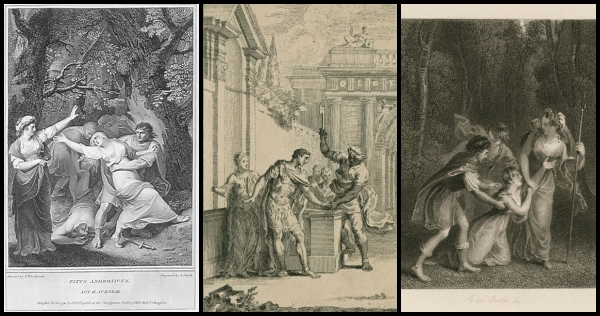
In Titus Andronicus, Titus has Chiron and Demetrius restrained and killed, to be baked up and served to their mother for revenge, a deception of cannibalism (vaguely similar to the deception at the end of The Spanish Tragedy). In The Bloody Banquet, by T.D., as punishment, an adulterer must eat the flesh of her lover.   Why the fascination with revenge and cannibalism? CANNIBALISM: Many Catholics believed in transubstantiation (that the bread and wine actually became the body and blood of Christ). Protestant polemics claimed it was a form of cannibalism, which Catholics denied. “EAT THEIR OWN CHILDREN” Deut 28:54-57 (Bishop’s Bible trans.) notes note people who are “delicate and tender” (entitled, pampered, spoiled), who - if the city were under siege and food limited - would eat their own children. [1] When Hamlet calls Fortinbras a “delicate and tender prince,” it is not a compliment, but a reference to this passage. Titus stabs his own daughter, and Tamora wants the mixed-race c...

Mother's Day After-Party: Mothers in Shakespeare, Part 2

Image
IS IT FAIR, for educators to hijack Mother’s Day as an occasion to examine the rich diversity of mother figures in Shakespeare, and also at times, their absence? I would say yes. Educators often treat such occasions as “teachable moments” when they invite students to study some text or artifact so as to better come to understand history and their culture. In Act 4, scene 4, Hamlet says, How all occasions do inform against me [...]. Sure He that made us with such large discourse, Looking before and after, gave us not That capability and godlike reason To fust in us unused. (4.4.34-41) [1] Such teachable moments should not be wasted, unused. Educators have at their disposal many resources which can work a kind of alchemy to turn occasions like Mother’s Day into gold. - Biology teachers can glimpse in wonder at the workings of the human body that allow conception and breast-feeding; - teachers in the human sciences can explore Freud’s ideas about the centrality of relationships to mothers...

Three challenges to teaching about incestuous marriage in Hamlet

Image
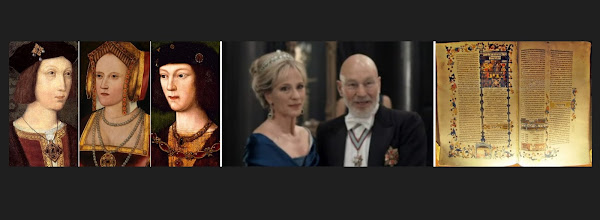
There are always challenges to teaching Hamlet, in part due to the historical and cultural gaps between the original audiences for whom Shakespeare was writing, and that of today’s students. When teaching about the “incestuous” marriage of Claudius and Gertrude, one may find challenges especially in at least three areas: Definitions, religious considerations, and trigger warning issues. [Left to right: Arthur Tudor, Prince of Wales (1486-1502), "regarded as the only surviving contemporary portrait"; circa 1500. Anglo-Flemish School. Private collection, Hever Castle, Kent. Public domain. Image via Wikimedia. Catherine of Aragon (1485–1536), originally identified as Catherine Parr, but now recognized as Catherine of Aragon. Unidentified painter. 16th Century. Lambeth Palace. Public domain, via Wikimedia. Henry VIII of England (1491-1547), circa 1509. Attributed to Meynnart Wewyck. Denver Art Museum. Public domain. Image via Wikimedia. Penny Downie as Gertrude, and Patri...