Posts

Showing posts with the label Measure for Measure

Feast of the Epiphany in Shakespeare's Time (Series, Part 14)

Image
The FEAST of the EPIPHANY in churches of Shakespeare’s time [1], JANUARY 6, celebrates the magi “from the east” who followed a star, met with Herod, paid homage to Jesus, and were warned in a dream to go home by another way [2]. City-dwellers may neglect the stars, but in Shakespeare they can be foreboding or determine fate; one can be “star-crossed” ( Romeo and Juliet ), or out of another’s star (Ophelia/ Hamlet ), or one might guide a ship by them; Shakespeare mentions them more than 100 times (a sample): “Look, the unfolding star calls up the shepherd.” - Measure for Measure “That I should love a bright particular star” - All's Well That Ends Well “O eastern star!” - Antony and Cleopatra “Our Jovial star reign'd at his birth” - Cymbeline “When yond same star that's westward from the pole Had made his course t' illume that part of heaven Where now it burns…” - Hamlet      “I am constant as the northern star” - Julius Caesar In the gospel, and in sleepless dreams of...

First Day of Christmas in English churches of Shakespeare's Time (series, Part 1)

Image
On the first day of Christmas in Shakespeare’s time, what Bible tales did they hear? People in England were required by law to attend church on Sundays and Holy Days, so hearing at least some of the Bible readings in church [1] would have been mandatory. On Christmas Day, if one rose early and made it to church for Matins (early morning prayer), one would hear the tale from the Gospel of Luke of the shepherds hearing the angels announcing the birth of Jesus, and going to adore him [2]. But if one attended only the later liturgy with communion service, one would hear from the Gospel of John about the Word of God being made flesh (the incarnation, the God of heaven made “incarnate” as a human being on earth), and about John the Baptist preparing the way for Jesus [3]. John the Baptist was already familiar from the gospels for the last two Sundays of Advent, a theme repeated on the first few days of Christmas at morning prayer. How do these come up in Shakespeare? - The infant princess,...

Elizabeth I, Popes, & Ferdinando I de' Medici in Love's Labor's Lost

Image
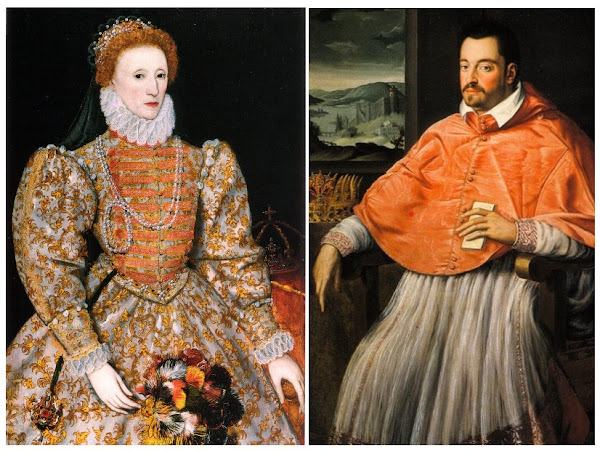
Love’s Labor’s Lost was Christmas entertainment (1593) for Elizabeth I and her court. It's about a bunch of guys who try to be celibate, and who keep a princess and her attending ladies locked out of their castle. The men fall in love with the women, but the women get the last word. Sort of like popes (some who failed at the celibacy thing) who excommunicated Elizabeth, keeping her out of the “castle” of the Roman Church, but never getting what they desired of her. Many scholars note that the character of King Ferdinand is based on King Henry III of Navarre, who had been raised Protestant, and who Elizabeth I had supported in French wars of religion. He converted to Catholicism (“Paris is worth a mass”) to consolidate his power as the next king of France, disappointing Elizabeth. Of the nine popes during Elizabeth’s reign,* one of them, Gregory XIII (1572-85), had a child out of wedlock (like Armado and Jaquenetta in the play) before his ordination. In their oaths and the...

Beggars & Players' Ill Report: Polonius Measuring, Being Measured (Part 4) (Updated)

Image
THIS IS PART 4 in a series on the ghost’s allusion to the parable of Lazarus and the Rich Man from Luke 16 in Shakespeare’s Hamlet. For an index and brief descriptions of the posts in the series so far, scroll to the bottom of this post. ~ [Detail from the prefatory cycle to the Eadwine Psalter, Morgan Library leaf M.521 (recto), English c. 1160s. Image cropped. Public Domain, via Wikipedia .] After the ghost evokes the name of Lazarus in Hamlet 1.5 to describe the poison’s effect on his skin, Shakespeare takes plot elements and themes of the Lazarus-rich man parable and situates them in other analogous moments of the play, giving them new local habitations and names (as Theseus of Midsummer Night's Dream might say). [Oliver Ford Davies as Polonius, David Tennant as Hamlet, 2009, BBC, Directed by Gregory Doran. Image via david-tennant.co.uk. Fair use.] One such moment occurs in 2.2, in discussion between Hamlet and Polonius regarding accommodations for the players. Poloniu...