Posts

Showing posts with the label Lazarus

Links to Lepers in Hamlet

Image
LINKS TO LEPERS IN HAMLET: References to tales of famous lepers, confusion about them, and those who cared for them: 1. The ghost says the poison made his skin lazar-like (1.5), like that of the beggar Lazarus in Luke 16:19–31 [1];  - Claudius poured “the leperous distillment" in the “porches" of the ghost's ear (1.5): In some art, the beggar Lazarus is left untended on the porches of the rich man’s house.  - Ophelia’s “the owl was a baker’s daughter” (4.5) references a folktale retelling of the Luke 16 gospel tale;  - Horatio’s “angels sing thee to thy rest” (5.2) references the Requiem Mass lines based on the Lazarus story. 2. The saint-namesake of the sentinel Francisco (1.1) is Francis of Assisi, who cared for lepers, and famously kissed one [2]. (Katherine of Aragon’s confessor was a Franciscan, John Forest, burned at the stake for opposing Henry’s divorce.)   3. In medieval and Elizabethan times, leprosy and venereal disease were confused, and leprosy thou...
Part 25: Ophelia's Self-Catching Conscience in the Mirror of her Arts

Image
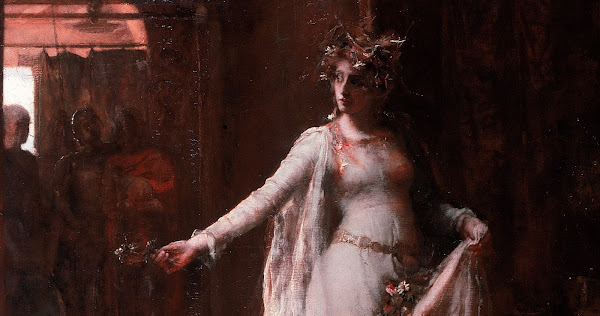
Unlike Claudius, who ignored qualms of conscience to murder his brother and usurp the throne, Ophelia’s relationship to her conscience is more healthy, rich, and self-directed.   Claudius just doesn’t get it, so he needs Hamlet to catch his conscience in The Mousetrap, [1] which reenacts Claudius poisoning his brother and wooing his victim’s wife. Hamlet says playing holds a mirror up to the age [2], and he uses the playlet to hold a mirror up to Gertrude and Claudius, showing what they’ve done. But Ophelia gets it, and doesn’t need someone to hold up a mirror for her conscience. She chooses her own songs, stories, and allusions to reflect upon her sadness and conscience. [3] She knows her father died, but doesn’t know that Hamlet killed him thinking it was Claudius. She sings songs of mourning for perhaps her father and/or the dead king [4], songs of her own choosing. Ophelia knows Hamlet made to her “almost all the holy vows of heaven” [5] perhaps the equivalent of a handfast w...

Does Shakespeare’s Hamlet depict religiously shaped or motivated regicide?

Image
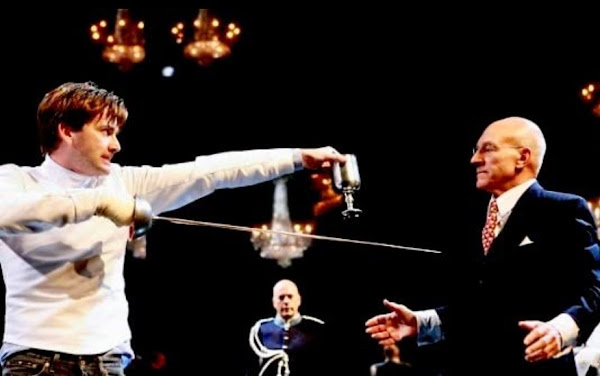
Does Shakespeare’s Hamlet depict religiously shaped or motivated regicide? [1] Given its many religious and biblical allusions and plot echoes, I would argue that it does. [David Tennant (L) as Hamlet and Patrick Stewart (R) as Claudius in the 2009 film, Hamlet , dir. Gregory Doran. Source: IMDB . Fair use.] Dr. Arthur F. Marotti gave a talk at Fordham in late October of 2013 in which he noted, “In the last years of Elizabeth’s rule people believed something was rotten in England—though perhaps not rotten enough to justify regicide. ” [2] Marotti has written numerous books [3] about Early Modern literature and religion, including a 2004 essay with Ken Jackson on “The Turn to Religion” in Shakespeare studies. In an abstract for a more recent (2017) essay [4], Marotti notes that “Shakespeare's plays may not stage religiously motivated regicides…,” with “may” being the operative word here: Scholars may disagree on this point. But what about Hamlet? Recognizing that H...

Begging and Poor in The Comedy of Errors (1594)

Image
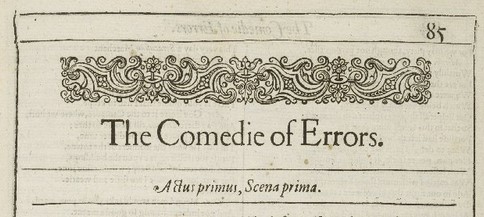
In The Comedy of Errors, "beg" occurs only four times; "poor," 10. The story contains two sets of twins, and each set bears the same name: Two of Antipholus, two of Dromio, the former raised to be masters, the latter bought and raised to be servants (slaves). - Because "their parents were exceeding *poor*," the Dromio twins were "bought and brought up to attend" Egeon's sons (1.1, an act of charity, or exploitation, or both). - But Egeon of Syracuse has traveled to Ephesus as a refugee to find his later-separated sons, risking death by execution because Syracuse and Ephesus are at war. - Solinus, Duke of Ephesus, tells Egeon to *beg* or borrow the money for his ransom to spare his life (1.1). - Luciana, sister-in-law to Antipholus of Ephesus, tells her sister that the love she *begged* for her sister from the Antipholus she believed was her sister's husband, he begged of her (4.2, because unknown to her, the Antipholus who begged lov...

Begging and Poor in 3 Henry VI (1591)

Image
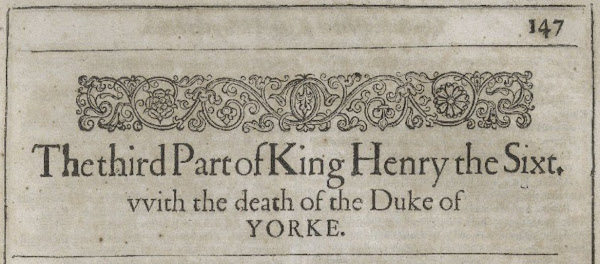
Shakespeare's Henry VI, Part 3 has five instances of "beg" and 18 of "poor." Characters often act more like the self-concerned rich man in the gospel tale than like beggar Lazarus, with the exception of Henry, who, while a weak king, is more humble than most of his nobles. [Image cropped from The third Part of Henry the Sixt, with the death of the Duke of Yorke , in the Second Folio edition of 1632, via Folger Shakespeare Library Digital Image Collection . Creative Commons.] "Poor" in this play is often used to mean "pitiable," and often sarcastically by characters who lack pity ( *emphasis* mine): 1.1 York and Lancaster factions argue about their claims to the throne. Lord Clifford is impoverished by the death of his father but also by his thirst for revenge. Warwick calls him "poor Clifford" as one might taunt an enemy: Earl of Warwick: " *Poor* Clifford! how I scorn his worthless threats!" Under duress, He...

Begging & Poor, Eve, & the Protestant-Catholic Context for 2 Henry VI

Image
A funny thing happened on the way to searching 2 Henry VI for instances of "beg" (five) and "poor" (14): [Image: From the First Folio of 1623, via Folger Shakespeare Library . Creative Commons.]  First, it is hard not to be struck by the idea that Shakespeare was writing at a time of Protestant-Catholic strife, in a divided country: He chose to write about the War of the Roses, a time when England was divided by the houses of Lancaster and York. Teachers who omit mention of this do their students a disservice. Second, in 2 Henry VI , audiences are again (as in Hamlet ) shown a variation of the theme of woman as an Eve figure, a source of corruption. In Hamlet, the prince complains about Gertrude's frailty and asks if she had a hand in killing his father; but in 2 Henry VI , Queen Margaret is having an affair with the Earl of Suffolk; if she is Eve, he is a serpent. Third, while searching for "instances of "beg" and "poor,...

Begging and Poor in 1 Henry VI, 1591-92

Image
I am still exploring instances of "beg" and "poor" in other Shakespeare plays, in light of references in Hamlet to the prince as begging or poor, and of the beggar Lazarus allusion in that play (1.5). 1 Henry VI is my focus today. Henry VI, Parts 1-3 takes up where Henry V leaves off, and is in part about the end of the Hundred Years War and the start of the War of the Roses. [Image from First Folio, File:STC 22273 Fo.1 no.68 k2v.jpg, via Folgerpedia at Folger.edu . Cropped. Fair use.] In 1 Henry VI , there are 11 instances of “poor” but only two instances of “beg.” In 4.5, John Talbot begs his father to flee, and for him to stay behind and fight to his death ( emphasis mine): Then let me stay; and, father, do you fly: Your loss is great, so your regard should be; My worth unknown, no loss is known in me. Upon my death the French can little boast; In yours they will, in you all hopes are lost. Flight cannot stain the honour you have won; But mine ...

Begging and poor in "The Taming of the Shrew," 1590-91

Image
I am still exploring occurrences of "beg" and "poor" in other Shakespeare plays, in light of references in Hamlet to the prince as begging or poor, and of the Lazarus allusion in that play. The Taming of the Shrew contains only four occurrences of "beg," many disparaging, and 9 instances of "poor," some quite interesting. [LEFT: "A pleasant conceited historie, called The taming of a shrew." By anon., printed 1594, which may have been a source for Shakespeare, or an early draft. Image via Folger.edu , which Folger obtained via Huntington Library, and which allows not-for-profit use . MIDDLE: The first page of Shakespeare's The Taming of the Shrew , printed in the First Folio of 1623, via Wikipedia , from Folger. Fair use. RIGHT: The title page from the first quarto, printed in 1631 Quarto of A wittie and pleasant comedie called The Taming of the Shrew , via Wikipedia.org , from Folger Shakespeare Library. Fair use.] Pet...