Posts

Showing posts with the label Mothers

Mother's Day After-Party: Mothers in Shakespeare, Part 2

Image
IS IT FAIR, for educators to hijack Mother’s Day as an occasion to examine the rich diversity of mother figures in Shakespeare, and also at times, their absence? I would say yes. Educators often treat such occasions as “teachable moments” when they invite students to study some text or artifact so as to better come to understand history and their culture. In Act 4, scene 4, Hamlet says, How all occasions do inform against me [...]. Sure He that made us with such large discourse, Looking before and after, gave us not That capability and godlike reason To fust in us unused. (4.4.34-41) [1] Such teachable moments should not be wasted, unused. Educators have at their disposal many resources which can work a kind of alchemy to turn occasions like Mother’s Day into gold. - Biology teachers can glimpse in wonder at the workings of the human body that allow conception and breast-feeding; - teachers in the human sciences can explore Freud’s ideas about the centrality of relationships to mothers...

Mother's Day "Deep Dives" via New York Shakespeare - panel discussion

Image
REGARDING MOTHERS IN SHAKESPEARE, video of our discussion with Rodney Hakim, host of “Deep Dives” at New York Shakespeare, is now available in two parts at YouTube: Part 1: https://youtu.be/THvwuGYKQcA?si=fgn2EceaGkiQN8AJ Part 2: https://youtu.be/7-g43NcarOM?si=1WaoNEnAUgGtknTJ There are things I wish our discussion might have had more time for.... These include: 1. Among reasons for mothers often being absent in Shakespeare plays, one may have been that both monarchs Shakespeare lived under had their mothers executed. I might have extended this idea: If one is writing plays that one may perform before the monarch, one might downplay or omit the presence of mothers in deference to them. 2. Some assume that Lady Macbeth was never a mother, but in fact she refers to having nursed a babe, and often uses milk and nursing figuratively. Lady Macbeth in 1.7: “I have given suck, and know How tender ’tis to love the babe that milks me.” 3. In Hamlet, there are many referen...

(Part 10) Boy Amazes Mother in Shakespeare's Macbeth

Image
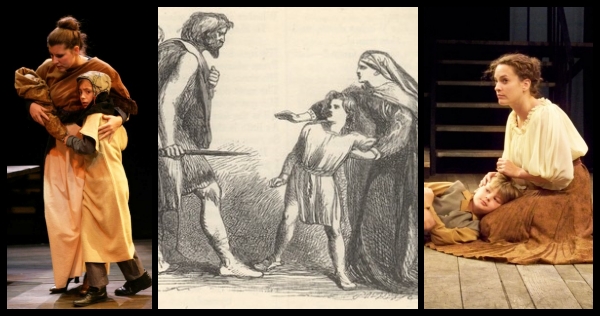
~~~~~~~~~~~~~~~~~~~~~~ INDEX OF POSTS IN THIS SERIES: https://pauladrianfried.blogspot.com/2023/01/index-hamlet-in-32-as-boy-jesus-lost.html ~~~~~~~~~~~~~~~~~~~~~~~~~~~~~~~~~~~~~~~~~~~~~~~~ When considering an allusion by an author, it’s often informative to check and see if that author has other works that make a similar allusion. With Hamlet’s allusion to the boy Jesus amazing his mother and the temple elders in 3.2, besides checking things such as homilies of the time (as I did in Part 9 of this series) [1], we might wonder: Did Shakespeare allude to this Bible tale in other plays? Naseeb Shaheen believes Shakespeare’s Cymbeline has a brief reference to this same gospel tale (1.1.47-52), and King Lear (more explicitly) in 4.4.26-32. Less explicitly - yet perhaps quite significantly - in Macbeth, the dynamics between Lady Macduff and her son have a strong thematic connection to the tale of the boy Jesus amazing and [a-]stonishing his parents (and especially his mother, as...

"See the inmost part of you": Gertrude's literalism, fear of evisceration in 3.4

Image
In Hamlet 3.4, the scene in Gertrude's closet, Hamlet tells her that he will show his mother her "inmost part," and it's clear to the audience or readers that he's talking about her conscience. But she quickly jumps to the conclusion that perhaps he is going to kill her: "What wilt thou do? Thou wilt not murther me? Help, help, ho!" This scene is often played with some violence by Hamlet toward his mother, throwing her on her bed, to help explain why she jumps to this conclusion. But this is not in the stage directions, and perhaps there are other reasons why she jumps to this conclusion. ~~~~~~~~~~~~~~~~~~~~~~~~~~~~~~~~~~~~~~~~~~~~~~~~~~~ With me in the "Rethinking Science and Religion" seminar at Shakespeare Association of America this spring, there were two members who wrote about Renaissance anatomists and drawings of the dissected human body. This made me think about Elizabethan public executions of Catholics and others, sometimes inv...

(Part 8) Hamlet in 3.2 as the boy Jesus: Why has this been missed?

Image
~~~~~~~~~~~~~~~~~~~~~~ INDEX OF POSTS IN THIS SERIES: https://pauladrianfried.blogspot.com/2023/01/index-hamlet-in-32-as-boy-jesus-lost.html ~~~~~~~~~~~~~~~~~~~~~~~~~~~~~~~~~~~~~~~~~~~~~~~~ In previous parts of this series,[1] I have explored Hamlet’s allusion in 3.2 to himself and his mother Gertrude [2] as like the boy Jesus, found in the temple by an astonished mother Mary among the elders.[3]  This allusion was missed by all major writers of reference books on Shakespeare and the Bible through at least the late 20th century [4]. Why have these scholars in this specialty field missed this allusion? Possibilities: 1. THE BIAS OF SCHOLARS: Perhaps many critics have preferred to imagine Hamlet as either not religious, or as a virtuous hero, rather than as one who would gloat after The Mousetrap and compare himself, perhaps blasphemously, to the boy Jesus? [5] And perhaps some scholars, especially in the last half century, simply resisted viewing Hamlet as a Christ fig...

(Part 7) Hamlet’s allusion in 3.2 to the boy Jesus: Hamlet as Abbott, Rosencrantz and Guildenstern as Costellos?

Image
~~~~~~~~~~~~~~~~~~~~~~ INDEX OF POSTS IN THIS SERIES: https://pauladrianfried.blogspot.com/2023/01/index-hamlet-in-32-as-boy-jesus-lost.html ~~~~~~~~~~~~~~~~~~~~~~~~~~~~~~~~~~~~~~~~~~~~~~~~ Hamlet’s allusion to himself and his mother as like the boy Jesus and his mother Mary is delivered, couched inside of a kind of comedy routine, not unlike Abbott and Costello’s “Who’s on First?” [1] This is great fun but makes it easier to miss the allusion. Rosencrantz and Guildenstern are being serious with Hamlet, trying to convey messages about the king’s “distemper” and the queen’s “affliction of spirit,” but Hamlet keeps joking. Even Hamlet’s final allusion line, “O wonderful son that can so ’stonish a mother!” is delivered as a joke. Note this section of the scene: ~~~~~ GUILDENSTERN  Good my lord, vouchsafe me a word with you. HAMLET  Sir, a whole history. GUILDENSTERN  The King, sir— HAMLET  Ay, sir, what of him? GUILDENSTERN  Is in his retirement marvelou...

(Part 4 ) Dissonance and Irony in Hamlet's 3.2 Allusion to Luke 2

Image
~~~~~~~~~~~~~~~~~~~~~~ INDEX OF POSTS IN THIS SERIES: https://pauladrianfried.blogspot.com/2023/01/index-hamlet-in-32-as-boy-jesus-lost.html ~~~~~~~~~~~~~~~~~~~~~~~~~~~~~~~~~~~~~~~~~~~~~~~~ IRONY: In the third act, Hamlet makes a subtle allusion, implying that he astonishes his mother like the boy Jesus astonished his mother the Virgin Mary and amazed the temple elders. - But in spite of all the points of similarity listed in my last post [1] regarding Hamlet’s allusion, there may be even more ways in which Hamlet is quite different from the boy Jesus. The tension or dissonance between these similarities and differences is an important source of irony. (For a comparison of the relevant Hamlet text [2] to the relevant gospel text from Luke, [3], see Part 1 of this series [4].) HOW IS HAMLET UNLIKE THE BOY JESUS? A non-exhaustive list: 1. Hamlet is a revenger. Audiences may assume that a revenger is so controlled by passion for revenge that he risks his own damnation. Not like Jes...

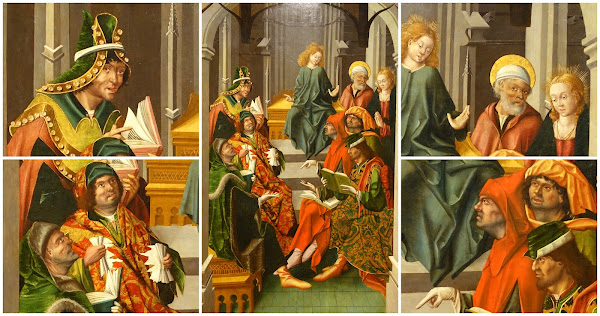
(Part 3) Hamlet as boy Jesus among Temple Elders: A closer look

Image
~~~~~~~~~~~~~~~~~~~~~~ INDEX OF POSTS IN THIS SERIES: https://pauladrianfried.blogspot.com/2023/01/index-hamlet-in-32-as-boy-jesus-lost.html ~~~~~~~~~~~~~~~~~~~~~~~~~~~~~~~~~~~~~~~~~~~~~~~~  After The Mousetrap, Hamlet subtly compares himself to the boy Jesus,[1] amazing elders in the Temple (Luke 2:41-52).[2] See Part 1 of this series [3] for a simple comparison of the Hamlet lines to the scripture verses in Luke 2.  Some of my readers caught the allusion right away with the texts side-by-side. Others were reluctant. It may help to look more closely. HOW THE ALLUSION WORKS Why might Hamlet (and Shakespeare) have thought that this moment parallels the Luke tale enough to warrant the allusion? (Not an exhaustive list.) DISTRESSED PARENTS - In Luke: Mary and Joseph had “heavy hearts” (v.48) to find that Jesus was missing. - In Hamlet: Claudius is “marvelous distempered” [4]; Gertrude, “in most great affliction of spirit" [5]. ASTONISHED & AMAZED - Luke uses the word “a...