Posts

Showing posts with the label Elijah

INDEX: When you are desirous to be blest, I'll blessing beg of you (Elijah/Elisha and widow tales)

Image
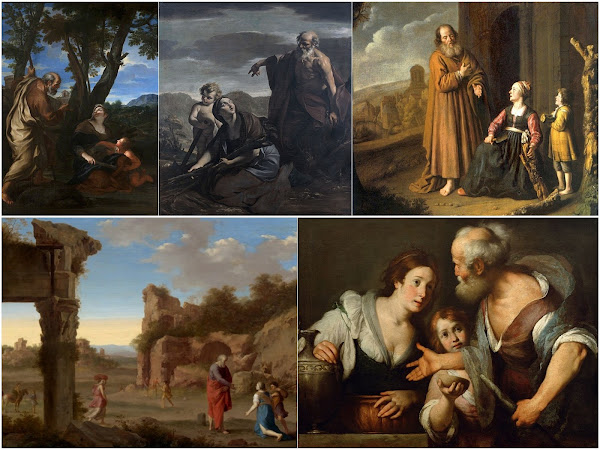
It's good sometimes to pay special attention to things that we don't understand. This was the case for me with a statement that Hamlet makes to his mother Gertrude in her closet: "When you are desirous to be blest, I'll blessing beg of you." (3.4.192-3) It seems counter-intuitive, that Hamlet would tell his mother that when she is in need of blessing, he would beg one of her. But it occurred to me that a similar dynamic happens in the Bible, as when the disciples notice that the crowd to which Jesus is preaching is becoming hungry (the hungry desire to be blessed with food), and instead of creating a miracle, he first asks what food they do have: a few fish and loaves (he begs a blessing of them). Something similar and perhaps even more relevant happens in 1 and 2 Kings, in tales about Elijah (and later, his successor prophet, Elisha) and a widow or widows. In 1 Kings, a widow is hungry or in need, and 2 Kings, a widow's late husband left the family ...

Part 37: Sts. Gertrude, pilgrim's lovers, & mousetraps (Interlude D.4)

Image
Gertrude is more associated with “mousetrap” than many scholars have allowed. Previously [1], I argued that Gertrude suspects a poison cup but doesn’t know for certain, so she signals publicly that she will drink in order to mousetrap Claudius. He tells her not to drink; she replies, “I will, my lord; I pray you pardon me.” [2] Hamlet said he would catch the conscience of the king, but first, his playlet sought to catch Gertrude’s conscience. I am grateful to Federico La Sala for mentioning saints by the name of Gertrude whose legends were familiar in the middle ages and Shakespeare’s time. These included  Gertrude the Great from the monastery of Helfta, a mystic who, with other sisters, explored a spirituality in which they believed they were “brides of Christ.” In The Herald of Divine Love, she speaks of paying a debt, [3] which sounds like the widow helped by the prophet Elijah (2 Kings 4:1-7), which Hamlet associated with his mother. [4] Gertrude as a “bride of Christ” also rel...

TRANSCRIPT: Presentation for Post Graduates, N.S.S. College, Kerala, India, 7 December, 2023

Image
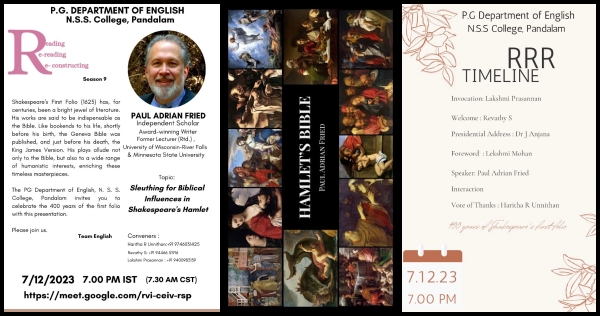
TRANSCRIPT: Presentation for Post Graduates, N.S.S. College, Kerala, India, 7 December, 2023 Edited planned transcript of remarks delivered on 7 December, 2023, in an online presentation for the Post Graduate program, N.S.S. College, Kerala, India, 7 P.M. IST, 7:30 A.M. CST. (A few words and points below were cut from the live presentation for time considerations, and I made a few additional extemporaneous remarks, but for the most part, this is the transcript.) (I did not have time to talk about allusions that fit into the theme of orphaned children who find transcendent parents in others or in a heavenly parent, but perhaps some other time....) ~~~~~~~~~~~~~~~~~~~~~~~~~~~~~ Informal outline (followed by transcript): INTRODUCTION: [Disclaimers] - Contested times, contested scripture LIST OF BOOKS cataloging Bible allusions in Shakespeare, some open-access: Sleuthing scripture allusions in Hamlet CHANGE THOSE NAMES WITH YOU: Servant-Prince, & Renunciation of Fruits DOUBTING ...

Part 3: When you are desirous to be blest, I’ll blessing beg of you

Image
Two weeks ago,[1] I began exploring the curious and counter-intuitive thing that Hamlet says to his mother: "when you are desirous to be blest, I’ll blessing beg of you." (3.4.192-3) [2] In part 3, I wish to consider: 1. Does Gertrude desire to be blessed? 2. If so, how is this desire implied? 3. Does Hamlet beg a blessing of her? Or does someone close to Hamlet, a surrogate or an extension of him, beg of her a blessing? 4. Does she offer any favors or blessings to certain characters without Hamlet having to beg? Gertrude does desire to be blessed, and Hamlet or his surrogates do ask blessings of her: Gertrude's desire to be blessed is shown or implied in her feelings of guilt. We notice this when she has to face Ophelia, who seems to have gone mad, like Hamlet. When asked to speak to Ophelia, she is almost too ashamed to do so (4.5.18-25). She may feel guilty for having married Claudius: Hamlet had told her that Claudius murdered his brother, the king, Gertrud...

Part 2, Hamlet and inherited debt (2 Kings 4:1-7): "when you are desirous to be blest, I’ll blessing beg of you"

Image
Last week I began considering Hamlet’s line to Gertrude, “when you are desirous to be blest, I’ll blessing beg of you” (3.4.192-3). [1] The idea of asking a blessing of a person in need led to Hebrew stories of Elijah and Elisha and the widow(s): Elijah asks a favor before doing the needed miraculous work. This week, I will consider a third prophet-and-widow story of Elisha (successor to Elijah, in 2 Kings 4:1-7) [2] in which a woman’s husband died and left the family in debt. The widow’s sons are to go into debt slavery to repay the husband’s debts. Elisha asks what she has (a jar of oil), and tells her to collect vessels from neighbors. She collects as many as they will give her. Elisha tells her to fill these with oil from her jar, which she does. The oil does not run out until all of the vessels she collected from her neighbors are full. As further instructed from Elisha, she sells these, and in this way, she pays off her dead husband’s debts, and her sons are thereby save...

Hamlet to Gertrude: "when you are desirous to be blest, I’ll blessing beg of you" (part 1)

Image
In Hamlet 3.4, after scolding his mother to repent of her marriage to his Uncle Claudius, Hamlet says a curious thing: "when you are desirous to be blest, I’ll blessing beg of you." (3.4.192-3) [1] If his mother desires or needs to be blest, why would Hamlet beg blessing of her? If someone desired medical aid, would you ask them to heal you? If they were hungry, would you ask them to feed you? This is counter-intuitive. But it may foreshadow something yet to come; it may also reflect a certain spiritual dynamic. To understand Hamlet’s cryptic statement, we might ask: Are there Bible stories that conform to this pattern, asking a favor of a person who is in need? Stories with which Shakespeare and his age were familiar? The answer is yes. Certain Bible tales demonstrate this dynamic. These include tales of Elijah and Elisha helping widows, and gospel tales of Jesus feeding multitudes. In each, a person or group is in need, and the prophet or Jesus first asks a favor be...