Posts

Showing posts with the label False Steward

Hamlet's Transcendent paths of Francis, Bernard, & Yorick, vs. Freud's Oedipal path

Image
Shakespeare's Hamlet offers glimpses of two ways of transcending dysfunctional parentage: a) The limited path of Freud's Oedipal complex, or b) Yorick and the paths of Francis of Assisi and Bernard of Clairvaux. In the first, the son kills the father-figure to reclaim a lost closeness to the mother. If the father is a tyrant and the son resorts to violence to replace him, this is a very limited, temporary transcendence, with the son too much like the father he replaces [1]. Francisco and Bernardo are the names of sentinels, the first two characters on stage in the play. Together, they are the names of the Pazzi assassins [2], but individually they are names of saints: - Francis of Assisi and Bernard of Clairvaux didn't kill their fathers, but Francis famously renounced his abusive father before the bishop, stripping off his clothes and giving them back to his father, saying that he had a father in heaven. - St. Bernard’s biological father and brothers eventually joined t...

Part 57: My favorite things about Ophelia

Image
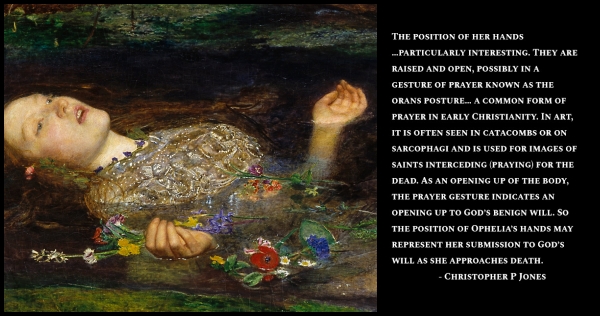
My favorite things about Ophelia? 1. By obeying her father too much, she demonstrates the failure of over-valued Elizabethan parental [and political] authority, but also displays heroic patience and self-control. 2. She calls out the potential hypocrisy of her brother. 3. She understands (although her father and brother do not) that “almost all the holy vows of heaven” from Hamlet are most probably a marriage betrothal, and that she could be Denmark’s next queen. 4. She reveals her love for Hamlet even while giving back his love poems, obeying her father. 5. She talks back to Hamlet in the nunnery scene and at “The Mousetrap” play, bold to act this way with the prince. 6. She uses coded meanings of flowers to criticize her king and queen. 7. She sings a bawdy song, perhaps mourning her unspent virginity like Jephthah’s daughter, or mourning the loss of Hamlet as lover, expressing disappointment at being denied access to Hamlet by her father, and then by Hamlet as well.    8. S...

Part 25: Ophelia's Self-Catching Conscience in the Mirror of her Arts

Image
Unlike Claudius, who ignored qualms of conscience to murder his brother and usurp the throne, Ophelia’s relationship to her conscience is more healthy, rich, and self-directed.   Claudius just doesn’t get it, so he needs Hamlet to catch his conscience in The Mousetrap, [1] which reenacts Claudius poisoning his brother and wooing his victim’s wife. Hamlet says playing holds a mirror up to the age [2], and he uses the playlet to hold a mirror up to Gertrude and Claudius, showing what they’ve done. But Ophelia gets it, and doesn’t need someone to hold up a mirror for her conscience. She chooses her own songs, stories, and allusions to reflect upon her sadness and conscience. [3] She knows her father died, but doesn’t know that Hamlet killed him thinking it was Claudius. She sings songs of mourning for perhaps her father and/or the dead king [4], songs of her own choosing. Ophelia knows Hamlet made to her “almost all the holy vows of heaven” [5] perhaps the equivalent of a handfast w...

Part 17: Ophelia's "Owl" and "False Steward" Allusions: Why in that order?

Image
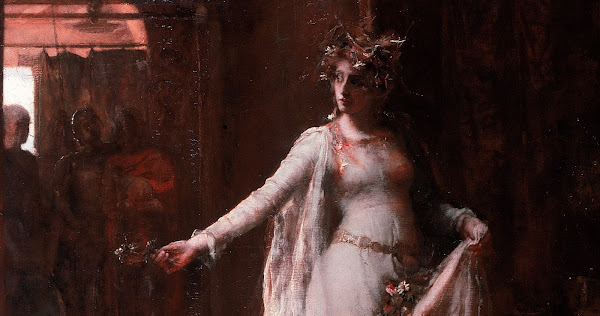
In her alleged madness, Ophelia says things that seem merely mad ramblings. But to original audiences, these may have been allusions to well-known tales, and there may be a reason for their ordering. First: OPHELIA: They say the owl was a baker’s daughter. Lord, we know what we are but know not what we may be. God be at your table. (4.5.47-49) [1] Second: OPHELIA:  You must sing “A-down a-down”—and you “Call him a-down-a.”—O, how the wheel becomes it! It is the false steward that stole his master’s Daughter. (4.5.194-197) Consider: “THE OWL WAS A BAKER’S DAUGHTER” is a reference to a tale in which a baker’s daughter is turned into an owl after being repeatedly ungenerous with a beggar at the door - who was Jesus in disguise. This is a folktale retelling of the gospel tale of the Rich Man (Dives) and the beggar Lazarus.[2] Ophelia summarizes: “Lord, we know what we are but / know not what we may be.” Ophelia may feel punished, like the baker’s daughter, and as people in Denmark’s ...

Part 16: Ophelia, priestess and peace-parted mystic

Image
To Elizabethans, preparing to die a “good death” involved such things as 1. generosity and love for the community; 2. repentance of mistakes, sins, harm to others; 3. seeking God’s favor, grace, forgiveness; 4. contemplating God at the moment of death.   With these, one might be considered a “peace-parted” soul [1]. In Hamlet, Shakespeare shows that Ophelia’s death not only conforms to all of this, but that she is a kind of priestess [2], mourning in song, offering prayers, flowers, symbolic advice, and blessings. 1. GENEROUS: Ophelia sings of her father’s death [3], and of the loss of Hamlet’s love [4], generously expressing grief that others avoid. She prays for Hamlet [5]; sings, and speaks words of blessing as if directing her congregation to sing [6]; bids Claudius “God [yield] you” [7]; bids Gertrude that her true love will be recognized not as a king but as a pilgrim [8]; speaks of transformation [9]; bids that God will be at others’ table [10]. In place of communion, she ...

Rethinking Ophelia and the Virgin Mary

Image
It is said that in the patriarchy of Shakespeare’s world, characters like Hamlet sort women into two categories: Virgin or whore. Ophelia and Gertrude can’t live up to an iconic model like the Virgin Mary. [1] In this way, we may view the Virgin Mary in a class by herself, sinless “Mother of God” who conceived Jesus by the Holy Spirit, and not by any man, and therefore to view Ophelia and Gertrude as far lesser mortals. [2] I will focus this post on Ophelia. I have come to believe, however, that it’s better to consider some of the many things Ophelia has in common with the Virgin Mary story rather than how Mary is in a class by herself. The story claims that Joseph, after a dream, did the honorable thing and married her (Matt 1:18-25). So the story is not merely about virginity, but also about treating a pregnant woman with compassion. If Hamlet had learned that he had made Ophelia pregnant, would he have acted in love to marry her? From his graveside declaration of his love (5.1.285...

The Winter’s Tale & Hamlet: Common Themes & Political Concerns?

Image
If you have viewed the recently available Shakespeare's Globe production of The Winter's Tale (more information near the end of this blog post), you may have noticed many themes and story elements in common with Hamlet (and perhaps other Shakespeare plays as well). In fact, Hamlet and The Winter’s Tale share a number of important features that are perhaps instructive regarding the political interests and moral concerns of the time. [Image via Shakespeare's Globe] Consider: Both Hamlet and The Winter’s Tale are about what is appropriate mourning for the dead: - In Hamlet , the mourning by Gertrude of her husband's death, and by Claudius, of his brother's death, are too short in Hamlet's opinion. - In The Winter’s Tale , in spite of the real need for Leontes to demonstrate a very real repentance for his grave mistakes, the mourning may seem too long. - Hamlet involves suspected adultery, poisoning, conspiracy to poison, and revenge. - The Winter...

Ophelia: "The false steward that stole his master's daughter"

Image
OPHELIA: "THE FALSE STEWARD THAT STOLE HIS MASTER'S DAUGHTER" In recent years, scholars* have identified a cryptic statement Ophelia makes: “It is the false steward that stole his master's daughter” (4.5). They now think this points to a Ben Jonson play in which a young girl is taken by a steward and passed off as his own while the father is away at war. Years later, she falls in love but is told she is unworthy of the match, when in fact she is worthy by her true parentage. This changeling theme resembles the story of Jesus, apparent son of a carpenter, but actually of a heavenly father. I have posted before of how Francisco of Assisi (see sentinel name) renounced his earthly father in favor of a heavenly one, and how, after his Jonah-like sea-voyage, Hamlet finds a heavenly father in Providence. Ophelia is told by Laertes that she is "unvalued"/unworthy of marriage to Hamlet, who made to her “almost all the holy vows of heaven” (a marriage propo...