Posts

Showing posts with the label Graveyard Scene

Yorick, the Gravedigger, Emmaus, and St. George (Emmaus Postlude, Part 8)

Image
The name Yorick [1] may come from the same root as St. George [2], patron saint of England since 1348 : from the Greek “Georgios”: from ge (γῆ)  - 'earth, soil' - and ergon (ἔργον), 'work' [3]. Yorick, as “earth worker.”   The gravedigger in Shakespeare’s Hamlet is called “Goodman Delver” by his friend (5.1.14). - So the gravedigger and Yorick echo one another in more ways than foolery… This relates also to my series on the Emmaus echo in 5.1, the graveyard scene: the story of Jesus’ appearance to the disciples on the road to Emmaus [4] was a gospel read in church on the first Monday after Easter every year of Shakespeare’s life [5]. In that gospel, two disciples on the road are mourning the death of Jesus. They meet a stranger (somehow a real or figurative Jesus, unrecognized [6]) who shows them compassion, listens, scolds them for their flawed thinking, and gives them hope, explaining the scriptures to them. These are all things Jesus had done for them. The disciple...

INDEX: Emmaus in Hamlet's Graveyard (and a Venice Courtroom)

Image
At some point in my work on Hamlet, I realized that the first part of the graveyard scene resembles the gospel tale of the appearance of Jesus as a stranger to the two disciples on the road to Emmaus: In the graveyard scene, instead of two disciples, it's two Danes, and instead of being on the road to Emmaus, they're on the road to Elsinore. Instead of recognizing a supernatural being in the breaking of bread (one of the actions at the Last Supper), they recognize the skull of Yorick (fool of "infinite jest" -a sort of god of fools) in the clown/gravedigger's tale of poured wine (a flagon of Rhenish wine Yorick poured on the gravedigger's head). Something similar occurs in the courtroom scene of The Merchant of Venice, where Portia is the disguised stranger later to be recognized, not in the breaking of bread, but in the breaking of ring-vows, when rings that two men had promised never to part with until death are given away. The Jonah echo in Hamlet's sea...

Part 14: Ophelia's figuratively incestuous family

Image
Ophelia’s brother and father are overly protective of her chastity [1], too suspicious that Hamlet might take advantage of her. Like a lover or spouse, Laertes leaving for France tells Ophelia, “do not sleep, But let me hear from you” [2]. Biblical sayings urge welcome for strangers, which involves risk; but they also discourage fear [3]. Laertes, in contrast, repeatedly urges Ophelia to fear Hamlet [4]. After warning her to be chaste, Laertes tells Ophelia to remember his advice. Ophelia replies, "'Tis in my memory lock'd, / And you yourself shall keep the key of it."[5] Chastity can be a virtue, keeping something of great value secret, disclosed only in an intimate, faithful relationship. Ophelia’s promise to Laertes is analogous: she has the feminine lock and he the masculine key, suggesting a figuratively incestuous relationship. Polonius mistrusts his children’s secret, so he figuratively rapes Ophelia's memory by demanding she disclose it. [6] Ten lines ea...

Part 7: Ophelia's Gravedigger: They "sat on her"

Image
We should resist the temptation to treat the gravediggers and their clowning in Hamlet 5.1 as mere comic relief: They prepare audiences and readers to view the “churlish priest” more critically. GRAVEDIGGER  Is she to be buried in Christian burial, when she willfully seeks her own salvation? [1] (Shouldn’t all people seek their own salvation? “Willfully” suggests a parody of the Protestant idea that we are saved by “faith alone,” not by works. But by Gertrude's account, it is not at all clear that Ophelia committed suicide - it is a mystery - so why assume?)   OTHER  I tell thee she is. Therefore make her grave straight. The crowner hath sat on her and finds it Christian burial. GRAVEDIGGER  How can that be, unless she drowned herself in her own defense? [2][3] (The gravedigger mangles “The coroner’s inquest sat to consider her death,” which becomes “The crowner hath sat on her.” Funny but disturbing, to sit on the corpse of a drowned woman. The original spelling wa...

Part 1: The Controversy over Ophelia's Death in Hamlet

Image
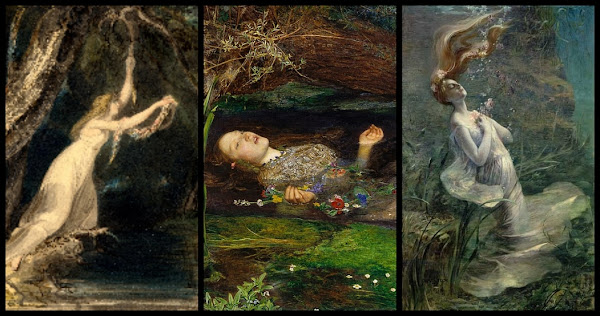
If you ask an average Shakespeare reader or viewer to tell you how Ophelia dies in Hamlet, many might say “suicide,” or “she drowns herself.” But the play presents a controversy of at least seven interpretations of her death, ranging from accident to suicide. [1] These are represented by 1. Gertrude; 2. the king (implied); 3. the Coroner’s Inquest; 4. the Gravedigger-clowns; 5. Hamlet; 6. the “churlish priest”; and 7. Laertes. Some of these agree more with the others, some not. Educators often say it’s good to “teach the controversy,” so instructors might have students seek, document, and reflect on the position of each party, as well as other possibilities (with or without evidence). 1. GERTRUDE offers the earliest account of Ophelia’s death, saying Ophelia fell in the brook while decorating a willow with flowers, when an “envious sliver” of a bough broke [2]. Her garments helped her float for a while [3], but they became “heavy with their drink” and “Pulled” her “To muddy...

Emmaus Key Change in Hamlet & Merchant of Venice (Emmaus in Hamlet, part 6)

Image
When a song or orchestral piece changes keys, we not only hear it with our ears, but also feel it in our bodies, our bones, vibrating at a new frequency. Shakespeare accomplishes something similar, not only in Hamlet , but also in The Merchant of Venice when he sets up one character as a Christ-figure, then changes key, shifting to a new (improved) Christ figure. [Image: “Supper at Emmaus” (French: Le Repas d'Emmaüs), 17th century, by Matthias Stom (1615–1649). Collection: Museum of Grenoble. Public domain, via Wikimedia .] In Luke 24:13-35, after Jesus dies and rises, he later appears as a stranger on the road to Emmaus. I’ve noted previously how in Hamlet , biblical allusions suggest the ghost is a flawed Christ-figure/victim, with divine attributes.[1] But in the graveyard scene (5.1), instead of the ghost appearing as the stranger[2], our expectation is redirected: Yorick’s skull and the gravedigger-clown fill the role of the stranger in whom divine "infinite jest...

Heresy in Hamlet 5.1 Emmaus figures: Part 2

Image
My last post explained potentially blasphemous implications of offering a fool (Yorick or the gravedigger) as the Emmaus figure in Hamlet 5.1. I will explore other heretical or atheistic implications of the graveyard scene’s Emmaus echo in this post. [Image: Painting by Caravaggio(1571–1610) "Supper at Emmaus," 1606. Collection: Pinacoteca di Brera. Pubic domain, via Wikipedia .] If you missed that previous post, you can find it here : https://pauladrianfried.blogspot.com/2022/05/blasphemy-and-heresy-in-hamlets-emmaus.html In Shakespeare’s time (as now), the tale of Jesus’ appearance to the disciples on the road to Emmaus after his crucifixion [1] was commonly read as a tale of miraculous power. This Jesus, supernaturally and gloriously resuscitated, was one with God, omnipotent and capable of anything: to appear in a locked room, or to prevent disciples from recognizing him. This may have distorted the original meaning of the tale: The disciples may have met a st...

Coroner's Drowning Inquest as "Crowner's Quest" in Hamlet

Image
In David Bevington's book Murder Most Foul: Hamlet Through the Ages, Bevington includes the following parenthetical observation regarding suicides: (Coroners in Shakespeare's day were instructed to issue of suicide in such dubious cases, partly because swimming was regarded as reckless self-endangerment and thus virtually a suicidal act, but more importantly because the estate of the deceased would then go to the crown.) (60) Bevington died last summer in his late 80s, and the book was first published in 2011 when he was about 80. On this point in the parenthetical above, there is no footnote, no mention in the end notes. (If this is a commonly-known understanding, and if many other sources confirm it, and if you are aware of some of those, please let me know). The general logic is that suicide is self-murder, and murder violates one of the ten commandments ("thou shalt not kill"), so a suicide (or even an attempted suicide) is therefore a criminal, and the land...