Posts

Showing posts with the label Freud

Hamlet's Transcendent paths of Francis, Bernard, & Yorick, vs. Freud's Oedipal path

Image
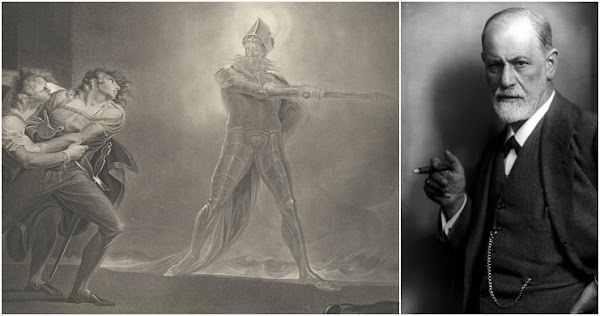
Shakespeare's Hamlet offers glimpses of two ways of transcending dysfunctional parentage: a) The limited path of Freud's Oedipal complex, or b) Yorick and the paths of Francis of Assisi and Bernard of Clairvaux. In the first, the son kills the father-figure to reclaim a lost closeness to the mother. If the father is a tyrant and the son resorts to violence to replace him, this is a very limited, temporary transcendence, with the son too much like the father he replaces [1]. Francisco and Bernardo are the names of sentinels, the first two characters on stage in the play. Together, they are the names of the Pazzi assassins [2], but individually they are names of saints: - Francis of Assisi and Bernard of Clairvaux didn't kill their fathers, but Francis famously renounced his abusive father before the bishop, stripping off his clothes and giving them back to his father, saying that he had a father in heaven. - St. Bernard’s biological father and brothers eventually joined t...

Prodigal is Oedipal spelled badly - Biblical Allusions as Lenses for Hamlet

Image
HAMLET AS PRODIGAL (OEDIPAL SPELLED BADLY) OEDIPAL [1]: Freud claimed that men want to kill their fathers and possess their mothers, like Oedipus, whose father (Laius) was in fact a jerk. Laius made bad karma, abandoning his son to die.[2] - Oedipus doesn't know he was saved and adopted, so he thinks the prophecy means he will kill his adoptive father and marry his adoptive mother. He doesn't want that, so he flees. - While fleeing, his biological father is cruel to him on the road, and Oedipus kills him, not knowing it is his father. - Having suffered trauma as a child, Oedipus may be lashing out in revenge at a stranger who happens to be his father. All fathers die, most before their sons. But the tale is also a metaphor for how children need to establish their own identities as distinct from their parents (though some sons may "want a girl / just like the girl / that married dear old Dad," as the song says.[3]) We can follow Freud and read Hamlet as Oedipal. PRODIG...

Part 13: Ophelia, Hamlet, and 13 ways of looking at madness

Image
Often we speak of Ophelia as having really gone mad, while Hamlet only pretends . But in fact the play uses the word “mad” in many ways, as do critics. So, with a nod to Wallace Stevens’ poem title [1], a list: MADNESS AS DEMONIC POSSESSION: Horatio worries that the ghost is demonic and “might deprive [Hamlet] sovereignty of reason / And draw [him] into madness” (1.4.77-82). MADNESS AS FEIGNED: After meeting with the ghost (1.5), Hamlet says he will “put on” “an antic disposition” (1.5.189-192), as did Odysseus, King David, and Amleth in the Saxo Grammaticus source; but Hamlet’s encounter with the ghost may actually be driving him insane… [Edit 9/24/2023: In 3.1.7-10, Guildenstern also comments on Hamlet's feigned madness: "Nor do we find him forward to be sounded, But with a crafty madness keeps aloof When we would bring him on to some confession Of his true state." ] MADNESS AS WHAT LOST LOVE CAN DO: Polonius believes Hamlet has been made insane by the los...

Part 1: Hamlet Before Freud ("Tough Love" for Gertrude and Ophelia)

Image
If we take seriously that Hamlet, Horatio and the sentinels saw a ghost from purgatory, [1] then we have to consider this possibility: Hamlet is harsh with his mother and Ophelia because he thinks he has seen his father’s ghost from purgatory who claims to be there because he had sinned, committed foul crimes. Hamlet doesn’t want the two women he loves most to end up in purgatory like his father, or worse, in hell. He scolds Ophelia and tells her to get to a nunnery; he scolds his mother, tells her to repent of her incestuous marriage, a relationship that began, according to the ghost, with adultery when his father was still alive. Hamlet feels a duty to be harsh with them because he fears for their eternal fate. If one encountered a ghost from purgatory as Hamlet did, and loved his mother and Ophelia, it makes sense that one might want to warn them, to spare them such a fate. [2] To be clear, while many in Shakespeare’s time believed in ghosts [3], there were also those who did not,...

Overall Major Stengths & Weaknesses: Notes on Asimov on Hamlet, Part 7

Image
Some Shakespeare fans are huge fans of Asimov's two-volume work, Asimov's Guide to Shakespeare . It surveys all the plays, provides cross-references to how various plays share references, especially to elements of history and classical mythology, but also to a smaller number of biblical tales. It's also accessible, free of scholarly jargon that often makes many readers feel excluded from the intended audience. These are among its greatest strengths. The explanations of distant European history especially helps to place Hamlet in a much larger and interesting context, especially in the sweep of political and military history, and that's quite interesting. It gives a sense that very old history matters, and that the forces of history keep finding expression even in the present. But at least as far as its treatment of Hamlet is concerned, Asimov's Guide is not without a number of glaring weaknesses. First published in 1970, Asimov's Guide is terribly dismiss...

What I'm Reading: Absent Fathers in Hamlet & Other Lit

Image
Before the COVID-19 crisis shut down libraries, I had a number of books on inter-library loan from college and university libraries in Minnesota, within a few hours of where I live. The books are now long overdue, but as libraries are all closed, I’m getting no notices of late books. Two of these books are about absent fathers, one by Avi Erlich relating to Hamlet (Hamlet’s Absent Father, Princeton University Press, 1977), the other by Paul Rosefeldt relating to modern drama in general (The Absent Father in Modern Drama, Peter Lang, 1995). The second book (Rosefeldt) gives a good overview of work on absent fathers by Freud and some of his contemporaries, and also an essay on Oedipus, The Libation Bearers, and Hamlet. Yet quite a bit of the thinking on absent fathers seems muddied in a number of ways: 1. FREUD ON KILLING THE FATHER: Freud’s position is one of atheistic scientific reductionism. He assumes that religions and the idea of a father-god are human inventions, which ...