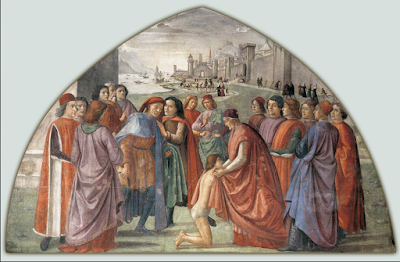
Posts

Showing posts with the label Pazzi Conspiracy

Religious and Biblical Allusions in Hamlet 1.1

Image
Many viewers and readers of Shakespeare's Hamlet (including me) approach the play from a secular point of view. Yet historians and Shakespeare scholars know that the play was written at a time when there were many religious controversies: Shakespeare's older sister had been baptized Catholic under "Bloody" Mary I, when Protestants had been burned at the stake as heretics. Shakespeare had been baptized under Protestant Elizabeth I, during whose reign many Catholics were executed as traitors, hung until nearly dead and disemboweled so they could see their organs ("drawn and quartered"). Catholics believed in transubstantiation, that the host was actually the body of Christ, but English Protestants took that language less literally. Catholics believed in purgatory, that imperfect but mostly good souls might be purified before entry into heaven, while Protestants believed that at the moment of death, one's fate was sealed, bound for heaven or hell at th...
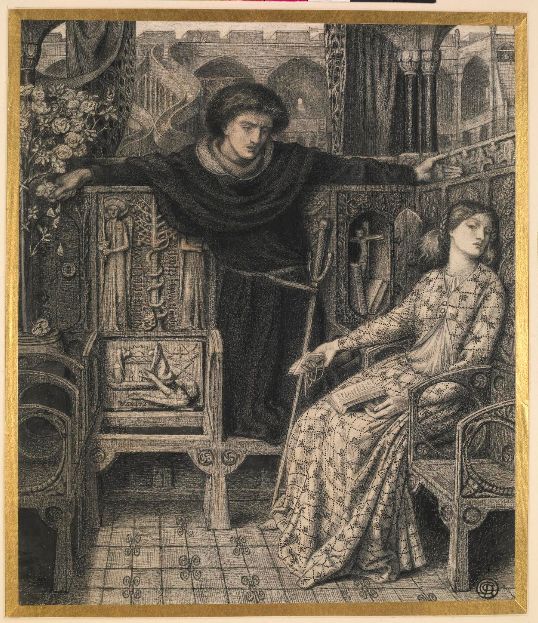
Hamlet Sentinels & "A House Divided"

Image
"A house divided" is a phrase famously associated not only with Abraham Lincoln and the US Civil War, but also with King David and divisions with his sons. - It could describe England, split between Catholics and Protestants. - But it could also describe Christianity more basically, divided between some like St. Francis of Assisi who preached and lived nonviolence and love of enemies, and others like St. Bernard of Clairvaux, who helped found the Knights Templar and preached in favor of the Second Crusade. - The fact that Shakespeare named his sentinels after two Catholic saints may not indicate a Catholic allegiance, but instead, attention to the "house divided" of Christianity, where some wished to follow the path of Francis, willing to "suffer the slings and arrows of outrageous fortune," and others preferring to follow the path of Bernard, and to "take up arms against a sea of troubles."  QUESTION: Why would Shakespeare - at a time of English...

Toxic Masculinity Distracts While Ophelia Drowns, 4.7: (Part 7) Labors of Gratitude and Regret in Hamlet

Image
Part 7: Laertes' Labors of Gratitude & Regret: Toxic Masculinity Distracts While Ophelia Drowns ( Hamlet 4.7) This is the latest installment in a multi-part series examining how characters interact in Hamlet, offering opportunities, gifts, planting seeds for future inspiration, or for changes of heart & mind. It follows ideas from Lewis Hyde (“The Labor of Gratitude,” a chapter in his book, The Gift: Imagination and the Erotic Life of Property ). For an index of previous posts in this series, see the end of this post. Sorting Out Hamlet 4.7 The seventh scene of Act Four in Hamlet may seem packed with superfluous details that could be (and probably often are) cut: It’s a long play; usually, cuts are made. Laertes still has questions about his father’s death: if Hamlet intended to kill Claudius, then why didn’t Claudius take action against Hamlet? Claudius shares more flattery with Laertes, conveying to Laertes some things Claudius claims (truthfully or not) that Haml...

C. Elliot Browne on Francisco, Bernardo, & Pazzi Conspiracy

Image
C. ELLIOT BROWNE WROTE IN 1876 that the names of the first two characters on stage in Hamlet may allude to assassins in the Pazzi conspiracy.* Modern readers may think: Never heard of that! Are there Pazzi allusions in other Elizabethan plays? In a 1995 book, Frank Ardolino shows that Thomas Kyd’s play, The Spanish Tragedy—the best-known English revenge tragedy before Hamlet—contained allusions to the Pazzi conspiracy. If Kyd’s play did so, it’s easier to think that Hamlet contained them as well. But the sentinels in Hamlet are not assassins. And there are correspondences between stories of Francis of Assisi and Bernard of Clairvaux, and Hamlet - so the Pazzi allusion probably wasn’t the only thing on WS's mind. Q: But why might scholars have neglected the possibility that these names are allusions to the saints? A: England after the reformation, and Protestants after Luther in general, rejected the Catholic cult of the saints - and may have avoided painful memories of lost ...

Four Approaches to Francisco & Bernardo in Hamlet

Image
FOUR APPROACHES to the names of sentinels Francisco & Bernardo at the opening of Shakespeare’s Hamlet: 1. Pay no attention to the names. Just enjoy. 2. Assume (as Joseph Ritson did, writing in 1783) that Shakespeare didn’t know his Latin or Italian well and sometimes chose such names randomly. This may imply permission to ignore these names (as in 1, above), but you can feel you’ve taken the playwright down a notch in the process, avoiding Bardolatry (à la Ritson). 3. Assume (as C. Elliott Browne did, writing in 1876) that these names point to two key assassins in the Pazzi conspiracy of 1478. The allusion therefore points to papal corruption and Machiavellian scheming, which could seem anti-Catholic, justifying England’s break from Rome. Scholars with a Protestant bias can feel self-satisfied with this one and look no further. Or the connection to names of Pazzi assassins may be cover (out-wit the censors) for #4: 4. Consider that the names point to Saints Francis of A...

FATHER ISSUES FOR HAMLET & FRANCISCO

Image
Shakespeare's Hamlet has father issues, and only after being spared by pirates at sea does he refocus from his father's ghost to what he sees as the hand of Providence. It might have been better if he'd made the break sooner. But Shakespeare chose to name the first character on stage Francisco, a sentinel, and a possible allusion to Francis of Assisi, who also had father issues, and whose monasteries spread all over Europe and to England, where hundreds of monasteries were "dissolved" during the reign of Henry VIII - a nice way of saying land was stolen to be sold off by the crown and for political favors. [April 12, 2024 note: We may also observe that, just as Francis of Assisi had father issues - and famousely sought to separate himself from an abusive father in favor of a heavenly one - Bernard of Clairvaux was famous for having said to have had a dream in which he was fed on milk from the breast of the Virgin Mary, a vision portrayed in various paintings....

INDEX OF POSTS on Francisco & Bernardo

Image
Starting in 2017, I did a number of posts about Francisco and Bernardo, two sentinels in the opening scene who may have been named not only after the Catholic saints (Francis of Assisi, and Bernard of Clairvaux), each of whom have rich stories and possible reasons for allusions, but also after the two assassins in the Pazzi Conspiracy. The possible implications for holding up a mirror to the times and to Shakespeare's original audiences are wide-reaching and profound. MIGHT ART LOST IN DISSOLVED MONASTERIES HAVE HELPED CONNECT HAMLET'S FRANCISCO & BERNARDO TO THE SAINTS? https://pauladrianfried.blogspot.com/2017/04/might-lost-art-in-dissolved-monasteries.html - April 03, 2017 FATHER ISSUES FOR HAMLET & FRANCISCO https://pauladrianfried.blogspot.com/2019/01/shakespeares-hamlet-has-father-issues.html - April 10, 2017 TOP SIX REASONS Shakespeare probably named sentinel Francisco after Francis of Assisi https://pauladrianfried.blogspot.com/2017/04/top-six-reas...