Posts

Showing posts with the label Catherine of Aragon

Why Claudius as a (Thomas) "More" was an insult in Hamlet 3.4

Image
Thomas More and Hamlet’s uncle Claudius were both, in their own ways, defenders of incestuous marriage. More would not agree to Henry VIII’s plan to break from Rome to get his divorce from his first wife, a marriage that the church had considered incestuous from the start: Henry and Catherine had to ask Rome for special permission to marry in the first place [1]. So for Hamlet to refer to Claudius as a “moor” - meaning also a “More” - would be entirely appropriate.  In Act 3, scene 4, when Hamlet refers to his father favorably as a “fair mountain” and his uncle insultingly as a "moor," to the Elizabethan ear, audiences heard no difference between "moor," or "Moor," or the last name of Thomas More [2].  Today, many may consider Thomas More a martyr for conscience who opposed Henry’s quest for divorce [3]. There is nothing wrong with this view, but it is incomplete: It doesn’t consider how some Elizabethans understood More.  By the end of her life, Elizabe...
Part 41: Love Madness: Ophelia, Gertrude, and Helen of Troy

Image
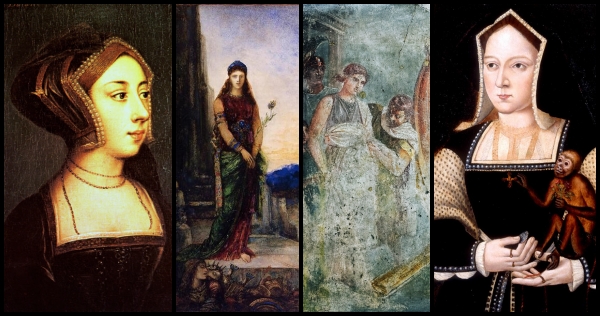
QUEEN: [...] for your part, Ophelia, I do wish That your good beauties be the happy cause Of Hamlet’s wildness. So shall I hope your virtues Will bring him to his wonted way again, To both your honors. OPHELIA  Madam, I wish it may.  (3.1.42-47)   Queen Gertrude expresses hope that Ophelia’s father Polonius may be correct in thinking that Hamlet is mad for the loss of Ophelia’s love. Shakespeare often described love as a madness in need of a cure.[1] This may be more significant than one might assume at first glance, for at least three reasons.   First, Gertrude’s comments apply not only to her son but also to her new husband, even if she doesn’t know it. For Claudius to kill his brother and take the throne and his brother’s wife seems a kind of madness. Gertrude’s “virtues” were not enough to cure him. Secondly, “The face that launched a thousand ships” is the famous Christopher Marlowe line describing the beauty of Helen of Troy. To steal her, Paris risked war, w...

How Hamlet toyed with Elizabethan expectations: Incestuous marriage, adultery, right succession

Image
If Londoners in Shakespeare’s England heard that his play, Hamlet, was in part about the incestuous marriage of a king, what did they expect? Elizabeth was still queen when it was first performed, and still remembered long after James took the throne. Some thought she was only legitimate if her father, Henry VIII, had been right to divorce his first wife, Catherine of Aragon, over claims that the marriage violated biblical laws.[1] There had been a popular earlier play, A Looking Glass for London, about a king saved from an incestuous marriage by an act of God (lightning bolt). The king heeds a prophet sent by God and repents. Happy ending. Such a play could affirm Protestant Elizabethan hopes, that yes, biblically incestuous marriage is wrong, and Henry VIII was right to divorce Catherine, although the pope disagreed. And yes, he was right to break with Rome to get his divorce. Therefore, his second marriage was legitimate, Elizabeth was legitimate, and all was right with the ...

"Incestuous" marriages of Henry VIII and Claudius: two relevant biblical passages

Image
What Bible verses relate to the allegedly incestuous marriages of Henry VIII and Claudius in Shakespeare’s Hamlet? Mainly two. These may seem contradictory, but examined carefully, make sense. [Image: Mishneh Torah (Maimonides), Perugia, c. 1400 (Elie Kedouri, The Jewish World, 1979, p. 193). Illuminated Hebrew manuscript. National Library of Israel, Jerusalem. Photo is from replica at the Diaspora Museum, Tel Aviv. Fair use. Via Wikimedia.org .] First, Arthur Tudor died without any children, so Deuteronomy 25:5-10 seems to apply: Verse 5 explains: If a brother dies without children (especially a male child in Hebrew biblical culture), his widow should not marry a “stranger” outside the family; a surviving brother should take the brother’s widow as a wife. (This is called "levirate marriage.") Verse 6: The first child she bears by this new marriage will be considered the child of the dead brother, to carry on his line and legacy. (Yes, very patriarchal.) Verses 7...

Hamlet and the Incestuous Marriages of Claudius and Henry VIII - via John Erskine Hankins

Image
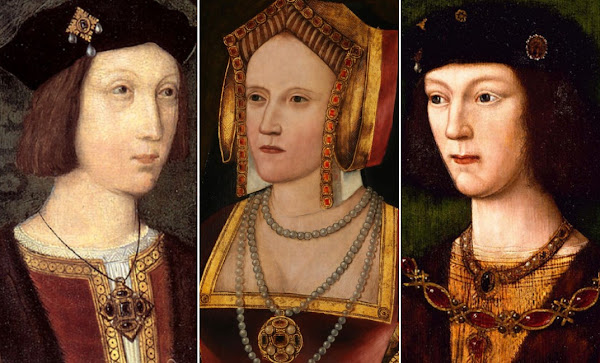
Shakespeare certainly wrote of Claudius and Gertrude’s “incestuous” marriage with Henry VIII in mind. Early audiences recognized it. In teaching the play, is it a mistake to omit that context? [Left: Arthur Tudor, Prince of Wales (1486-1502), "regarded as the only surviving contemporary portrait"; circa 1500. Anglo-Flemish School. Private collection, Hever Castle, Kent. Public domain. Image via Wikimedia . Center: Catherine of Aragon (1485–1536), originally identified as Catherine Parr, but now recognized as Catherine of Aragon. Unidentified painter. 16th Century. Lambeth Palace. Public domain, via Wikimedia . Right: Henry VIII of England (1491-1547), circa 1509. Attributed to Meynnart Wewyck. Denver Art Museum. Public domain. Image via Wikimedia ]. From “The Character of Hamlet,” by John Erskine Hankins* (1941), p.101: ~~~ It will be remembered that Henry VII's eldest son Arthur was married to Katherine of Aragon to cement an alliance between England and Spa...