Posts

Showing posts with the label Veronica

Part 38: Christ figures in Hamlet: Ophelia, Gertrude, Hamlet (Good Friday 2024 post)

Image
Today is Good Friday. In Shakespeare’s England, church rituals spoke of baptism as a dying to self in Christ, so as to be made new in him [1]. Contrary to some Shakespeare scholars who explicitly resist the idea of Christ-figures in the plays (including Harold Jenkins, Arden editor), all the baptized are called to be Christ-figures [2], imitators of Christ. The spiritual rhythm in medieval mystery, morality and miracle plays assumes all are sinners, but if they express sorrow for their sins, they can know God’s mercy and be saved. [3] Any drama in which a person who dies is saved, is a comedy; the only tragedies are those in which a sinner resists salvation. In her madness, Ophelia expresses regret through her story of the baker’s daughter [4]. Gertrude explains that Ophelia falls in the brook because of an “envious sliver” of willow [5]. Willows in Psalm 137 were incorporated weekly in Christian vespers and associated by St Benedict of Nursia [6] and Martin Luther [7] with the cruci...
Good Friday/Christ’s Passion Allusions in Hamlet

Image
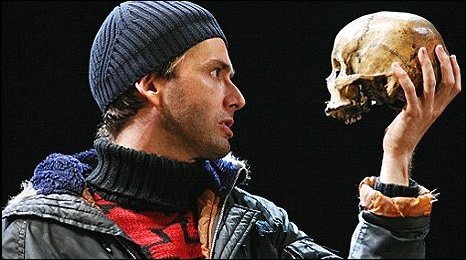
Christianity has long used the Friday before Easter to commemorate the story of the betrayal, torture, crucifixion, and death of Jesus. These stories are retold in the Bible (Mark 14-15, Matthew 26-27, Luke 22-23, John 18-19). [Image: David Tennant in 2008 RSC production of Hamlet, directed by Gregory Doran. Via BBC . Fair use.] Shakespeare’s Hamlet echoes a number of details from these stories and from larger Christian tradition. (See also Shaheen.) A few examples: [1] 1.1.125-137: Horatio describes the dead rising and strange signs in the heavens upon the death of Julius Caesar, but Matthew 27:53 similarly describes the dead raised at the moment of Jesus' death, and Luke 23:44-45 describes an eclipse. 1.1.162 and 163-4: The ghost hears the cock crow, and Horatio comments, “it started like a guilty thing / Upon a fearful summons.” Each of the gospels tells of Jesus predicting that Peter will deny him, and later, that the prediction comes true, marked by the crowing of a...

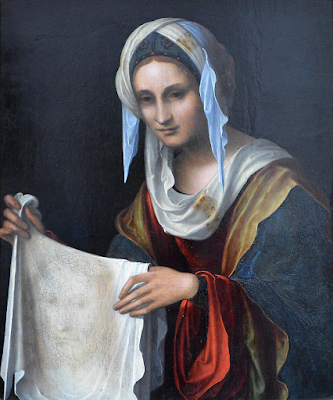
THE GHOST OF VERONICA HAUNTS HAMLET [or, did Gertrude have a Veronica complex?]

Image
In his book, “Images of Christ in Art,” British art historian and museum director Robert Neil Macgregor notes that from 1200 CE on, “wherever the Roman Church went, the Veronica would go with it." In legend, after St. Veronica wiped the face of Jesus on his way to crucifixion, the image of Christ’s face (“the Veronica”) remained on the cloth. Her act later became part of the stations of the cross ritual in Roman Catholic and English churches. Note: In the Christian legend, Jesus is doing strenuous physical activity of cross-carrying when a woman, Veronica, wipes his face as he goes to his death; in Hamlet 5.2, the prince is doing strenuous physical activity of a fencing match when a woman, Gertrude, wipes his face as he goes to his death: GERTRUDE: He's fat, and scant of breath. Here, Hamlet, take my napkin, rub thy brows [….] / Come, let me wipe thy face. What was the Bard thinking? Not that Gertrude = Veronica, but that Shakespeare, immersed in his cultu...