Posts

Showing posts with the label Roland M. Frye

Part 38: Christ figures in Hamlet: Ophelia, Gertrude, Hamlet (Good Friday 2024 post)

Image
Today is Good Friday. In Shakespeare’s England, church rituals spoke of baptism as a dying to self in Christ, so as to be made new in him [1]. Contrary to some Shakespeare scholars who explicitly resist the idea of Christ-figures in the plays (including Harold Jenkins, Arden editor), all the baptized are called to be Christ-figures [2], imitators of Christ. The spiritual rhythm in medieval mystery, morality and miracle plays assumes all are sinners, but if they express sorrow for their sins, they can know God’s mercy and be saved. [3] Any drama in which a person who dies is saved, is a comedy; the only tragedies are those in which a sinner resists salvation. In her madness, Ophelia expresses regret through her story of the baker’s daughter [4]. Gertrude explains that Ophelia falls in the brook because of an “envious sliver” of willow [5]. Willows in Psalm 137 were incorporated weekly in Christian vespers and associated by St Benedict of Nursia [6] and Martin Luther [7] with the cruci...

Gatekeeping and Religious Turns in Shakespeare Scholarship (Part 8: Religious Bias in Shakespeare Scholarship)

Image
If we are to believe Roland Frye (1963) [1], what was later called “The Turn to Religion in Early Modern English Studies” [2] may actually have been more of a *return* to religion on renewed terms, after a turning away that was aided in part by Frye and a bit of Protestant gatekeeping. Frye writes, “In the train of [G. Wilson] Knight’s influence, we have had and continue to have a great wave of supposedly theological analyses of Shakespeare: again and again we are informed of the discovery of some new Christ-figure or Christ-allusion in the plays, or we are advised as to the eternal destiny in a future life of Shakespeare’s stage characters, or we are introduced to some doctrine which serves as a theological structure upon which an entire plays is built.” (5) At least at that time, Frye believed there was too much “supposedly theological analyses of Shakespeare,” marked by sloppy or ill-supported religious claims, and poorly thought out theology, often for not being Protestant enou...

Roland Frye's Protestant Bias (Part 7: Religious Bias in Shakespeare Scholarship)

Image
When he was a research professor at the Folger Shakespeare Library, Roland M. Frye wrote Shakespeare and Christian Doctrine (1963),* which criticizes Shakespeare scholars like G. Wilson Knight (the subject of last week’s post) and others who, according to Frye, offered too-simplistic or unsupported religious readings of the plays (4-6, 19-42). [* All quotes here are from my 1963 edition, published by Oxford University Press. Frye's Shakespeare and Christian Doctrine is still published through the Princeton Legacy Library .] Frye was a Protestant theologian and Presbyterian elder. Protestant writers believed in the utter depravity of humanity due to original sin since the fall of Adam and Eve; this could be overcome by “faith alone,” not by works. Frye stresses Protestant views throughout. Initially Frye notes that people in Shakespeare’s time who conformed outwardly may have privately held “heterodox, heretical, or… anti-Christian opinions” (4). Later he contradicts this...

Nietzschean & Christian-Mythical Bias in G. Wilson Knight (Part 6: Religious Bias in Shakespeare Scholarship)

Image
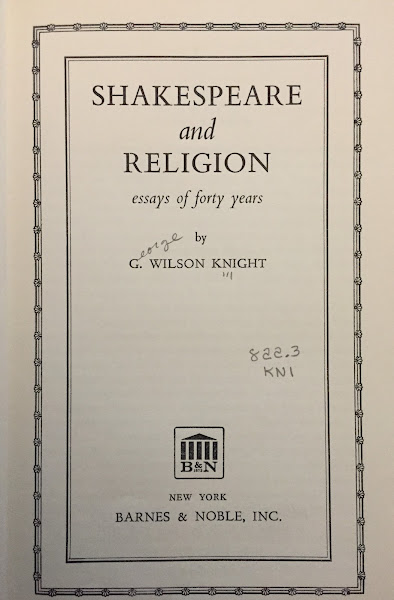
If all one knew of G. Wilson Knight (1897-1985) was that Roland Frye (1921–2005), a Folger Shakespeare Library scholar, once accused him and others of too-easy “theologizing” of too many Shakespeare plays, one might think Knight was a Christian evangelical, and Frye a champion of secular humanism. Both assumptions would be wrong. Knight was a disaffected English Protestant who admired Nietzsche and noticed archetypal trends in literature, including Christ-figures. But as such, he was painting with a broad brush, not as exacting as Protestant scholars like Frye would have preferred. In 1948, Knight wrote of Nietzsche’s idea of the “Avenging Mind”: “Hamlet… is an archetypal play, where Shakespeare watched his hero trying, sometimes successfully, more often [not], to transmute this dark thing through his own dramatic personality” (184).* [* G. Wilson Knight, Shakespeare and Religion (1967)] On Protestantism: “...perhaps our traditional Christianity leaves today a want [...] t...

Historical Criticism & Michael MacDonald's essay, "Ophelia's Maimèd Rites"

Image
This past week, one generous reader on a FaceBook Shakespeare-related forum recommended a helpful essay by Michael MacDonald called "Ophelia's Maimèd Rites," published in Shakespeare Quarterly Vol. 37, No. 3 (Autumn, 1986), pp. 309-317 (9 pages). The recommendation was in response to my blog post from last week, "Coroner's Suicide Inquest as 'Crowner's Quest' in Hamlet" which quoted David Bevington's claim that coroner's inquests were pressured by the crown to rule questionable deaths as suicides, in which case the crown often took possession of the deceased's property, since suicide was considered sinful by the church and a crime by the state. It may also have tempted the crown to the sin or vice of greed. [ Painting by Benjamin West, 1789, Boydell Shakespeare Gallery ] MacDonald doesn't explicitly claim any support for a position like Bevington's regarding pressure on coroner's inquests; in fact, he takes a more ne...

SHAKESPEARE, SUICIDE, & HOW NARRATIVE ARTS CAN HELP ADVANCE THEOLOGICAL UNDERSTANDING

Image
Gustav Klimt, Death of Romeo & Juliet, "Theatre of Shakespeare" (1886) from historic Burgtheater, Vienna, via UK Shakespeare Magazine, Twitter. Shakespeare has many plays with suicides in them. Most famously, perhaps, is the dual suicide of Romeo and Juliet. Lady Macbeth kills herself, as do Anthony and Cleopatra, Brutus, Cassius, the wife of Brutus, Timon of Athens, and a daughter of King Lear. In Lear, the blinded Gloucester wants to commit suicide by jumping off a cliff, but his son in disguise sets it up to make his father believe he has been miraculously saved. Othello kills himself after he realizes he has been tricked into killing his wife by Iago (whose name is a Spanish form of James, which makes sense considering how the English hated the Spanish after the Armada, and the Jesuits, based in Spain; but which creates cognitive dissonance when we think of how the play was written while a king named James occupied the English throne). In Hamlet, the prince c...

Shakespeare, Christ Figures, and the Critics

Image
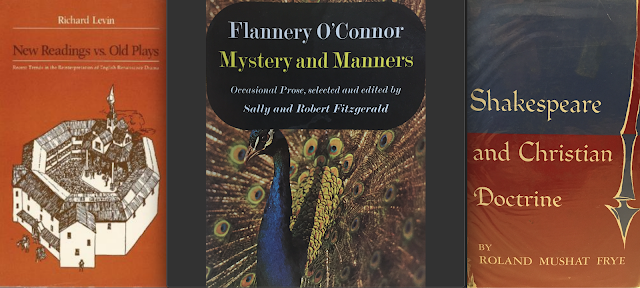
Two books in roughly the past half-century have done a good job identifying the flaws in sloppy or superficial Christian criticism that tries too hard at times to find Christ-figures everywhere. These have had good and bad effects on the way that people who are less aware of the field of Shakespeare and Religion sometimes perceive it. On the one hand, Christians should not proselytize sloppily through Shakespeare, finding religious allegories anywhere or everywhere, and if they point out religious themes or biblical echoes, they should cite evidence to support their claims. Fair enough. But some of this criticism of the Christian theologizers is fraught with its own flaws and distortions, as well as having unintended negative effects. Roland Mushat Frye was a scholar-in-residence at the Folger Shakespeare Library, and his book, Shakespeare and Christian Doctrine (1963), is often cited. Chapter 1 (19-42) is called "Theologizing Analyses: The School of Knight," named after...