Posts

Showing posts with the label Luke 16

Dives and Pauper, Hamlet, Ten Commandments, and Falstaff (Series)

Image
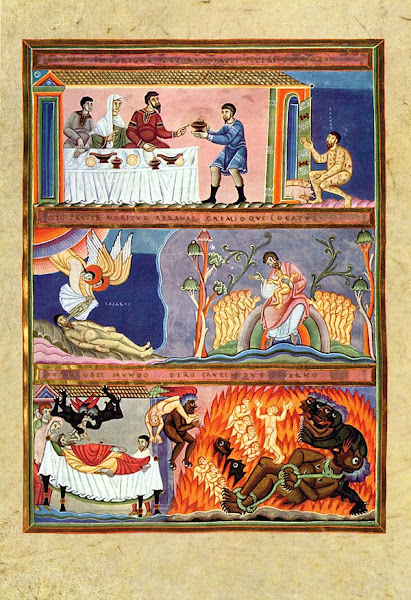
Dives and Pauper [1] was an English text from early 1400s, probably by a Franciscan, and although there are no direct allusions in the play to this Middle English text, it has interesting connections to Shakespeare and Hamlet, as well as representing the general influence of the Ten Commandments [2] on the evolution of English religious culture. The title is an allusion to Luke 16:19-31 in which a rich man (Latin: "Dives") neglects the beggar Lazarus and suffers eternal punishment while Lazarus goes to heaven [3]. Lazarus, whose body had sores that were licked by dogs, was often thought to have been a leper (hence "Lazar houses," hospitals for lepers in England). The ghost in Hamlet 1.5 thinks a “leperous distillment” of poison that his brother poured in his ear made his skin all "lazar-like" [4]. Ophelia's reference to the story of the owl and the baker's daughter is a folktale retelling, where a baker is rich in bread, but his daughter is r...

Links to Lepers in Hamlet

Image
LINKS TO LEPERS IN HAMLET: References to tales of famous lepers, confusion about them, and those who cared for them: 1. The ghost says the poison made his skin lazar-like (1.5), like that of the beggar Lazarus in Luke 16:19–31 [1];  - Claudius poured “the leperous distillment" in the “porches" of the ghost's ear (1.5): In some art, the beggar Lazarus is left untended on the porches of the rich man’s house.  - Ophelia’s “the owl was a baker’s daughter” (4.5) references a folktale retelling of the Luke 16 gospel tale;  - Horatio’s “angels sing thee to thy rest” (5.2) references the Requiem Mass lines based on the Lazarus story. 2. The saint-namesake of the sentinel Francisco (1.1) is Francis of Assisi, who cared for lepers, and famously kissed one [2]. (Katherine of Aragon’s confessor was a Franciscan, John Forest, burned at the stake for opposing Henry’s divorce.)   3. In medieval and Elizabethan times, leprosy and venereal disease were confused, and leprosy thou...

Hyperion & Lazarus: Kings, Rich Men, & Pitiless Gods - Hamlet & The Odyssey part 6

Image
In Hamlet , the prince says that, compared to his Uncle Claudius, his dead father was “So excellent a king, that was to this Hyperion to a satyr” (1.2.143-4). [1] He compares his father to Hyperion and three other pagan gods (Jove, Mars, Mercury) with his mother in the closet scene. (3.4.66-8) What are the implications of comparing his father, the dead king, to Hyperion? Are some of the implications affirmed by another allusion, to the skin-sores of the beggar Lazarus? In The Odyssey, against his advice, Odysseus' men kill and eat the cattle of Hyperion/Helios. [2] The fact that they’re hungry sailors on a long journey home doesn’t matter so much to Hyperion as their disrespect. Are they not like bread-stealing Jean Valjean in Victor Hugo's Les Misérables, starving, to be pitied? [3] Hyperion seems ungenerous, greedy, unmerciful toward the hungry sailors. As punishment, they never make it home. Consider: Hyperion and the sailors resemble the Rich Man and L...

In service of art: How visual arts may have influenced the Lazarus theme in Hamlet - part 18

Image
VISUAL ART INFLUENCING THE LAZARUS THEME IN HAMLET Scholars often think of how texts influence other texts. But what about other arts influencing texts? Some scholars consider this, but it seems that they are not in the majority. By the time Shakespeare wrote or revised his version of Hamlet for the stage, the Luke 16 tale of the rich man and Lazarus already had centuries of history of being interpreted in many forms, perhaps not only for a folksong-ballad whose origins may be older than Shakespeare ,* but also by sculptors and artists. * ( Another reference regarding an Elizabethan version of the ballad, noted by Bronson : "Bronson (Vol. II, p. 17) writes: "CHILD NO. 56: As Child's note informs us, something on the order of this ballad was in print in early Elizabethan times, and seventy-five years later was still matter for common allusion as 'the merry ballad of Diverus and Lazarus.' No early text survived, how ever, and Child had to resort to nineteenth-c...

Where's the body? Kings, Beggars, Worms, Excrement, Eucharist, Buddha Bunny, and Lazarus in Hamlet 4.3 (part 17)

Image
In Hamlet 4.3, Claudius is disturbed that Hamlet, for some inexplicable reason, has hidden the body of Polonius. Perhaps a main reason is to allow for some fascinating dialogue between Hamlet and Claudius about bodies, supper, worms, kings, and beggars, and to hint at more than this, regarding the Diet of Worms, and perhaps about Eucharist. The dialogue sounds a bit like a "Who's on First?" comic skit by Abbott and Costello: [Image from 1950s recording via Amazon.com , cropped. Fair use.] King: Now Hamlet, where's Polonius? Hamlet: t supper. King: At supper? Where? Hamlet: Not where he eats, but where 'a is eaten. A certain convocation of politic worms are e'en at him. Your worm is your only emperor for diet. We fat all creatures else to fat us, and we fat ourselves for maggots. Your fat king and your lean beggar is but variable service: two dishes but to one table. That's the end. King: Alas, alas! Hamlet: A man may fish with t...