Posts

Showing posts with the label Patriarchy

Part 45: Ophelia's Terrible Awakening and Liberation

Image
Part 45: Ophelia's Terrible Awakening and Liberation Ophelia and Gertrude awaken from earlier naivete and become liberated from aspects of an oppressive and inauthentic patriarchy, Ophelia from her father, and Gertrude from her husband. Consider Ophelia: Ophelia had been excited to spend “free and bounteous” time with Hamlet [1], to be wooed by him “in honorable fashion” [2], to receive from him “almost all the holy vows of heaven” [3], probably a marriage proposal, not snares [4] to steal her “chaste treasure” [5] as her brother and father fear and suspect. She is forbidden by Polonius to see Hamlet or receive his letters [6], but used as bait by him and Claudius for their spying [7]. Gertrude tells her that she hopes Ophelia’s “virtues” will help to heal Hamlet [8]. Hamlet does not tell her that he has spoken with an apparition like the ghost of his father, but seems to fear that those he loves most may be at risk at least of suffering purgatory for sins, apparently like his fa...
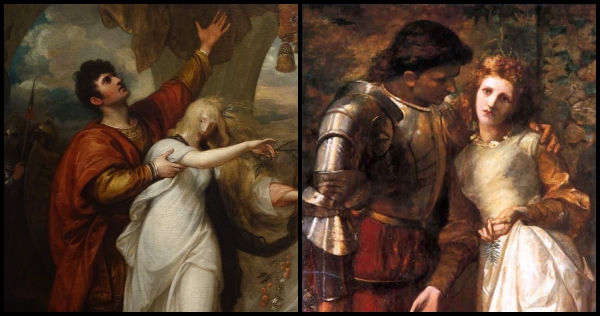
Part 23: Queen Ophelia and the male gatekeepers defining her madness

Image
Ophelia is too often portrayed as limp, soft, and either blank-eyed in her apparent innocence, or wide-eyed in her madness, as shown in these paintings by William Gorman Wills (c.1880) and Benjamin West (detail, 1792). This is based more on artistic and dramatic assumptions than on the text of the play. When we first see her brother Laertes in 1.2, he is reluctant to speak in an audience with the king who asks him repeatedly about his requested permission to return to France and scolds him for his shyness:   CLAUDIUS: What is ’t, Laertes? You cannot speak of reason to the Dane And lose your voice. What wouldst thou beg, Laertes, That shall not be my offer, not thy asking? [...] What wouldst thou have, Laertes? (1.2.43-51) Claudius is a bully, and also bullies Hamlet later in the same scene about his mourning of his father. (1.2.96-109) But Ophelia in her “mad” scene shows no shyness, and asks the first question: OPHELIA: Where is the beauteous Majesty of Denmark? (4.5.26) And if Ha...