Posts

Showing posts with the label Roy Battenhouse

Christopher Devlin's Catholic Bias in Hamlet's Divinity (part 13)

Image
Hamlet’s Divinity and Other Essays (Christopher Devlin, 1963) contains two chapters relating to Hamlet as well as a chapter making a case for Shakespeare’s Catholicism. Devlin was a Jesuit priest, and while I was raised Roman Catholic, I find him to be a bit too certain about plucking the heart of the mystery of Shakespeare’s faith. Yet Devlin demonstrates a great knowledge of history and literature, and in a field where for too long Protestants advanced too many of their own assumptions about Shakespeare’s faith, Catholic voices like Devlin’s opposing the status quo played a helpful role. [Image: Author photo. Hamlet's Divinity and Other Essays by Christopher Devlin (d.1961), with an introduction by C.V. Wedgwood. Published 1963. This book is out of print but still available at libraries and in used copies.] In his title chapter, “ Hamlet ’s Divinity” (30-43), Devlin argues that there are various ways he finds divinity to be present in the play. A major element for him is ...
Battenhouse's Authoritarian-Protestant Bias (part 12)

Image
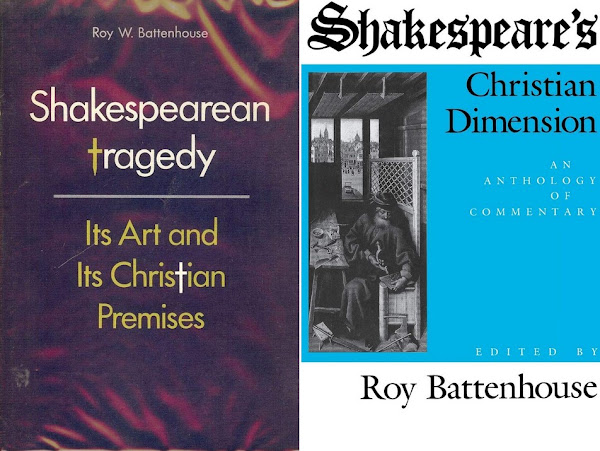
Of all well-known Protestant religious Shakespeare critics of the 20th century, Roy W. Battenhouse is, to me, troubling. He demonstrates broad familiarity with many sources and attends to details. But due either to a Protestant or an authoritarian bias (or both), he is determined to find more selfishness and sin in Prince Hamlet than even in Claudius. Many of his Shakespeare essays are collected in Shakespearean Tragedy: Its Art and Its Christian Premises (1969). His chapter “Hamartia in Aristotle, Christian Doctrine, and Hamlet” (204-266) is helpful in a variety of ways. But he finds more sin than grace in each character, especially Hamlet, even where other scholars find traces of turning or redemption (250). [L: Shakespearean Tragedy: Its Art and Its Christian Premises (1969). Image via Amazon.com. Fair use. R: Shakespeare’s Christian Dimension (1994). Image via Google Books. Fair use. Both out of print, available used and in libraries.] He views Hamlet’s love of Opheli...

Honoring the (Sometimes Dishonorable) Dead in Hamlet, the Oedipus Cycle, & in a Time of Pandemic

Image
Why do we honor the dead? How might we best honor them, if while living, some of them greatly dishonored themselves? What if their dishonorable actions are hidden behind a veil of family lies or state propaganda? In Hamlet as well as other famous works of literature, honoring the dead, usually the dead kings or princes, sometimes by avenging their deaths or bringing murderers to justice, is a recurring theme. I was reminded of this yet again over the past two weeks by watching the 2018 Shakespeare’s Globe production of The Two Noble Kinsmen by William Shakespeare and John Fletcher. In The Two Noble Kinsmen , three queens complain that their husbands have been dishonored by being left unburied after battle, echoing a theme from Antigone in the Oedipus cycle. In Hamlet , the prince feels his mother and uncle have dishonored his dead father by not mourning long enough, and by what would have been considered a biblically incestuous marriage in Shakespeare’s England. Honoring the dead wa...